Does a New HVAC System Add Resale Value? What Appraisers, Buyers, and Sale Data Actually Say
Published on October 11, 2026

Put a house on the market with an 18-year-old furnace and someone will tell you to replace it first, because a new system “pays for itself at closing.” Sometimes it does. More often it pays for something else: an inspection that does not turn into a renegotiation, a buyer who does not walk, a loan that is not held up by a repair condition. Those are real returns. They are just not the same thing as getting the invoice back in the sale price, and sellers who treat them as one number tend to spend more than they recover.
This guide separates the three numbers that get blurred together, looks at what sale data actually shows, and sorts the situations where new cooling or a heat pump changes what a house is worth from the ones where it only removes an objection. It finishes with whether to replace before listing or offer a credit, and with the paperwork that turns a new system into money.
Three Numbers That Get Blurred Together
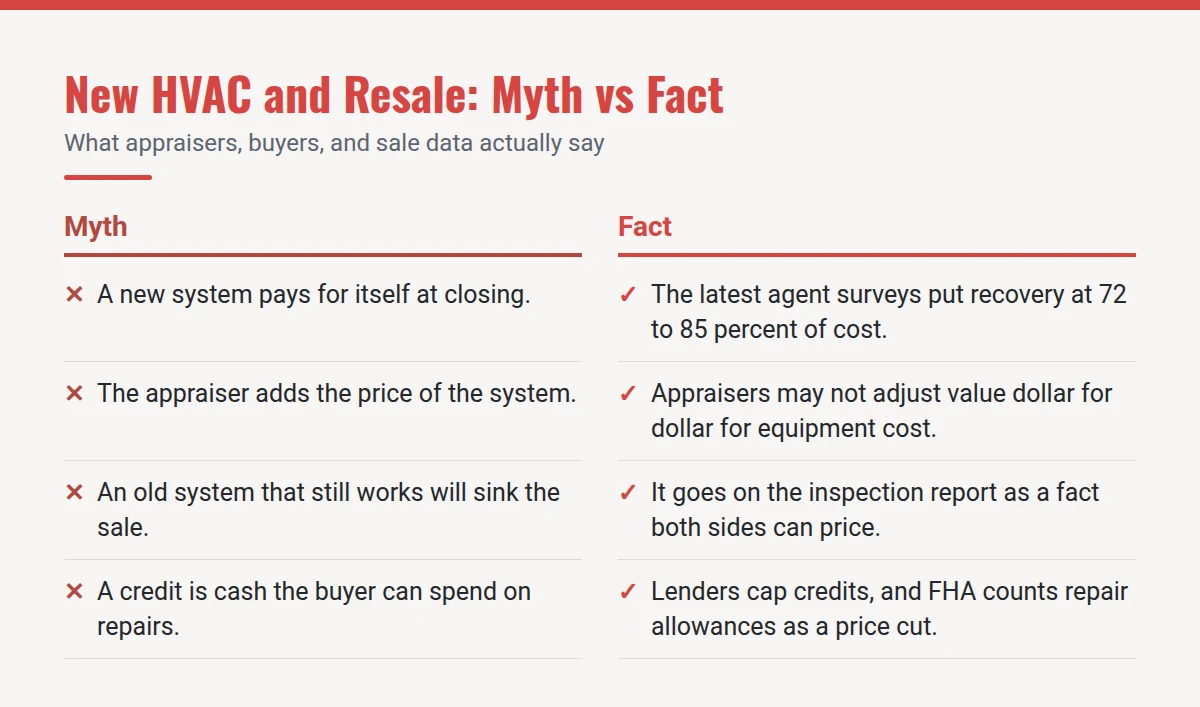
Appraised value is the appraiser’s opinion of market value, built mostly from recent sales of comparable homes nearby and adjusted for the differences. It matters because the buyer’s lender works from the lower of the sale price and the appraised value, so a premium the comparable sales do not support has to be covered by the buyer’s cash or come off the price. There is no line on the form where the appraiser adds your installer’s invoice. For energy-saving features, Fannie Mae’s guidelines say appraisers cannot adjust value “on a mechanical dollar-for-dollar basis based on equipment and installation cost,” and must instead compare those features with the ones in the comparable sales and “analyze the market reaction” to them. HVAC also feeds the condition rating, listed with appliances and floor coverings as a short-lived building component in the definitions the two big mortgage agencies share. A house in its first cycle of replacing those components can rate C3, while one whose short-lived parts are near the end of their life but still function adequately is described at C4. A new system can help nudge that rating, but the rating covers the whole house, and a better rating is still not the invoice coming back.
Sale price is what a buyer agrees to pay, and then often renegotiates after the inspection. This is where an old system costs sellers money. Inspectors who follow the American Society of Home Inspectors (ASHI) standard must report systems that are, in their judgment, “near the end of their service lives,” and the age can usually be read from the equipment’s data plate or decoded from its serial number. The buyer’s agent does the rest.
Days on market, and whether the contract survives to closing, is the third number and the least measured. We could find no credible study that isolates the age or condition of the HVAC system as a cause of slower sales. The mechanism is easy to see anyway: a system that does not run narrows the pool of buyers whose loans can close, and a failing furnace at the top of an inspection report starts a negotiation at the worst possible moment.
What the Sale Data Actually Shows
Two kinds of numbers get quoted, and they measure different things.
Cost recovery surveys ask real estate agents for their opinion. The 2025 Cost vs. Value report priced an HVAC electrification project, converting a house from a fossil fuel furnace to a heat pump system, at $19,484 nationally and put the resale value at $14,053, or 72 percent of the cost. Two years earlier the same project recouped 104 percent, the top score of any project in that edition, which tells you how soft these figures are. The National Association of Realtors (NAR) last surveyed a plain HVAC replacement in 2019: an estimated $8,200 job, with $7,000 of it, or 85 percent, coming back at sale. Both describe a national average house, both currently land below 100 percent, and both are opinions rather than closed sales.
Sale studies measure what buyers actually paid, and they price the feature, not the replacement. A peer-reviewed study by Shen and colleagues in Nature Energy compared 14,211 homes with air source heat pumps against more than 440,000 similar homes in 23 states that sold between 2000 and 2018. Homes with a heat pump carried a premium of 4.3 to 7.1 percent, or $10,400 to $17,000. The premium was larger in mild climates and among middle-income and environmentally minded buyers, and it was not statistically significant where incomes or heating and cooling needs were very low or very high. A June 2026 report from the Smart Energy Consumer Collaborative, NAR, and a property data firm looked at homes with ducted heat pumps sold in 2024 and 2025: listings that mentioned the heat pump sold for 0.6 to 1 percent more, about $2,300 to $3,900 on a $399,000 median home.
Neither is a return on replacing equipment. The first compares houses that had heat pumps with houses that did not, and the second compares listings that advertised an existing heat pump with listings that left it out. Read together, the evidence says buyers pay for what a system does for a house, and appraisers are told not to pay for what it cost.
When a New System Genuinely Moves the Needle
The house has no cooling where nearly every house does. Eighty-eight percent of U.S. households use air conditioning, according to the Energy Information Administration’s (EIA) 2020 survey, rising to 92 percent in the Midwest and 93 percent in the South. In those markets a house without it competes against comparable sales that have it, and buyers notice. In the marine climate along the Pacific Coast, where EIA found that only 49 percent of households use air conditioning, cooling is closer to a bonus than an expectation. In the first kind of market, adding cooling changes the category of house you are selling. In the second, it is a nice extra.
It heats with electric resistance. EIA counts about 13.8 million homes heated mainly by an electric furnace and another 7.7 million by built-in electric heaters such as baseboards. Resistance heat turns one unit of electricity into one unit of heat. Natural Resources Canada puts the coefficient of performance of air source heat pumps between 2.0 and 5.4 at 8°C (46°F), meaning two to more than five units of heat per unit of electricity, and between 1.1 and 3.7 at -8°C (18°F). That gap shows up on twelve months of utility bills, which is exactly the evidence a buyer can check, so this is the replacement whose running cost case is easiest to prove.

The system does not work or is not safe. A furnace that will not light, a heat exchanger a technician has confirmed is cracked, or an air conditioner that is dead in July is not an objection. It is a financing problem. FHA’s property standards require “heating adequate for healthful and comfortable living conditions,” and its appraisers must run the systems; if one appears damaged or does not work, the appraisal is made conditional on repair or further inspection. Air conditioning is not required, but if it is installed it must work: an FHA appraiser reports the cost to cure a dead system, and a VA appraiser makes the appraisal subject to its repair by a licensed contractor. Skip the repair and you end up doing it on a deadline before closing, or losing those buyers.
A confirmed crack is also a carbon monoxide hazard, so shut that furnace off and treat it as a safety issue rather than a bargaining chip; if a CO alarm sounds, get everyone outside and call 911 or your gas utility from there. Get the diagnosis confirmed before you spend, though. The ASHI standard does not require home inspectors to inspect heat exchangers, so a “possible crack” note on an inspection report is a reason to call an HVAC technician, and our guide to reading an HVAC diagnosis covers the cracked heat exchanger calls that turn out to be wrong.
When It Only Removes an Objection
Most sellers have a system that works and is getting old. Here the honest case for replacing it is peace at the inspection, not a higher price.

NAR’s 2019 survey captured the gap neatly: 20 percent of Realtors said they had suggested that sellers replace the HVAC system before listing, but only 7 percent said the project had helped close a sale. A buyer’s request for a credit is the start of a negotiation, and you can counter it. A replacement bought before listing is a fixed cost at full retail, chosen on a deadline, for equipment the buyer did not pick. The inspection report is also less damning than sellers fear. The ASHI standard says the inspector is not required to determine “the remaining life expectancy of systems and components” or what corrections would cost, so an old system on the report is a fact both sides can price.
The premium tier is the clearest case of money that will not come back. A variable-speed heat pump with a high efficiency rating may be the right choice for a house you plan to keep. On a house you are selling, the appraiser needs comparable sales that show buyers paying for that difference, and those are hard to come by. In NAR’s 2025 sustainability survey, 73 percent of Realtors said they were not sure whether appraisers in their area are educated on the added value of sustainability features.
What does reliably pay before listing is cheap: a tune-up, a fresh filter, a cleared condensate drain, and a dated service report saying the system was checked and is operating. It answers the inspector’s question before it is asked. If the technician finds a refrigerant leak, have it repaired rather than topped off, and remember that only an EPA 608 certified technician can legally handle the refrigerant.
Replace Before Listing, or Offer a Credit?
Start with two facts from the data plate: what kind of system you have and how old it is. Then weigh the two routes.
| Replace before listing | Offer a credit or price cut | |
|---|---|---|
| Your cash | Full installed price, paid now | Comes out of your proceeds at closing |
| Who picks the system | You, on a deadline | The buyer, after closing |
| Lender limits | None | Seller contributions are capped |
| The inspection report | Clean on HVAC | Old system noted and priced in |
| Usually best when | The system is dead or unsafe, or the house lacks cooling its market expects | The system works but is old |
A credit is less flexible than it sounds, because the buyer’s lender decides what it can pay for. On a conventional loan sold to Fannie Mae, seller contributions are capped at 3 percent of the price (or the appraised value, if lower) when the buyer puts down less than 10 percent, 6 percent with 10 percent up to 25 percent down, and 9 percent with 25 percent or more. That money can pay closing costs and prepaid items but never the down payment, and anything beyond the buyer’s actual closing costs counts as a sales concession that the lender deducts from the price. FHA allows up to 6 percent toward closing costs and lists “repair allowances” among the inducements it subtracts from the price, dollar for dollar, when it sizes the loan. VA treats concessions above 4 percent of the home’s reasonable value as excessive, not counting the buyer’s normal closing costs and discount points.
In practice, a “credit for a new furnace” usually ends up as help with the buyer’s closing costs or as a lower price, so settle the structure with your agent and the buyer’s lender before you agree to a number. If a repair cannot be finished before closing, FHA lets a lender hold repair money in escrow, but that is the lender’s decision, not yours.

If you do replace, treat it like any other replacement, just with a deadline. Get at least two or three written quotes, because installed prices vary widely by region; our 2026 cost breakdown shows the ranges by system type. Make sure the permit is pulled and closed before the listing goes live. In Florida, for example, title companies and closing agents search for open or expired permits, and the state Senate’s analysts note that unresolved ones can delay closings; our installation day guide covers getting the final inspection signed off. If the air conditioner is the part that failed, a heat pump will not look exotic to buyers: manufacturers shipped 3.6 million heat pumps in 2025 against 3.2 million gas furnaces, according to AHRI. And price the job without a federal tax credit, because the IRS says the 25C credit is not allowed for equipment placed in service after December 31, 2025. Your state energy office and your utility are the places to check for rebates that still exist.
The Paperwork That Turns a New System Into Money
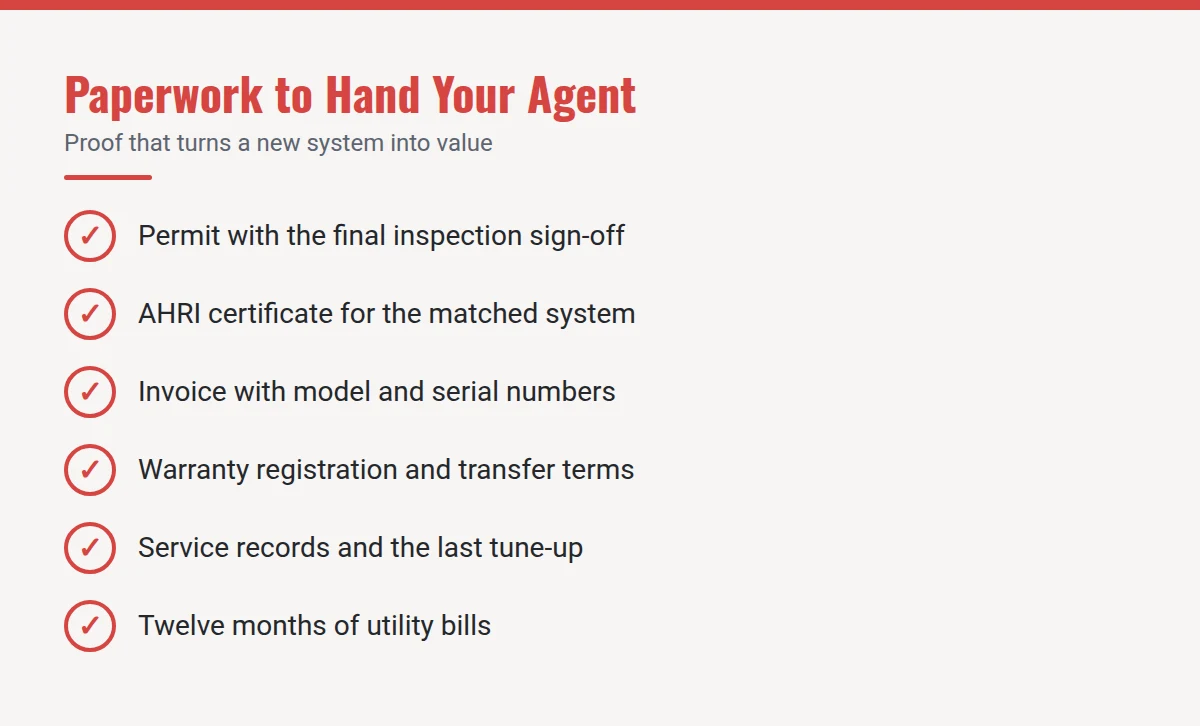
A new system is worth what you can prove about it. Put these together before the listing goes live and give copies to your agent:
- The permit and the final inspection sign-off. It proves the work was inspected, and it answers the disclosure question about work done without permits.
- The AHRI certificate. For split systems, AHRI certifies the matched combination rather than the individual pieces, and its directory generates a Certificate of Product Ratings showing the certified efficiency of your outdoor unit paired with your indoor coil or furnace.
- The installation invoice, with model and serial numbers and the install date.
- The warranty registration and its transfer terms. Federal law lets a limited warranty, unlike a full one, stop at the first owner, and the FTC’s own sample limited warranty ends coverage when the product is sold. Most HVAC equipment carries a limited warranty, so read yours: some registered warranties pass to the next owner automatically, while others transfer only if the paperwork is filed within a set period after closing, sometimes for a fee.
- Service records, including the most recent tune-up.
- Twelve months of utility bills, especially after a switch away from resistance heat. If the bills went up instead of down, our guide to diagnosing a heat pump bill can tell you why before a buyer asks.
Then make sure the listing says what you have. In homes with a heat pump, the 2026 study found, the listing mentioned it only 8 percent of the time. Listing it costs nothing. Your agent can also give the appraiser the Appraisal Institute’s Residential Green and Energy Efficient Addendum, filled in from the same documents. It has fields for HVAC efficiency ratings, and it is meant to be completed by builders, contractors, homeowners, or third-party verifiers, because appraisers typically lack the documentation to fill it in themselves, and the form suggests attaching the finished copy to the MLS listing. The current form still uses the older SEER and HSPF labels, so enter the figures from your AHRI certificate and say which rating each one is.
A few cities attach HVAC paperwork to the sale itself. Austin requires sellers of homes 10 or more years old to give buyers an energy audit covering “HVAC system efficiency, age, and condition,” and in Berkeley a heat pump earns all six upgrade credits the city’s sale ordinance asks for, as our guide to heat pump building code rules explains.
Whatever you decide, disclose what you know. California’s statutory transfer disclosure form lists central heating and central air conditioning, asks whether any of them are not in operating condition, and separately asks about repairs made without necessary permits. A credit negotiated over a disclosed problem is a deal. A problem discovered after closing is a dispute.
The Bottom Line
A new HVAC system rarely returns its full cost, and no sale data supports the idea that it pays for itself at closing. It earns its keep in three situations: the house lacks cooling its market expects, it heats with electric resistance, or the existing system does not work. Otherwise, service and document what you have, advertise the features you already own, and let the buyer price the age into the deal through a credit or a price cut structured within the lender’s limits. Whichever way you go, the paperwork is what turns equipment into value.
Further reading (sources)
- Fannie Mae on how appraisers must treat energy-efficient features
- Fannie Mae’s Selling Guide for the caps on seller contributions to a buyer’s costs
- Freddie Mac, hosting the appraisal condition ratings both agencies use
- HUD with FHA’s property standards, appraiser duties, and seller contribution rules
- VA Lenders Handbook on minimum property requirements for heat and air conditioning
- VA’s lender guidance for its 4 percent limit on seller concessions
- Appraisal Institute with the Residential Green and Energy Efficient Addendum form itself
- American Society of Home Inspectors with its standard of practice for heating and cooling
- National Association of Realtors on what an HVAC replacement recovers at resale
- NAR’s 2025 sustainability report for how agents see energy features and local appraisers
- Cost vs. Value on JLC Online with the 2025 national cost and resale figures by project
- Cost vs. Value on JLC Online, where the electrification project led the 2023 rankings
- Shen and colleagues, in Nature Energy on the sale price premium of homes with heat pumps
- Smart Energy Consumer Collaborative for what mentioning a heat pump in a listing is worth
- U.S. Energy Information Administration on how many homes use air conditioning, by region
- EIA’s housing survey tables with the main heating equipment in U.S. homes
- Natural Resources Canada on heat pump efficiency in mild and cold weather
- AHRI for how matched systems are certified and what the certificate shows
- AHRI’s year-end shipment data with 2025 heat pump and gas furnace shipments
- IRS on the end of the 25C credit for equipment placed in service after 2025
- Federal Trade Commission for how full and limited warranties differ
- Florida Senate staff analysts on open permits holding up home closings
- California Legislature with the transfer disclosure form, as amended in 2013
- Austin Energy on the energy audit that Austin home sellers must provide