HVAC Repair Scams and Upsells: How to Read a Diagnosis and Sanity-Check a Quote
Published on September 15, 2026
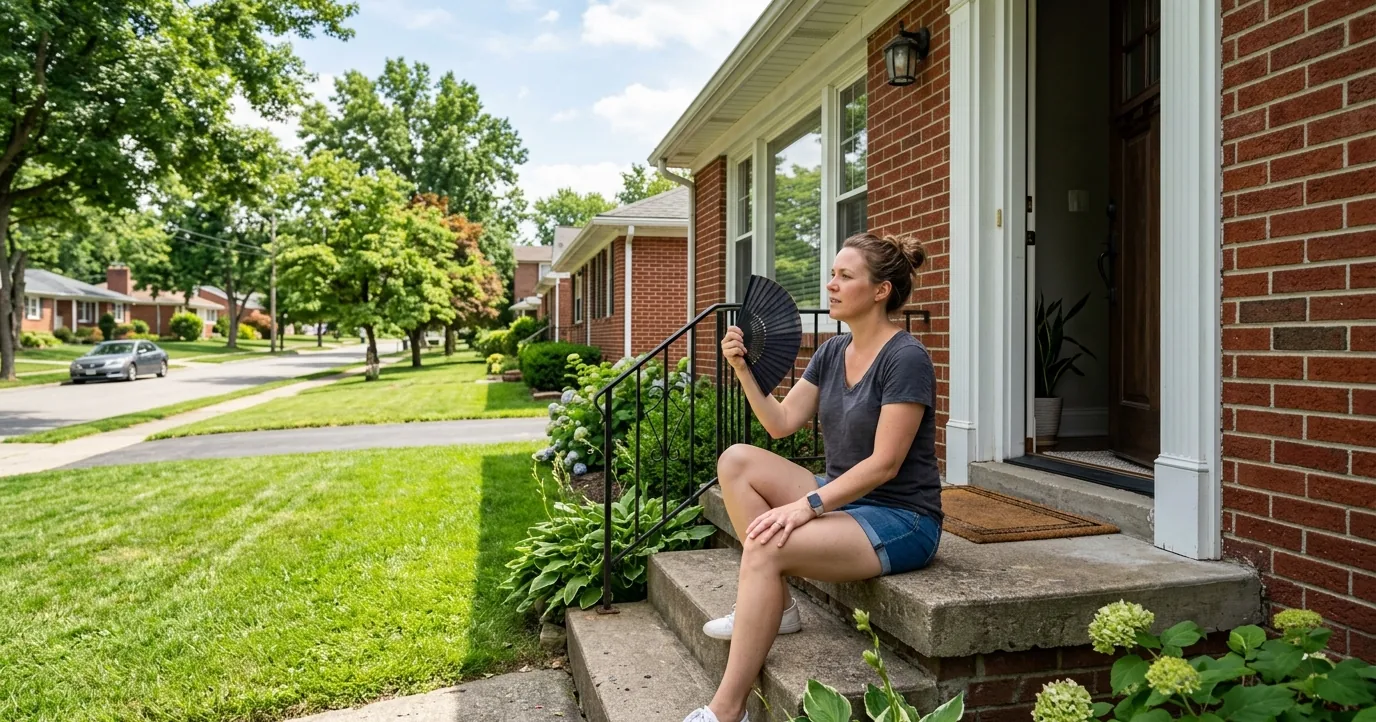
The Better Business Bureau of Eastern Carolinas spent much of this summer telling homeowners the same thing over and over: slow down. Its Scam Tracker had logged dozens of reports tied to heating and cooling work, and the pattern behind them was not clever fraud. It was heat. When the house is 92 degrees and the first available truck is in the driveway, almost nobody says “let me get a second opinion.”
That is the whole play. Most HVAC companies are honest, and the dishonest minority does not need to be sophisticated, because urgency does the work. This is the guide for the moment a technician is already standing in your yard with a verdict. Not how to choose a company, which we cover in our guide to vetting an HVAC contractor before you hire, but how to test the diagnosis and the invoice in front of you.
Heat Is the Pressure, Not the Problem
Call volume tells you why summer is the season for this. A Massachusetts contractor that normally fields 90 to 100 service calls on a summer day took more than 600 across four or five days during last July’s triple-digit stretch. Every honest company in your area is booked, which means the one that can come today is either very well staffed or not very busy, and it is worth knowing which.
Heat also manufactures false failures. Residential systems are generally designed to hold a house about 20 degrees below the outdoor air. At 100 degrees outside, an 80-degree living room is a system doing its job, not a system dying. If the diagnosis you are handed is “it cannot keep up, you need more tonnage,” that is a claim you can check against the thermometer before you check anything else. Our walkthrough for an AC that runs but will not cool covers the handful of causes worth ruling out first.
Six Classic Plays, and How to Test Each One
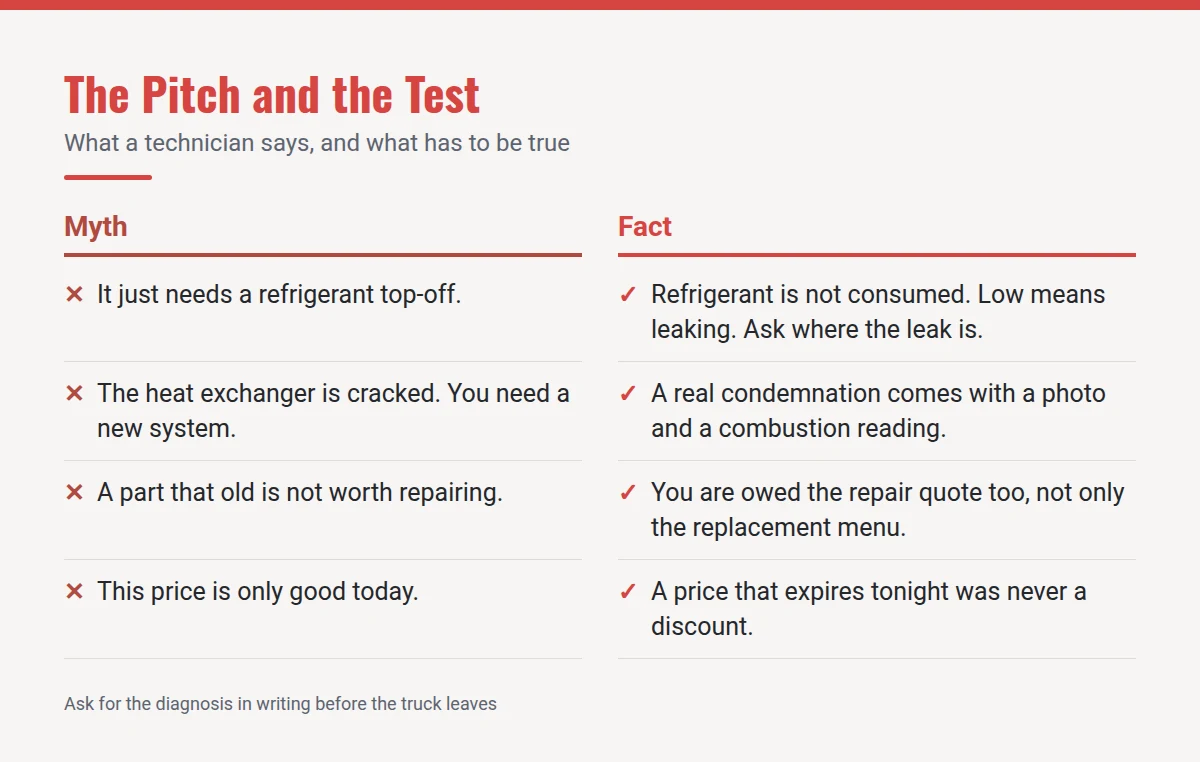
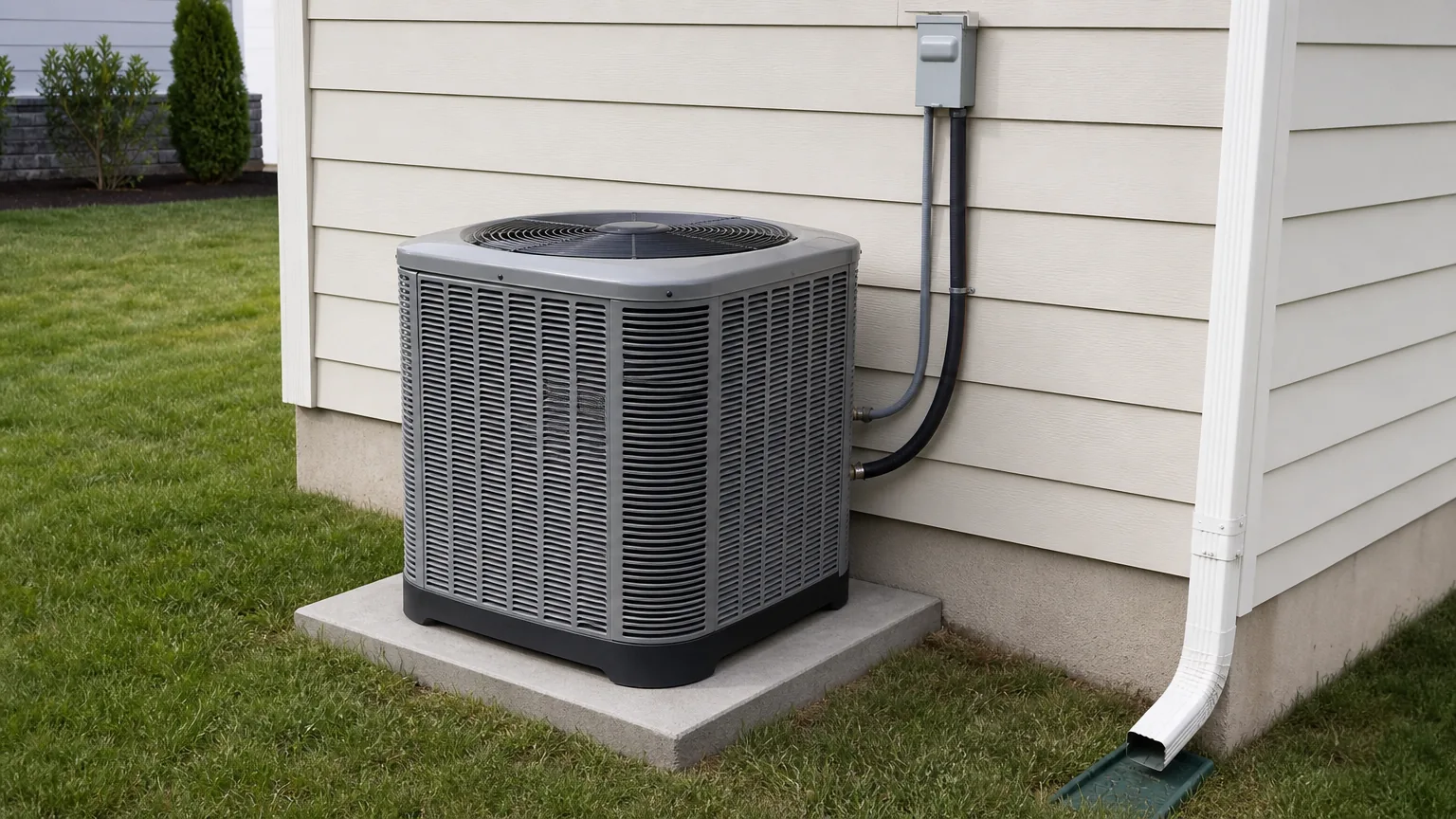
The annual refrigerant top-off. Refrigerant is not fuel. A sealed system does not consume it, so a system that is low is a system that is leaking, and adding more without finding the leak sells you the same pound of gas every July. Ask three questions: how did you search for the leak, what did you find, and what were the subcooling or superheat readings before and after. A real leak search means an electronic detector, UV dye, a nitrogen pressure test, or bubble solution, and it produces a location. Worth knowing: the federal leak-repair rule only binds appliances holding 50 pounds or more, so your 8-pound home system is not covered by it, which is exactly why this one persists. What does apply is that only an EPA Section 608 certified technician can buy or handle the refrigerant at all. On an older R-22 system, where production ended in 2020 and supply is reclaimed stock, a top-off can run into the hundreds, and that is the year to price the repair against replacement instead of repeating it.
The cracked heat exchanger. This is the highest-stakes call in the trade, because it invokes carbon monoxide, and it is also the easiest to assert, since the heat exchanger sits behind the burner assembly where you cannot see it. Some cracks are real and genuinely dangerous. The difference is documentation. A real condemnation comes with a photo or video from an inspection camera showing the crack and where it is, a combustion analyzer reading taken in the flue and in the supply air, and often a note about the flame moving when the blower kicks on. Then ask for the furnace model and serial number and the heat exchanger part number, and look up the warranty. Most manufacturers cover the heat exchanger for 20 years or the life of the unit for the original registered owner, so an in-warranty furnace may get the part free. A company that jumps from “cracked exchanger” to “you need a whole new system” without ever mentioning that warranty has skipped the step that would have saved you money.
The capacitor that becomes a new system. A run capacitor is a $20 to $60 part, and a contactor is not much more. Both are ordinary no-cool causes and both are a same-day repair, typically a couple hundred dollars installed in most markets. The play is arriving on that call and presenting a good, better, best replacement menu instead of the fix. You are entitled to the repair quote even if the recommendation is replacement, and a flat “we don’t repair those” on a nine-year-old unit is a tell. A legitimate replace recommendation rests on the age of the equipment, the refrigerant it uses, whether the compressor is involved, and the repair cost relative to a new system. The common rule of thumb is to multiply the age of the unit in years by the repair cost and lean toward replacement above roughly $5,000. It is a rough tool, not a law, but it beats a sales binder.
The bait tune-up. A $49 seasonal tune-up is not automatically a scam, and plenty of good companies use one to fill a slow week. The tell is what happens after the truck arrives: 20 minutes of work on a system that was fine that morning, followed by a list of urgent findings and a quote. A real maintenance visit follows a defined task list, and the industry has one in ANSI/ACCA Standard 4. More usefully, it produces numbers. Ask for the readings, not the adjectives. “Capacitor is weak” means nothing. “Capacitor reads 38.1 microfarads against a 45 rating” means it is genuinely out of tolerance, which is usually 6 percent.
Mandatory duct cleaning. The EPA’s own position is that duct cleaning has never been shown to prevent health problems and should not be done routinely, only when there is visible mold growth inside the ducts, a vermin infestation, or debris actually blowing into rooms. Duct cleaning bundled into a repair, or presented as a condition of keeping a warranty, is an upsell. Be more careful still with the sanitizer add-on: no chemical biocide is registered by the EPA for use on porous duct surfaces like fiberglass liner.
Heat wave surge pricing. After-hours and emergency premiums are legitimate, and a Sunday-night call costing more than a Tuesday morning is normal business. Price gouging is a narrower legal idea. In most states, including North Carolina, the statute only switches on once a state of emergency has been declared, and a heat wave frequently is not one. So the practical defense is not the law, it is the phone call: ask for the diagnostic fee, the after-hours rate, and whether the fee is credited toward the repair, before the truck is dispatched. Our breakdown of what HVAC service actually costs gives you the ranges to measure the answer against.
What a Legitimate Written Diagnosis Contains
The single best defense costs nothing: ask for the diagnosis in writing before the technician leaves, whatever you decide about the work. A company that will not put its conclusion on paper is telling you something.
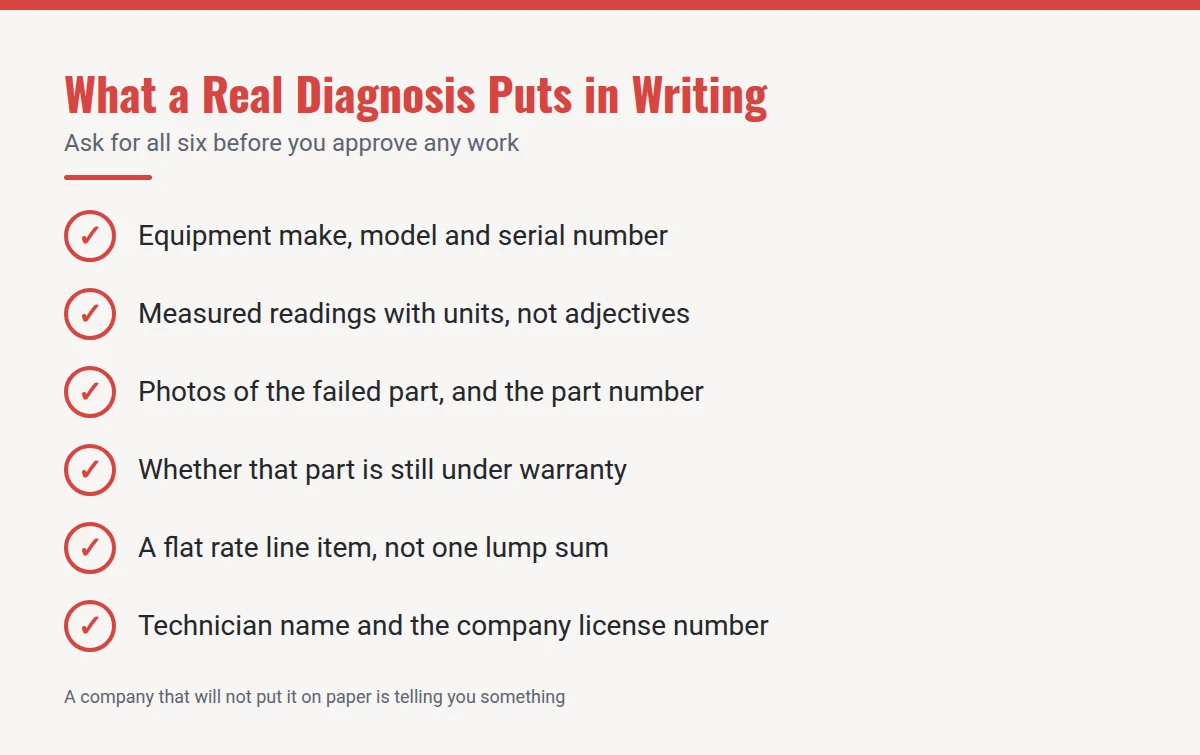
A real one includes the equipment make, model and serial number, so anyone can verify the age and warranty independently. It includes the measurements that led to the conclusion, with units attached: the temperature split between return and supply air, which normally runs 16 to 22 degrees, superheat or subcooling, static pressure across the air handler, measured capacitor microfarads against the rating stamped on the can, amp draw against the nameplate, and combustion analysis on anything that burns gas. It includes photos of the failed part. It includes part numbers and whether the part is under warranty. It includes the technician’s name and the company’s license number.
And it includes a flat-rate line item. Flat-rate pricing off a standard price book is normal in this trade and is not itself a red flag. Refusing to break the number into anything at all is.
How to Buy 24 Hours When the House Is 90 Degrees
Safety sets the floor. If anyone in the house is elderly, very young, pregnant, or managing a heart or lung condition, the right first move is to leave for somewhere cool, a library, a mall, a relative’s place, a hotel. Deal with the equipment second. If a furnace has been red-tagged and a carbon monoxide alarm is sounding, get everyone outside and call 911. A silent alarm is not proof the heat exchanger is fine, and alarms expire, usually at 7 to 10 years.
Once nobody is at risk, a day is easy to buy:
- Pay the diagnostic fee and decline the work. You owe the fee for the visit. You do not owe the repair. This is an ordinary, unremarkable thing to say out loud.
- Do not sign a financing application to “lock in” a price. The signature is the commitment, not the price sheet. If a discount genuinely expires tonight, it was not a discount.
- Photograph the data plates yourself on the outdoor unit and the furnace, and photograph the failed part. Ask for the old part back when it is replaced.
- Know your cancellation window. The FTC’s cooling-off rule gives three days to cancel many sales of $25 or more made in your home, with exceptions, and many states add their own home-solicitation rules. Ask which applies before you sign, not after.
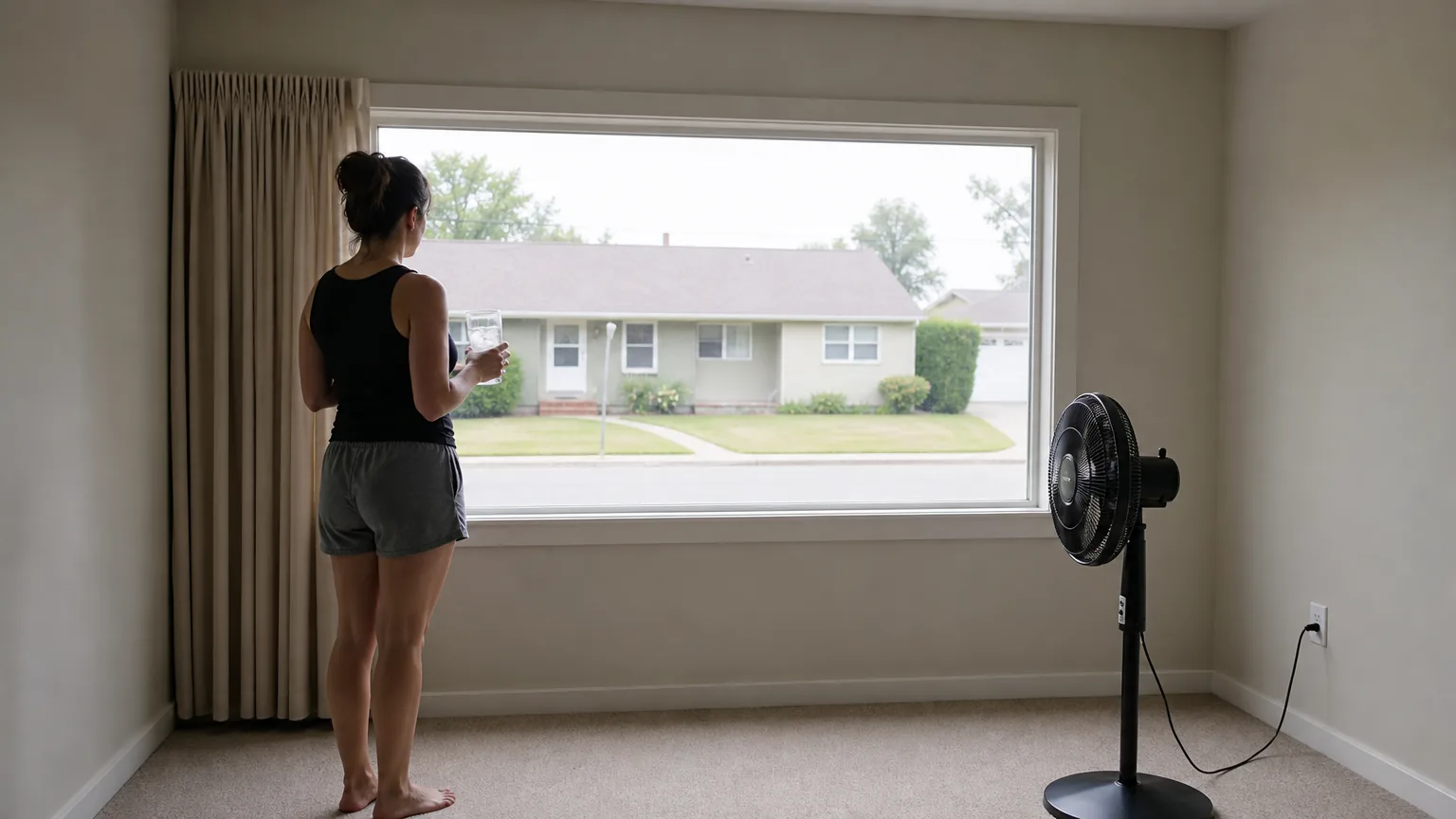
- Make the house survivable in the meantime. Close blinds on sun-facing glass, run a window or portable unit in one room, and pull cooler night air in with fans once the outdoor temperature drops below the indoor one.

Making the Second Opinion Actually Independent
Call a company with no relationship to the first, and do not lead with the first diagnosis. Say the system is not cooling, give the model and serial, and let them reach their own conclusion. Comparing two independent answers is worth far more than asking a second technician to grade the first one’s homework.
Two traps. First, a second opinion is not the same as a second quote: one is a diagnosis, the other is a price on a job already assumed. Ask for the diagnosis. Second, the “other company” down the road may not be a different company. Franchise networks and private equity roll-ups often run several familiar local brands out of one building, which is why our guide to finding out who actually owns your HVAC company is worth ten minutes before you dial.
For a condemned furnace specifically, there is a free option many homeowners miss. Gas utilities will usually send someone out to check for carbon monoxide at no charge, because the liability is theirs too, and they are not selling you a furnace. A home inspector with a combustion analyzer is another non-selling opinion.
Where to File When It Goes Wrong
Keep the paperwork, then use the right lever.
The state licensing board is the only body that can actually discipline a contractor’s license. Most take complaints online. Attach the invoice, the written diagnosis, and your photos. The Better Business Bureau is not a regulator, but complaints are public and often shake a response loose, and its Scam Tracker is where outright fraud belongs. Your state attorney general’s consumer protection division handles deceptive practices, and price gouging where a declaration is in force. Your building department matters if the job required a permit and none was pulled.
Then there is the lever most people give away at the moment of payment. Pay with a credit card. Federal law gives you the right to dispute a card charge and, separately, to raise claims against the merchant on purchases over $50, and the issuer holds the money while it sorts out. Cash, a personal check, and an instant bank transfer have no equivalent. If the amount is modest, small claims court is a realistic last stop.
One more category worth naming: if the pitch involved government money, free upgrades, or a rebate that a salesperson will handle for you, treat it as a separate problem. Our guide to HVAC tax credits, rebates, and rebate scams explains how to verify an incentive through the utility or state energy office rather than through the person selling it.
The Bottom Line
Every one of these plays depends on you deciding inside of an hour. Almost none of them survives a written diagnosis, a request for the measured readings, and one night to think. The fee for a second opinion is a hundred dollars or so, and on a replacement quote it routinely moves the number by thousands. When the house is hot and the pressure is on, the most valuable sentence you own is a calm one: put it in writing, and I will call you tomorrow.
Further reading (sources)
- The Cool Down on the BBB warning that followed the Carolinas heat
- NBC Boston for what a triple-digit week does to service call volume
- U.S. Environmental Protection Agency with the certification rule behind who may touch refrigerant
- U.S. Environmental Protection Agency on when duct cleaning is actually warranted
- Air Conditioning Contractors of America for the standard that defines a real maintenance visit
- Federal Trade Commission covering the three-day right to cancel a sale made at home
- Federal Trade Commission on how to dispute a charge after the work is done
- North Carolina Department of Justice explaining when price gouging law actually switches on
- New York Post for surviving the weekend after the AC quits
- NFPA on carbon monoxide alarm placement and lifespan