Gas Furnace Buying Guide 2026: AFUE, Staging, Venting, and Sizing a Replacement Right
Published on September 16, 2026
The best time to buy a furnace is while the old one still lights. A homeowner shopping in September, with a 17-year-old furnace that still runs, can collect three quotes, question the sizing, and turn down anything that feels rushed. The same homeowner on a January night with a dead furnace signs whatever shows up first. The equipment on offer is identical. The results rarely are.
A furnace looks like a simple purchase, but a replacement quote hides a stack of decisions: how efficient to go, what that does to the venting and the drain, whether the water heater beside it still vents safely afterward, how the burner should fire, and how big the new unit really needs to be. Get them right and a furnace runs quietly for about twenty years, close to the average lifetime the Department of Energy assumes. Here is how to get them right.
Start With the Furnace You Already Have
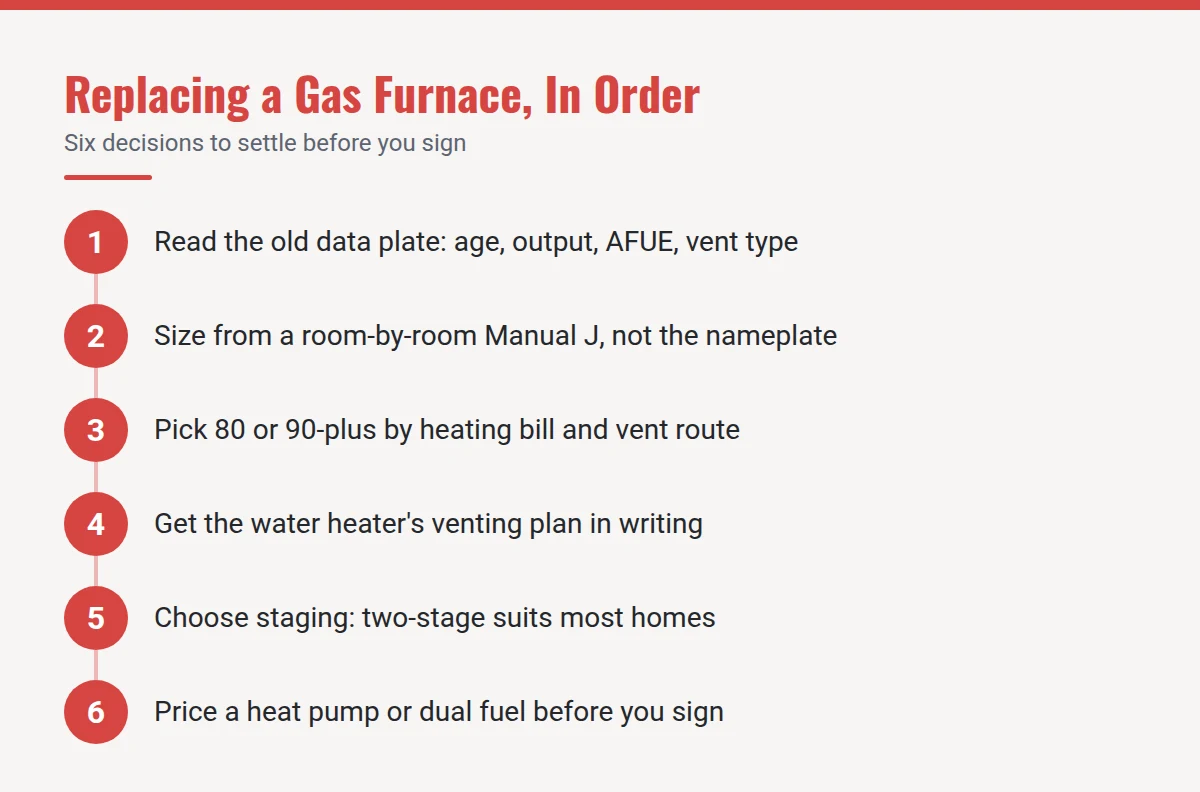
Open the furnace closet with a flashlight before you call anyone. The data plate, usually on the side of the cabinet or inside the blower door, lists the model and serial numbers plus two heat ratings: input, the gas it burns, and output, the heat it actually delivers. The manufacture date is often coded into the serial number. Photograph all of it.
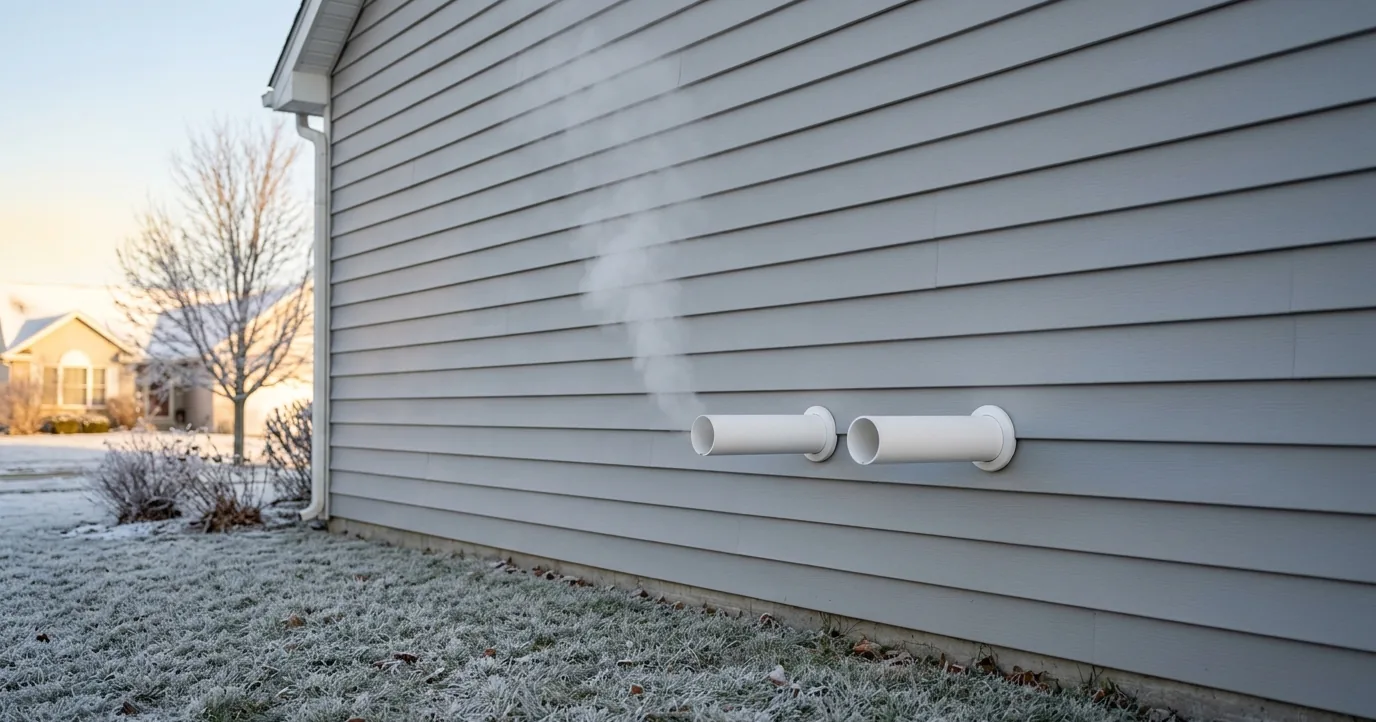
Then look at how it vents. A metal flue pipe into a chimney or through the roof means a non-condensing furnace, typically around 80 percent efficient if it was built in recent decades. Older draft-hood furnaces with a standing pilot rate closer to 60 percent, according to Natural Resources Canada’s gas heating guide, and there was no federal efficiency minimum at all until 1992. Two white plastic pipes through a wall or roof mean you already own a condensing furnace.
Note three more things, because each one changes the quote: whether a gas water heater shares the furnace’s chimney, whether an air conditioner coil is mounted on the furnace, and whether the furnace sits in a heated basement or in an attic, garage, or crawlspace.
If the project started with a technician condemning your furnace over a cracked heat exchanger, get that finding documented first. Our guide to reading a diagnosis and sanity-checking a repair quote shows what real evidence looks like. And if you ever smell gas or a carbon monoxide alarm sounds, get everyone out of the house and call the gas utility or 911 from outside.
What AFUE Is Worth in Real Dollars
AFUE, annual fuel utilization efficiency, is the share of the fuel’s energy that becomes heat in your house over a season. An 80 percent furnace sends about 20 cents of every gas dollar up the flue, while a 96 percent furnace loses about 4.
The arithmetic is simple: new gas use equals old use multiplied by the old AFUE and divided by the new one. To estimate your heating use, subtract a typical summer month’s gas from each winter month on a year of bills. The Energy Information Administration’s September 2026 outlook puts average residential gas at about $13 to $14 per thousand cubic feet this heating season, roughly $1.25 to $1.40 a therm, though your own rate may differ widely. At $1.30 a therm, for a house burning 800 therms a year through an 80 percent furnace:
- A 96 percent furnace cuts use to about 667 therms, saving roughly $175 a year.
- A 98 percent furnace cuts it to about 653 therms, saving roughly $190. The last two points of AFUE are worth under $20 a year.
- If that 800 therm bill comes from a 65 percent furnace, the 96 percent replacement saves about 258 therms, roughly $335 a year.
The big money is in retiring a truly old furnace, and savings scale with the bill: a small house in a mild climate burning 300 therms a year saves only about $65 annually going from 80 to 96 percent. Even DOE’s analysis for its 2023 furnace rule, which argued for the higher standard, estimated an average simple payback of about 7.6 years and found roughly 19 percent of affected households likely to come out behind over the furnace’s life. For reference, ENERGY STAR now requires 95 percent AFUE in southern states and 97 percent in northern ones.
On the rules: the federal minimum has been 80 percent since November 2015. In 2023 DOE finalized a 95 percent minimum, a level only condensing furnaces reach, for furnaces manufactured after December 18, 2028. That rule is now in doubt. In June 2026 the Supreme Court vacated the appeals court ruling that had upheld it and sent the case back, and DOE has been weighing a petition to delay compliance to at least January 2030. No federal rule stops you from installing an 80 percent furnace this year, so buy on the economics of your own house.
80 Percent or 90-Plus: The Vent Pipe Sets the Price
A condensing furnace adds a second heat exchanger that pulls so much heat from the exhaust that water vapor condenses inside the cabinet. That changes two things on the quote.
The exhaust needs a new path. Condensing exhaust is cool, wet, and mildly acidic, pushed out under pressure through sealed plastic pipe. A venting report from Oak Ridge National Laboratory lays out the constraint: these furnaces cannot vent directly into a clay tile lined masonry chimney or a Type B metal flue, although a sealed, corrosion-resistant liner can run up through one. So the pipe goes out a sidewall, which is usually cheapest, up the old chimney as a chase, or through a new route to the roof, the expensive last resort. Sidewalls come with rules too, commonly keeping the exhaust about two feet from windows, doors, and decks, above drifting snow, and away from walkways. In a row house, a legal spot may not exist.
The water needs somewhere to go. Condensate has to reach a drain, often through a small pump, sometimes through a neutralizer where local rules require one, and with heat tape wherever the line crosses an attic, crawlspace, or garage that can freeze. A blocked or frozen line shuts the furnace down, usually on the coldest night of the year.
Ask, too, whether you are being quoted one pipe or two. A two-pipe, sealed combustion setup draws its combustion air from outdoors, which Natural Resources Canada favors because household exhaust fans cannot interfere with it and corrosive vapors such as laundry bleach stay out of the burner.
DOE’s rule analysis put the average extra installation cost of a condensing replacement at about $490 in 2022 dollars, but it classed roughly 39 percent of replacements as difficult, averaging $867 in added work against $247 for the rest. An 80 percent furnace can still be the smarter buy when the heating bill is small, when condensate drainage would be a real problem in the furnace’s location, or when no workable vent route exists. Everywhere else, and certainly in a cold climate, condensing is the default for good reason.
The Orphaned Water Heater Nobody Puts in the Quote
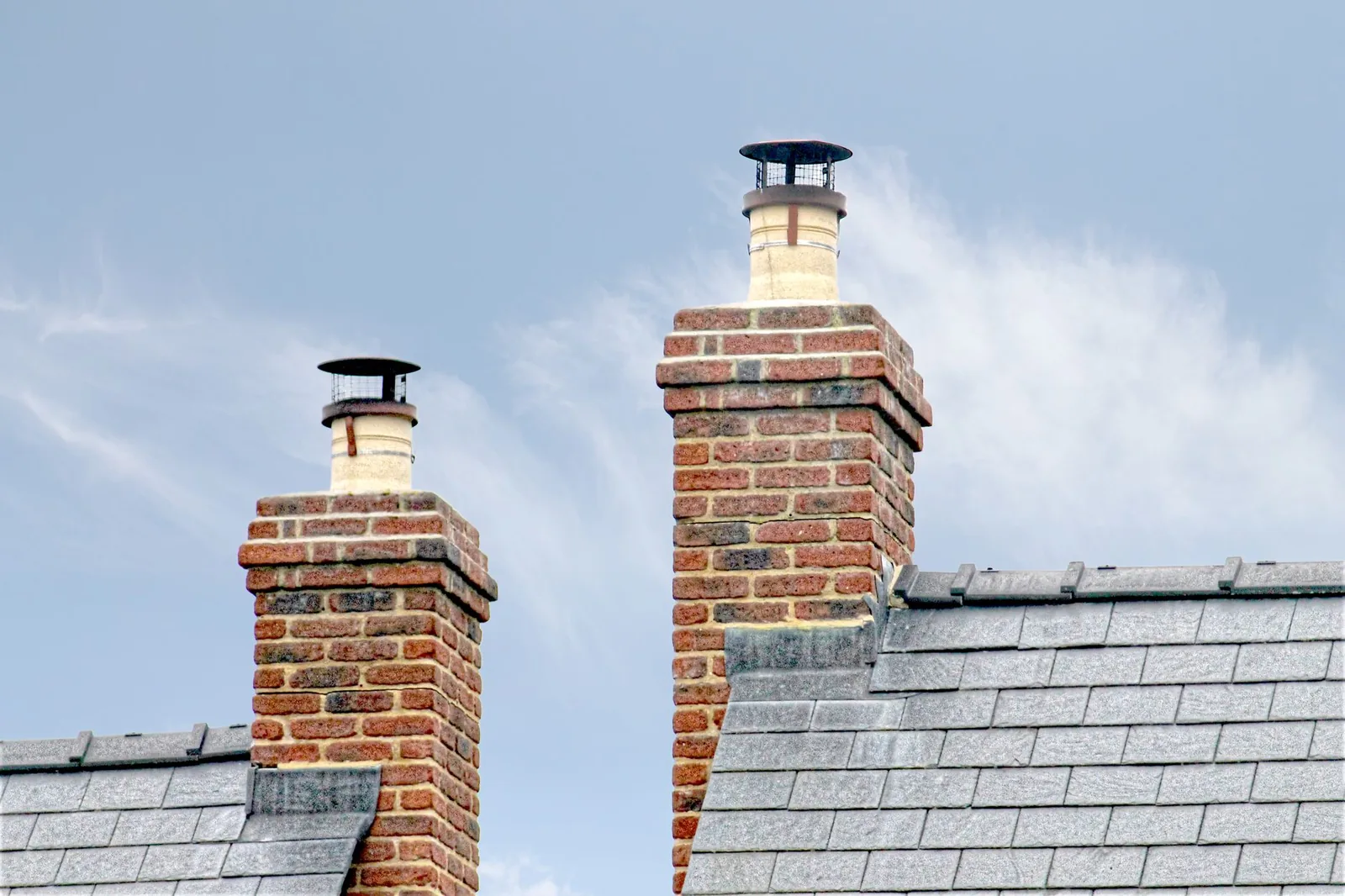
In many older homes the furnace and a tank water heater share one chimney, sized to carry both appliances’ exhaust. Take the furnace off it and the water heater is left alone in a flue far too large for it, which the Oak Ridge report calls an orphaned water heater. With so little warm exhaust in so much chimney, the draft can fail in some temperature and wind conditions, and flue gases, carbon monoxide included, spill out of the water heater’s draft hood into the house. In a cold masonry chimney the vapor also condenses and slowly damages the flue. Removing a furnace for an all-electric heat pump orphans the water heater just the same.
The fixes are well established, and every one of them belongs in the quote:
- A liner sized for the water heater alone, Type B double-wall or stainless steel, run down the existing chimney.
- A powered draft inducer on the water heater’s vent, with a backflow preventer.
- A water heater that does not need the chimney, such as a power-vent model or a heat pump water heater. Natural Resources Canada suggests that equipment which does not rely on a chimney may be the better alternative.
Furnace installation manuals also include a test for this moment: after a furnace comes off a shared vent, the remaining appliance is checked for spillage at its draft hood with doors and windows closed and exhaust fans running. Ask for that test by name and get the water heater’s venting plan in writing. A condensing furnace quote for a house with a shared chimney that never mentions the water heater is incomplete.
Why the Right Size Is Usually Smaller
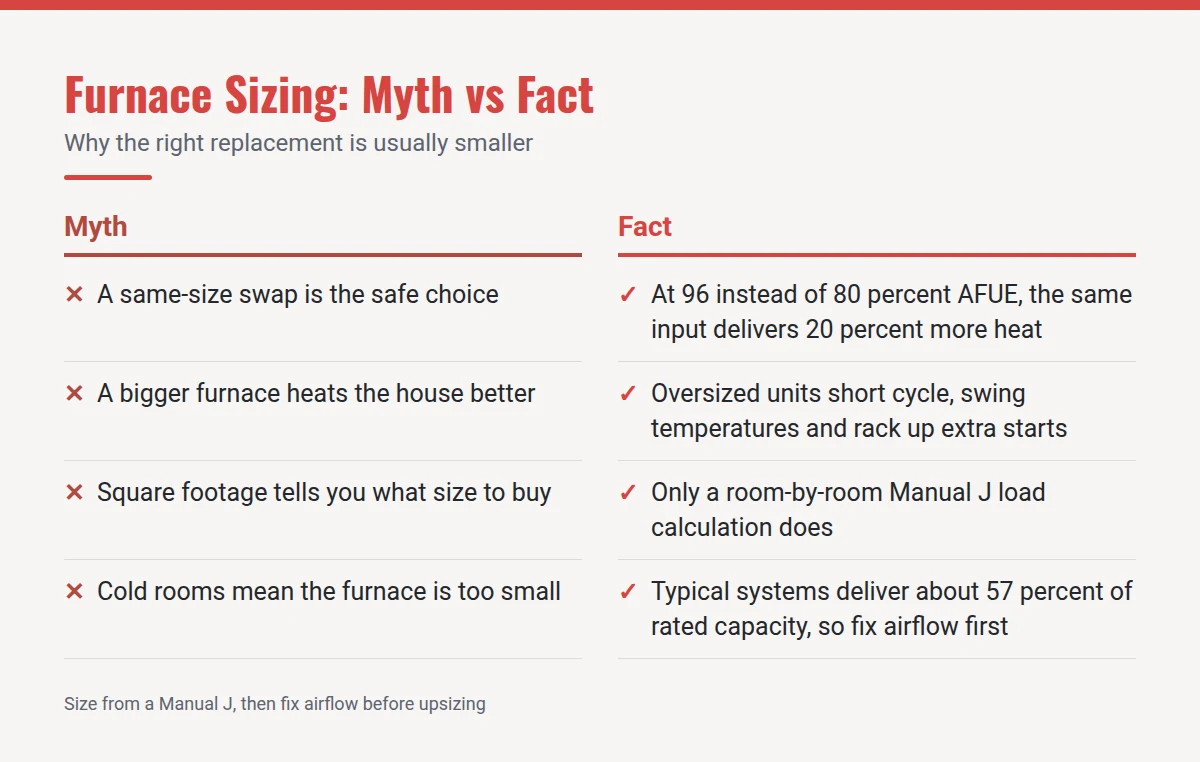
Most furnaces are bigger than the houses they heat. DOE’s rule analysis calls oversizing common industry practice and notes that it runs higher where an old furnace has been replaced by a more efficient one or the house has been improved since, which describes most replacement jobs.
The nameplate math shows why. A 100,000 BTU input furnace at 80 percent AFUE delivers about 80,000 BTU. Swap in a “same size” 100,000 BTU furnace at 96 percent and it delivers about 96,000, a 20 percent jump nobody asked for. Do the same with a 65 percent antique and output rises by nearly half, before counting any insulation, windows, or air sealing added since.
Right-sizing starts with a room-by-room load calculation, ACCA’s Manual J, followed by Manual S equipment selection, which, as DOE notes, recommends oversizing a furnace by no more than 40 percent. Natural Resources Canada’s guide is blunt: sizing by floor area or by “equivalent” replacement is not adequate in most cases, and a contractor who shows no interest in examining the house or your past gas bills is guessing. Your own memory helps too. If the old furnace still cycled on and off comfortably on last winter’s coldest nights, it had capacity to spare.
Oversizing is not a harmless margin. A big burner hits the setpoint fast and shuts off, so rooms swing between hot blasts and cool lulls while the igniter and heat exchanger rack up extra starts. A bigger furnace also needs more airflow than old ducts may carry. Two decades of field measurements by a contractor training organization, reported by Forbes, show the typical system delivers only about 57 percent of its rated capacity into the living space, with average duct pressures far above manufacturer limits. When some rooms run cold, the fix is usually airflow, not a bigger box.
Single-Stage, Two-Stage, or Modulating
How the burner fires decides how the house feels.
- Single-stage furnaces run at full fire every time. They cost the least and work fine when correctly sized for a mild climate, but they heat in bursts, and oversizing makes those bursts worse.
- Two-stage furnaces add a low fire, typically around 60 to 70 percent of full output, and spend most of the season there. They run longer, quieter, and steadier, and for most homes in real heating climates they are the value sweet spot.
- Modulating furnaces adjust in small steps from as low as roughly 35 to 40 percent up to full fire, giving the most even temperatures at the highest price. Many reach their full range only with the manufacturer’s own communicating thermostat, so ask before planning to keep a third-party smart thermostat.
The blower matters as much as the burner. Federal furnace fan standards that took effect in July 2019 moved new furnaces to efficient brushless blower motors, often sold as ECM, and they come in two kinds. Constant-torque motors are the efficient standard. Variable-speed motors hold a set airflow by speeding up as duct resistance rises, which brings soft starts and better moisture removal when the air conditioner runs, but on restrictive ducts they simply spin harder and draw more power.
Plan around the air conditioner. The AC’s indoor coil is usually mounted right on the furnace, so the new cabinet has to fit it, and if the coil must be disconnected, the refrigerant has to be recovered by an EPA 608 certified technician. If the AC is past about 12 years old, price its replacement in the same visit. The refrigerant switch explained in our central air conditioner buying guide makes mixing old and new cooling parts harder than it used to be.
What a Fair 2026 Price Looks Like
There is no national price list, and industry estimates vary widely by region, house, and crew. DOE’s analysis put the average installed cost of a 95 percent furnace just under $4,000, but that is a national average in 2022 dollars, so treat it as a floor. As a rough 2026 guide for a straightforward replacement in an average-size home, before venting complications:
- 80 percent, single-stage, like-for-like swap: roughly $3,000 to $5,000.
- 95 to 96 percent, two-stage, efficient blower: roughly $4,500 to $8,000.
- 97 to 98 percent, modulating, variable-speed blower: roughly $7,000 to $12,000, sometimes more.

Two quotes for the same furnace usually differ in the extras, so a complete quote should spell out the Manual J result and the furnace’s model number, output, and AFUE; the vent route and whether it is one pipe or two; condensate drainage and freeze protection; the water heater’s venting plan and spillage test; any coil, plenum, or gas piping changes; the permit and inspection; and a startup that checks combustion, gas pressure, and temperature rise against the data plate. Get at least three and compare them line by line.
Then strike one line from any 2026 quote: the federal tax credit. The Energy Efficient Home Improvement Credit that paid up to $600 toward a qualifying furnace applies only to equipment placed in service by the end of 2025, after the 2025 federal budget law ended it early. If a salesperson nets it out of this year’s price, the price is wrong. Many gas utilities still pay rebates on high-efficiency furnaces, so ask yours directly.
When a Heat Pump or Dual Fuel Is the Better Buy
For plenty of households, the best furnace purchase is a different one.
If the air conditioner is also near the end of its life, the real question is whether the new outdoor unit should be a heat pump. Pair it with a furnace and you have dual fuel: the heat pump carries the mild weather and the furnace takes over in deep cold.
Run the operating cost math with your own rates. A therm of heat equals about 29.3 kilowatt-hours. At EIA’s forecast of about 18 cents per kilowatt-hour this winter and gas at $1.30 a therm, a heat pump needs a coefficient of performance near 4, delivering four units of heat per unit of electricity, to match a 96 percent furnace. A good variable-speed heat pump can approach that in mild weather but not on a cold night, which is exactly the gap dual fuel exploits. Our cold-climate heat pump guide covers setting that economic balance point. Where gas is pricey or power is cheap, the heat pump wins far more of the winter.
Propane flips the answer. EIA expects residential propane around $2.44 a gallon this winter, roughly $2.80 per therm of heat from a 95 percent furnace. A heat pump beats that at a coefficient of performance of about 2, which cold-climate models sustain well below freezing.
Mild winters lean toward a heat pump outright, because a 90-plus furnace saves little where heating bills are small, and one heat pump can replace both the furnace and the AC. Check your electrical panel’s capacity first, since that is the hidden cost most likely to change the answer.
And sometimes the furnace is still right. Cheap gas, harsh winters, an air conditioner with years left, and sound ductwork add up to a strong case for a correctly sized two-stage condensing furnace.
The Bottom Line
Shop before the old furnace fails, and start with its data plate. Size from a room-by-room Manual J, because a “same size” swap to a more efficient furnace is really an upsize. Go condensing where the heating bill justifies it and the vent route works, and get the water heater’s venting plan in writing. Two-stage suits most homes. Ignore any 2026 price that counts the expired tax credit, compare three itemized quotes, and price a heat pump or dual fuel before you sign, especially if the AC is due too or you heat with propane.
Further reading (sources)
- U.S. Department of Energy on the 2023 furnace efficiency rule and its cost, sizing, and venting analysis
- Contracting Business with the Supreme Court sending the 95 percent furnace rule back for review
- Oak Ridge National Laboratory for how a sidewall-vented condensing furnace can orphan a shared water heater
- Natural Resources Canada on furnace sizing, chimney liners, and sealed combustion in its gas heating guide
- ENERGY STAR listing the northern and southern AFUE thresholds for certified furnaces
- U.S. Energy Information Administration with its September 2026 forecast of residential gas, propane, and electricity prices
- Internal Revenue Service on when the Energy Efficient Home Improvement Credit stopped applying
- Forbes covering field data on how much rated heating and cooling capacity reaches the rooms
- ACCA for the Manual S standard on selecting equipment to fit the load