Should You Turn a Heat Pump Down at Night? Why the Setback Rule Flips in Heating Mode
Published on September 25, 2026
“Turn the heat down at night” is about as settled as household advice gets. It is printed on utility bill inserts, repeated by energy auditors, and correct for the furnace most of us grew up with. Then a family switches to a heat pump, keeps the same 62 degree overnight schedule, and watches the January bill climb anyway.
The advice did not become wrong. It was written for a machine with one heater, and a ducted heat pump usually has two. Whether an overnight setback saves money on a heat pump comes down to a question furnace owners never had to ask: what warms the house back up at 6 a.m.?
Why the Setback Rule Works on a Furnace
A house loses heat in proportion to the gap between inside and outside. Let the indoor temperature drift down overnight and that gap shrinks, so the house leaks less heat for as long as it stays cool. When the furnace fires in the morning to catch up, it burns fuel at the same efficiency it always does, so every unit of heat it puts back costs exactly what it would have cost to hold the temperature all night. You come out ahead by the heat you never lost. The same physics is why the away and asleep setbacks in our guide to summer AC settings pay off in cooling mode.
A heat pump keeps the first half of that argument and breaks the second. The setback still saves heat overnight. The trouble is the price of the heat that replaces it.
A Heat Pump Has Two Heaters, and One Costs Far More to Run
The compressor does not make heat. It moves heat in from outdoors, which is why it delivers more energy than it consumes. Natural Resources Canada puts the coefficient of performance (COP) of air-source heat pumps at 46 degrees outdoors anywhere from 2.0 to 5.4, meaning 2 to 5.4 units of heat for every unit of electricity. The electric resistance strips in the air handler run at a COP of exactly 1. On a typical winter morning, every hour the strips carry the load costs two to three times what the compressor would have charged for the same heat, and sometimes more.
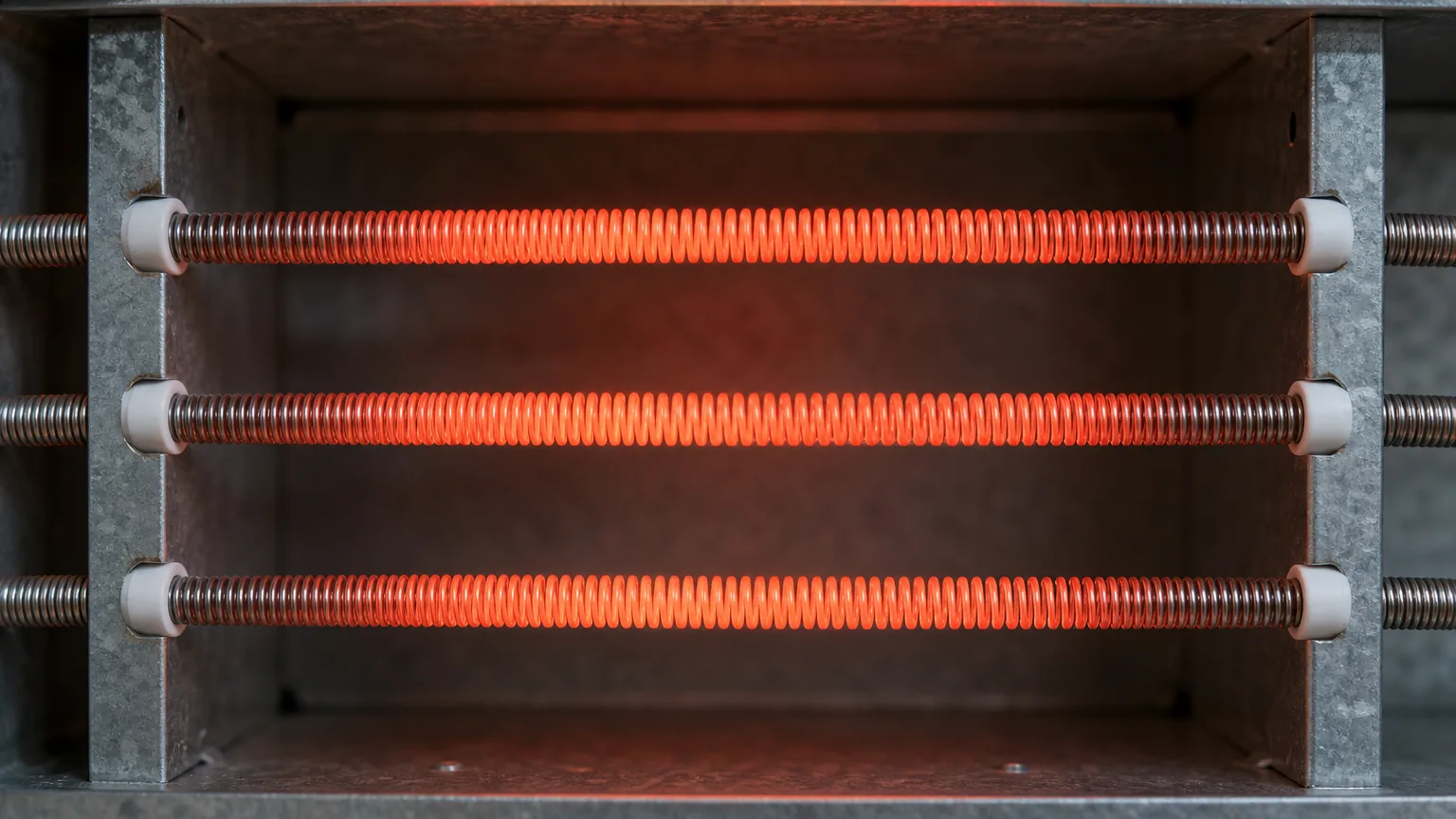
Most ducted systems are wired so the thermostat can call on both. NRCan describes the usual arrangement for single-speed ducted heat pumps: stage one calls the heat pump, and stage two calls the supplementary heat if the indoor temperature keeps falling behind. In practice, most thermostats bring the strips in when the room lags a couple of degrees behind the setpoint, or when the compressor has run for a set time without closing the gap.
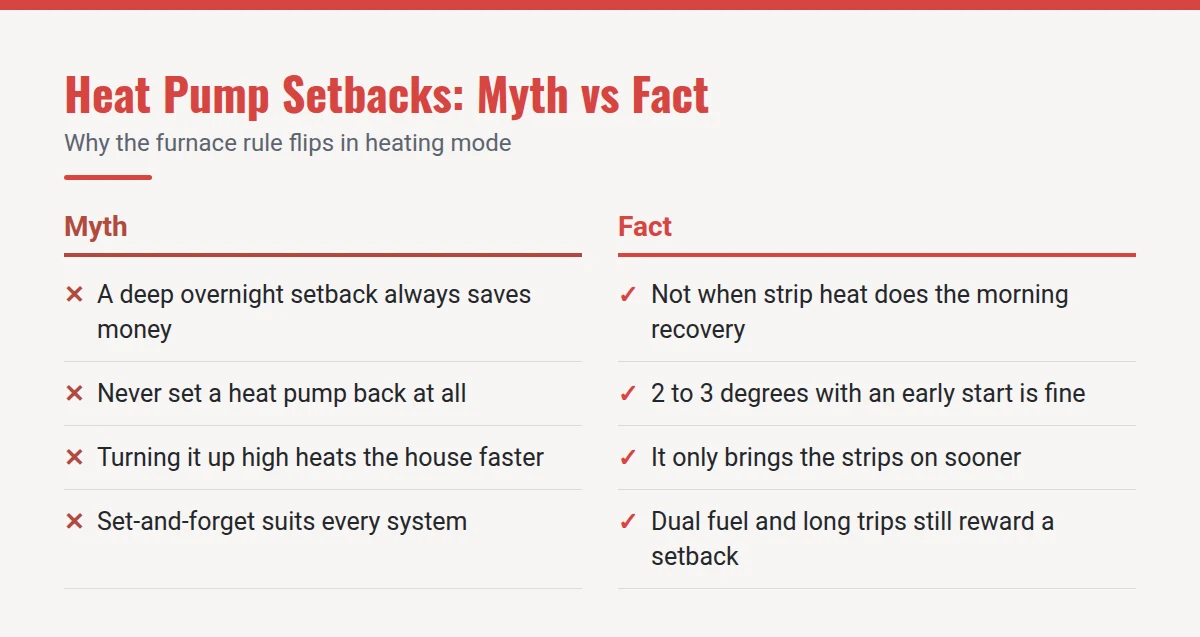
Now picture the morning after a 7 degree setback. The schedule jumps from 62 to 69, the room is 7 degrees behind, and the thermostat reads that as a compressor that cannot keep up. On come the strips. It is also the coldest hour of the day, when the compressor has the least capacity and the lowest efficiency. NRCan’s guide says it directly: depending on the setback, the heat pump may not be able to bring the house back on short notice, and the supplementary heat then “operates until the heat pump ‘catches up.’”
Variable-speed equipment is not immune. The Northwest Energy Efficiency Alliance’s BetterBuilt NW program notes that variable capacity heat pumps are “far more efficient when running at low speed than at full power.” Testing showed that a 5 to 10 degree setback does save energy at first, but recovering from it “causes the heat pump’s efficiency to plummet” as the system runs flat out, and depending on the configuration the compressor and the backup heat can end up running at the same time.
What the Meters Show
This is not only theory. In a paper for the 2024 ACEEE Summer Study, Christian Douglass and Josh Rushton examined 36 ducted heat pump homes in a Pacific Northwest metering study. Twenty-one showed some overnight setback, and nine had a deep one, which they defined as 4 degrees or more. In one home that dropped from about 69.5 to about 60 overnight, the circuit feeding the strips showed spikes of 8 to 11 kilowatts in the morning hours of the coldest months, and very little use at any other time of day. Across all the homes, the 6 to 10 a.m. window showed far more resistance heat than the rest of the day, and at milder outdoor temperatures. In another case they cite, a newer variable-speed heat pump in Bend, Oregon cut its peak demand by roughly 10 to 15 kilowatts once the owners switched to a constant setpoint.
The finding is not new, either. A 1978 ASHRAE study by C. E. Bullock of Carrier simulated heat pump homes through a Minneapolis winter and concluded that nighttime setbacks of 5 degrees Fahrenheit or more “can lead to increased energy consumption by the heat pump, high morning power demand, and poor indoor comfort.”
A rough example shows why the morning matters so much. Ten kilowatts of strips running through an hour of recovery use 10 kilowatt-hours. At a COP of 3, the compressor would have delivered the same heat for about 3.3. Repeat that every morning through a 120-day heating season and the recovery burns around 800 extra kilowatt-hours before anything the setback saved is counted. If your utility charges time-of-use rates with a winter morning peak, that strip heat also lands in the most expensive hours of the day.
Aux Heat and Emergency Heat Are Not the Same Thing
Two labels on a heat pump thermostat cause most of the confusion.
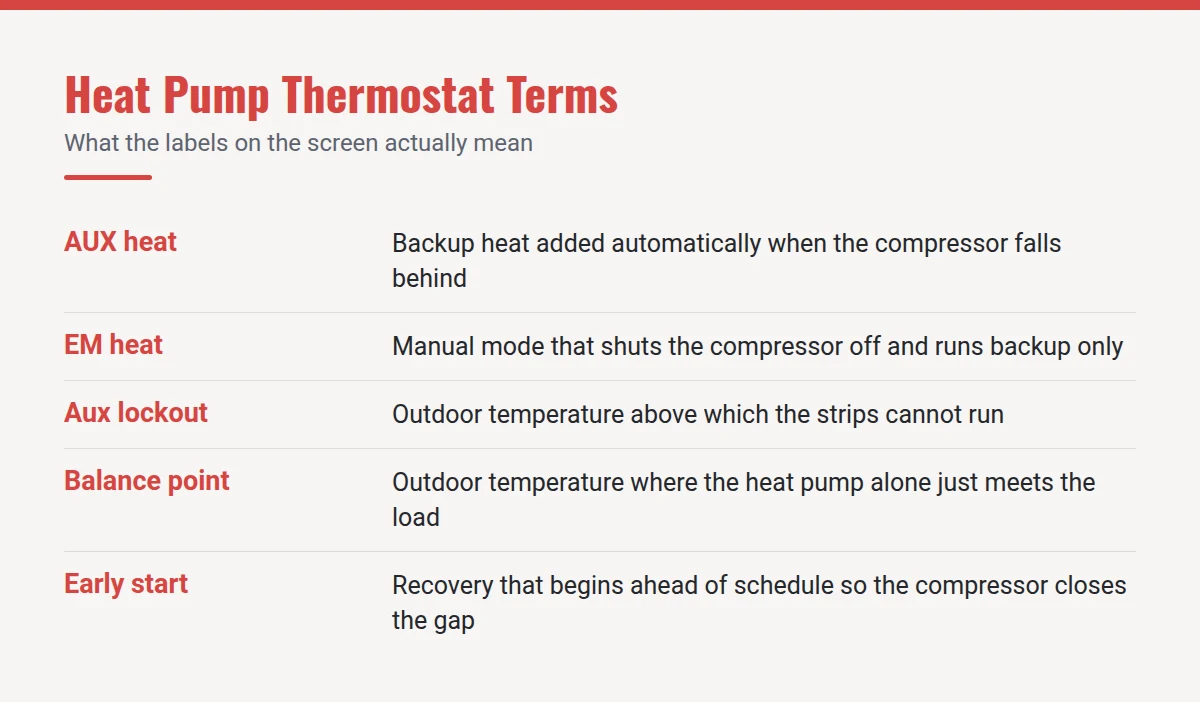
AUX (auxiliary heat) is automatic. The thermostat adds the backup alongside the compressor when it decides the compressor needs help: in the coldest hours, during defrost cycles when the outdoor coil briefly reverses to melt frost, and whenever the room falls far enough behind the setpoint. Seeing AUX in a cold snap is normal. Seeing it every morning at the end of your schedule’s setback is the pattern this article is about. The same logic explains why cranking the thermostat to 75 on a cold morning does not heat the house any faster. The compressor can only deliver so much heat at a given outdoor temperature, whatever number you dial in, so a higher setting just brings the strips on sooner.
EM HEAT (emergency heat) is a mode you select by hand. It locks the compressor out and heats the house on the backup alone, whether that is strips or, in a dual-fuel system, a gas furnace. It exists for one situation: the outdoor unit has failed, iced up solid, or been damaged, and you need heat until a technician arrives. It is not a cold-weather setting. Douglass and Rushton describe a homeowner near Tacoma, Washington who switched a new heat pump into resistance-only mode ahead of a January cold snap, forgot about it, and ran on the strips for nearly four weeks until the utility called.
If you end up on emergency heat because the outdoor unit quit, book the repair rather than living with it. A heat pump that suddenly cannot keep up is often a refrigerant, airflow, or defrost problem, and anything involving refrigerant legally requires an EPA 608 certified technician. On a dual-fuel system, emergency heat means the furnace is doing all the work, so make sure the carbon monoxide alarms are working. If one sounds, or you smell gas, get everyone out and call from outside.
How to Read Aux Heat Runtime in Your Thermostat’s History
You do not have to guess whether your setback costs money. The Environmental Protection Agency’s ENERGY STAR program requires certified smart thermostats to show owners information such as monthly run time, and to report how much resistance heat is used in heat pump homes, sorted into 5 degree bands of outdoor temperature from 0 to 60. That same lens, aux runtime against outdoor temperature, works on your own house.
- Open the history or energy report in the thermostat’s app and find the aux, emergency, or second-stage heat runtime, not just total heating time.
- Look at when it runs. Aux that clusters in the first hour or two after the morning schedule change is recovery heat. Aux spread through the coldest nights is a capacity question, which is a different conversation.
- Compare it with the outdoor temperature. A few minutes during a defrost cycle is expected. Aux at 40 or 45 degrees outside, when a healthy heat pump should carry the house alone, points to the setback, a setting, or a fault.
- Check the equipment settings. Look for an aux heat lockout (often labeled something like aux heat max outdoor temperature), a compressor lockout, and a recovery option that starts heating early. The names vary by brand, but together they decide how quickly the thermostat gives up on the compressor.
- Run a two-week test. Drop the setback, or trim it to 2 degrees, and compare daily aux runtime and meter readings with a similar-weather stretch before the change.

Lockouts are the setting most often missing. A 2019 Bonneville Power Administration field study, summarized in the ACEEE paper, found that most of the heat pumps it observed had no backup heat lockout enabled at all, and even in a utility program that required one, only 65 percent complied. The paper puts best practice in the Northwest at a lockout close to 35 degrees, but warns against locking out the backup above the temperature your compressor can actually carry the house. That temperature is your balance point, and our cold-climate heat pump guide explains how an installer sizes the backup around it. If the thermostat is configured as a conventional furnace system instead of a heat pump, or the strips are wired as the first stage, the strips become the primary heater. That is a wiring job for a technician, and our smart thermostat guide covers the terminals involved.
When a Small Setback Is Still Fine
None of this means a heat pump must hold one temperature around the clock. It means the compressor, not the strips, has to do the recovery.
NRCan’s guidance is the simplest version: keep setbacks moderate, no more than 2 degrees Celsius (roughly 3.5 degrees Fahrenheit), or use a “smart” thermostat that switches the system on early in anticipation of the recovery. Thermostats built for heat pumps, it notes, bring the house back “with or without minimal supplementary heating.” If yours cannot lock out aux or start recovery early, many utilities rebate ENERGY STAR certified smart thermostats.
For variable-speed and ductless equipment, BetterBuilt NW gives the clearest schedule:
- Under 6 hours (an evening out): no setback.
- 6 to 12 hours (a night’s sleep or a workday): 2 to 3 degrees.
- More than 12 hours (a long day away or a weekend): 5 to 8 degrees, depending on how much you want to save.

Mild weather changes the math too. If the strips are locked out above freezing, a setback on a 45 degree night has to recover on the compressor alone, which is slower but carries no strip penalty. And comfort is a legitimate reason to sleep cooler. The ACEEE paper describes a homeowner in Chelan County, Washington who replaced an old heat pump with a cold-climate variable-speed unit and kept the cooler nights. The new system started its morning warm-up earlier and stretched it out longer, and its average daily peak came in about 8 kilowatts below the old system’s. Dropping the setback would have trimmed another 2 to 3 kilowatts, but the owner preferred the cooler house.
If the real goal is a lower bill, lower the steady setpoint by a degree or two instead. Bullock’s simulation found that approach saved about 4 percent of seasonal energy per degree Fahrenheit, and called it “essentially foolproof.”
Set-and-Forget Is Right for Some Systems and Wrong for Others
Which advice applies depends on what is installed, so identify it first. An indoor air handler with no gas line or flue pipe almost always means electric strip backup, if there is backup at all. A furnace with a flue, paired with an outdoor heat pump, means dual fuel. Wall-mounted heads with no ducts mean a ductless system, which usually carries no strip heat. Age matters too: older single-speed heat pumps lose the most capacity in the cold, so they lean on the strips hardest.
| Your system | Overnight approach |
|---|---|
| Ducted heat pump, electric strips, basic thermostat | Set and forget, or 1 to 2 degrees at most |
| Ducted heat pump, strips locked out, heat pump thermostat with early start | 2 to 3 degrees |
| Variable-speed ducted or ductless | The 6 hour and 12 hour schedule above |
| Ductless heads added to an old boiler or furnace | Set the heads and forget them; keep the old system as backup |
| Dual fuel (heat pump plus gas furnace) | Ordinary furnace setbacks generally work |
| Air-to-water heat pump or radiant floors | Hold steady; the system responds too slowly |
Set-and-forget is the right default for heat pumps that recover on strips. Efficiency Maine, in a state where residents have installed more than 200,000 heat pumps, tells owners that turning them down when away or asleep “may actually use more energy than leaving them on.” It also tells households that still have a boiler or furnace to reserve it “for emergency back-up only” and let the heat pumps carry the house.
It is the wrong default in two cases. Dual fuel is the first. When the backup is a gas furnace, recovery burns gas rather than running strips, and the cost gap between furnace heat and heat pump heat is nowhere near the two to three times that strips carry. In cold weather it sometimes favors the furnace. An ordinary setback keeps most of its value; what matters more is that the switchover temperature reflects your actual gas and electric rates. The second is a long absence. For a week away, set the house back further on any system, no lower than the mid-50s to protect the plumbing, because the savings pile up for days and the recovery happens once.
Radiant floors and air-to-water systems sit at the far end of set-and-forget. They respond so slowly that deep setbacks work poorly with any heat source, as our guide to boilers and hydronic heating explains.
The Bottom Line
A setback saves heat on every system. On a heat pump, the real question is what pays for the recovery. If the answer is the compressor working steadily from a small gap, keep the setback. If the answer is 10 kilowatts of resistance strips at 6 a.m., the setback is costing you money, and the aux history on your thermostat will show it. Check that history during the first cold week of the season, ideally as part of your fall switchover checklist, and set the schedule from what the data says rather than from advice written for a furnace.
Further reading (sources)
- Natural Resources Canada on heat pump efficiency, supplementary heat and moderating setbacks
- BetterBuilt NW for setback lengths that suit variable capacity heat pumps
- Douglass and Rushton with metered data on morning strip heat and missing backup lockouts
- Bullock, writing for ASHRAE, on why deep setbacks backfired in a simulated Minneapolis winter
- Efficiency Maine explaining the set it and forget it rule for heat pump owners
- ENERGY STAR listing what certified smart thermostats must report about resistance heat