Who Actually Owns Your HVAC Company? Roll-Ups, Franchises, and How to Check
Published on September 14, 2026

Read heating and cooling industry announcements for a month and they stop reading like news and start reading like a ledger. In August 2026, Presidential Heating & Air Conditioning of Gaithersburg, Maryland announced it had acquired Shipley Plumbing, Heating & Air Conditioning, a neighboring shop working the same Montgomery County streets. Shipley’s customers keep their technicians. The Shipley name goes away. One paragraph further down sits the part most homeowners never reach: Presidential is itself part of Southern Home Services, a national network that refers to its local businesses as Centers.
None of that is a scandal. Acquisitions are legal, ordinary, and frequently good for the people working at the company being sold. The problem is that the whole arrangement is invisible at the one moment it matters to you, which is when a technician is standing in your basement saying the heat exchanger is cracked and handing you a tablet with three prices on it. You are not only buying a repair at that moment. You are buying whatever incentive structure that person works inside of, and the logo on the truck will not tell you what it is.
This is the layer underneath the usual contractor checklist. Our guide to vetting a contractor’s credentials covers licensing, insurance, and what a real written estimate contains, and all of that still applies. What follows is the ownership question: who holds the equity, what tends to change after a sale, and how to find out in about ten minutes.
What a Roll-Up Actually Is
Residential heating, cooling, plumbing, and electrical service is one of the most actively acquired corners of the American economy right now, and the reasons are not mysterious.
The trade is extraordinarily fragmented, with tens of thousands of small shops and most of them under twenty employees. Demand is non-discretionary, because nobody shops around for three days when the furnace quits in January. Maintenance agreements throw off recurring revenue, which investors value far more highly than one-off service calls. And a generation of owner-operators who hung out their shingle in the 1980s and 1990s is now reaching retirement with no family member who wants the business.
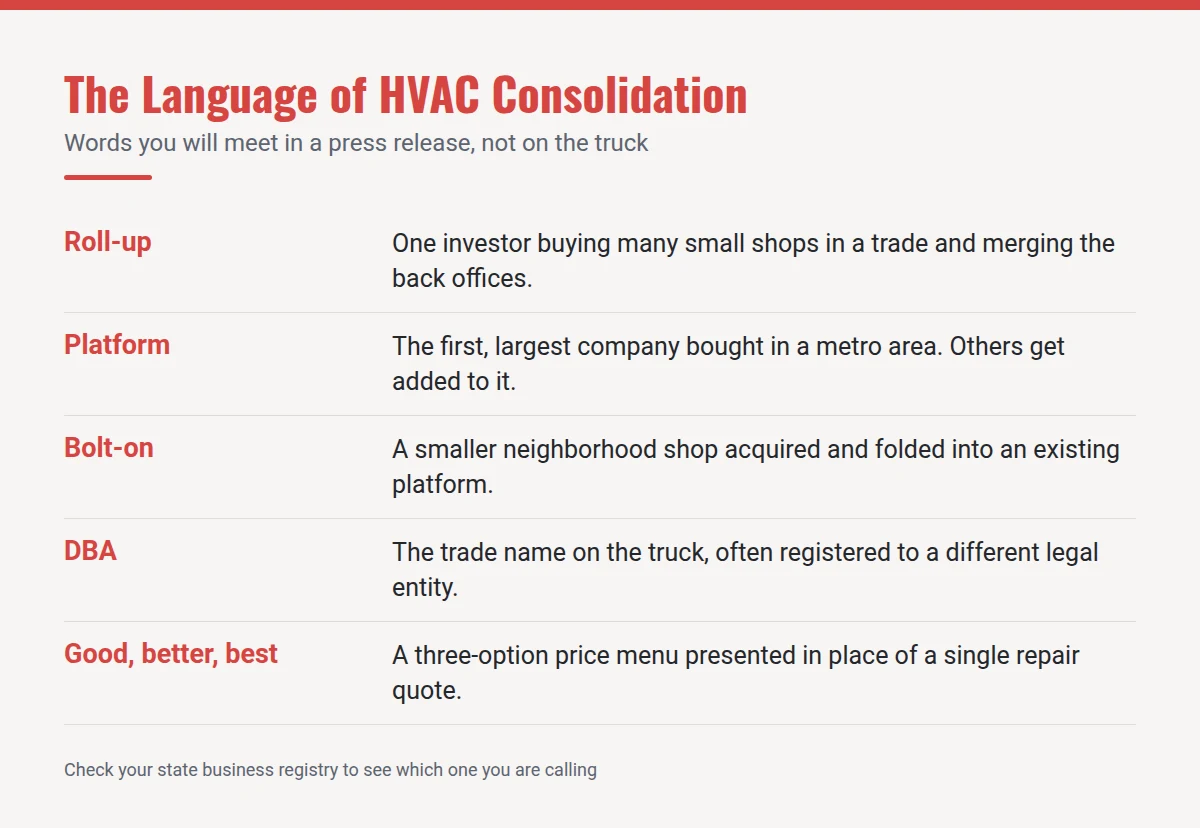
So an investor buys one well-run company in a metro area as a platform, then buys smaller shops around it as bolt-ons, and merges the back office. One dispatch center, one call center, one purchasing agreement with the distributor, one marketing budget, one set of performance targets.
The local name usually stays, at least for a while, because the local name is most of what was purchased. Forty years of word of mouth in one county is a real asset and destroying it in week one would be foolish. The truck logo does not change, the technician you have used since 2015 still shows up, and the only public evidence is often a press release you never saw.
There are three structures you can meet at your front door, and they are easy to mix up.
A true independent. The owner holds the equity, the name on the door is a person or a family, and decisions about pricing and repair-versus-replace get made by someone you can actually reach.
A franchise or brand network. A local owner pays to license a national brand, along with its training, its call scripts, its pricing software, and its advertising. The equity is still local. The playbook is not. This is why two companies in different states can send technicians who use identical language.
A platform company. The equity has been sold to a private equity sponsor or a publicly traded consolidator. The local brand becomes one of many the parent owns. Corporate sets the pricing book, the compensation plan, and the sales process.
One thing that is not ownership: “factory authorized dealer” or “premier dealer” status. That is a manufacturer program tied to sales volume and training, and it says nothing about who signs the paychecks.
What Tends to Change After the Sale
Be careful about how you hold this section. None of what follows is fraud, and a homeowner who assumes every acquired company is out to rob them will make worse decisions, not better ones. These are the predictable consequences of running a service business for a return target rather than for a living.
Technician pay shifts toward commission. Hourly service techs become, in part, salespeople, with a bonus or spiff attached to equipment sold, memberships enrolled, and accessories added. The tech who used to fix your capacitor for ninety dollars is now measured partly on average ticket and close rate.
The diagnosis arrives as a menu. Good, better, best, presented on a tablet, usually anchored with the most expensive option first. Presenting choices is not itself dishonest. What changes is that the repair option is sometimes not on the page at all unless you ask for it.
Membership plans get a hard push. Typically $150 to $300 a year for two tune-ups, priority dispatch, a discount on repairs, and a waived diagnostic fee. These are genuinely worth it for people who use both visits, and they are a quiet auto-renewing line item for people who do not. Ask whether it renews automatically, whether it is refundable, and what happens to it if the company changes hands again.
Repair-versus-replace tilts toward replace. Replacement is the big ticket, and the judgment involved (“that compressor has maybe two seasons left in it”) is genuinely hard to separate from a sales technique. The defense is boring and effective: get a second opinion on any recommendation above a couple of thousand dollars, and ask to see the failed part or the meter reading. Our breakdown of what service calls and repairs actually cost gives you the ballpark to check a number against.
The staff turns over. Comp plan changes and new metrics push out some of the old crew, especially veterans who dislike selling. Two or three years after an acquisition the truck may look the same while nobody on it has been there longer than eighteen months.
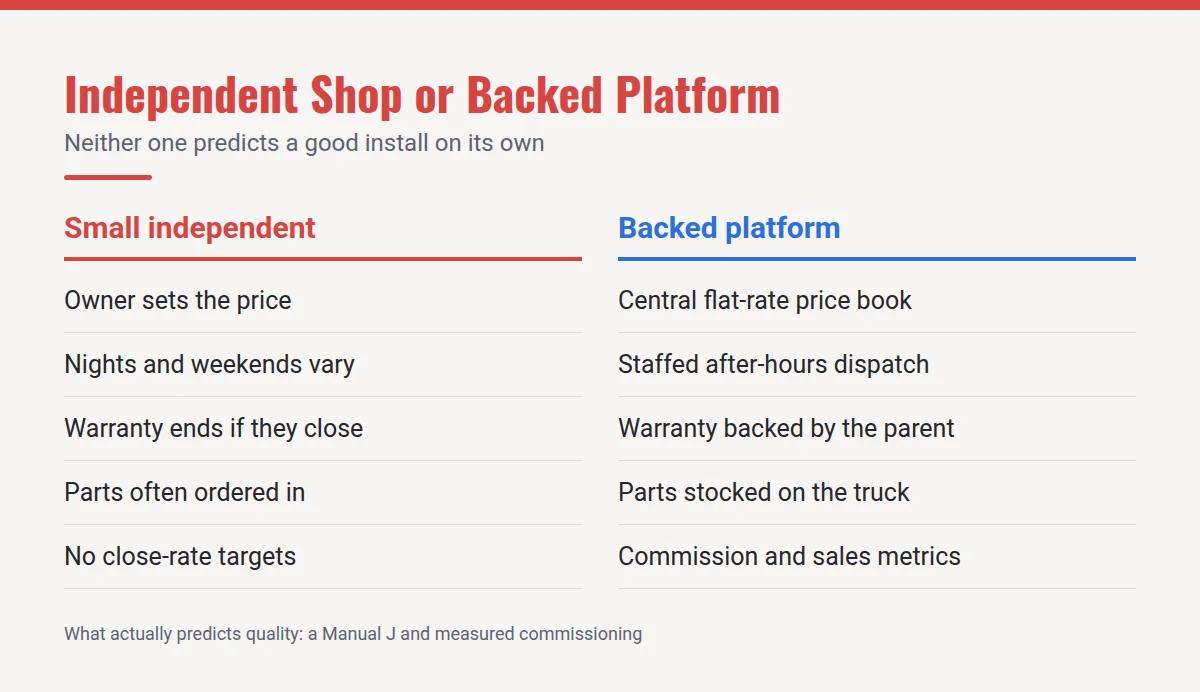
Pricing moves to a central flat-rate book. Not necessarily higher, but no longer something the person standing in your house has the authority to adjust.
Now the fair caveat, and it matters: plenty of independents run this exact playbook, because the same consulting firms and franchise trainers sold it to them. Ownership structure is a clue about incentives. It is not a verdict on the company.
What Genuinely Gets Better
The case for consolidation is not marketing fluff, and pretending otherwise does homeowners no favors.

After-hours coverage that is actually staffed. A three-truck shop’s emergency line rings the owner’s cell phone at midnight, and sometimes he is asleep. A platform has a dispatch center.
Parts availability. National purchasing contracts and a real warehouse mean a common motor or board is on the truck instead of five days out.
Financing at the table. Useful when the furnace dies in February and you do not have twelve thousand dollars. Read the terms with suspicion anyway, particularly deferred-interest offers that retroactively bill the whole period if you miss the payoff date, which our guide to HVAC money and rebate scams walks through.
A labor warranty that outlives the owner. If you have ever tried to get a two-person shop to honor a four-year labor warranty after the owner sold his tools and moved south, you already know what corporate backing is worth.
Documented process and verified insurance. Background checks, workers’ compensation you can confirm, commissioning readings recorded on a form, an escalation path above the technician when something goes wrong.
Training on current refrigerants. The shift to A2L refrigerants such as R-454B and R-32 requires new tools and new procedures, and larger organizations generally got their crews trained sooner.
How to Find Out Who Owns Them in Ten Minutes
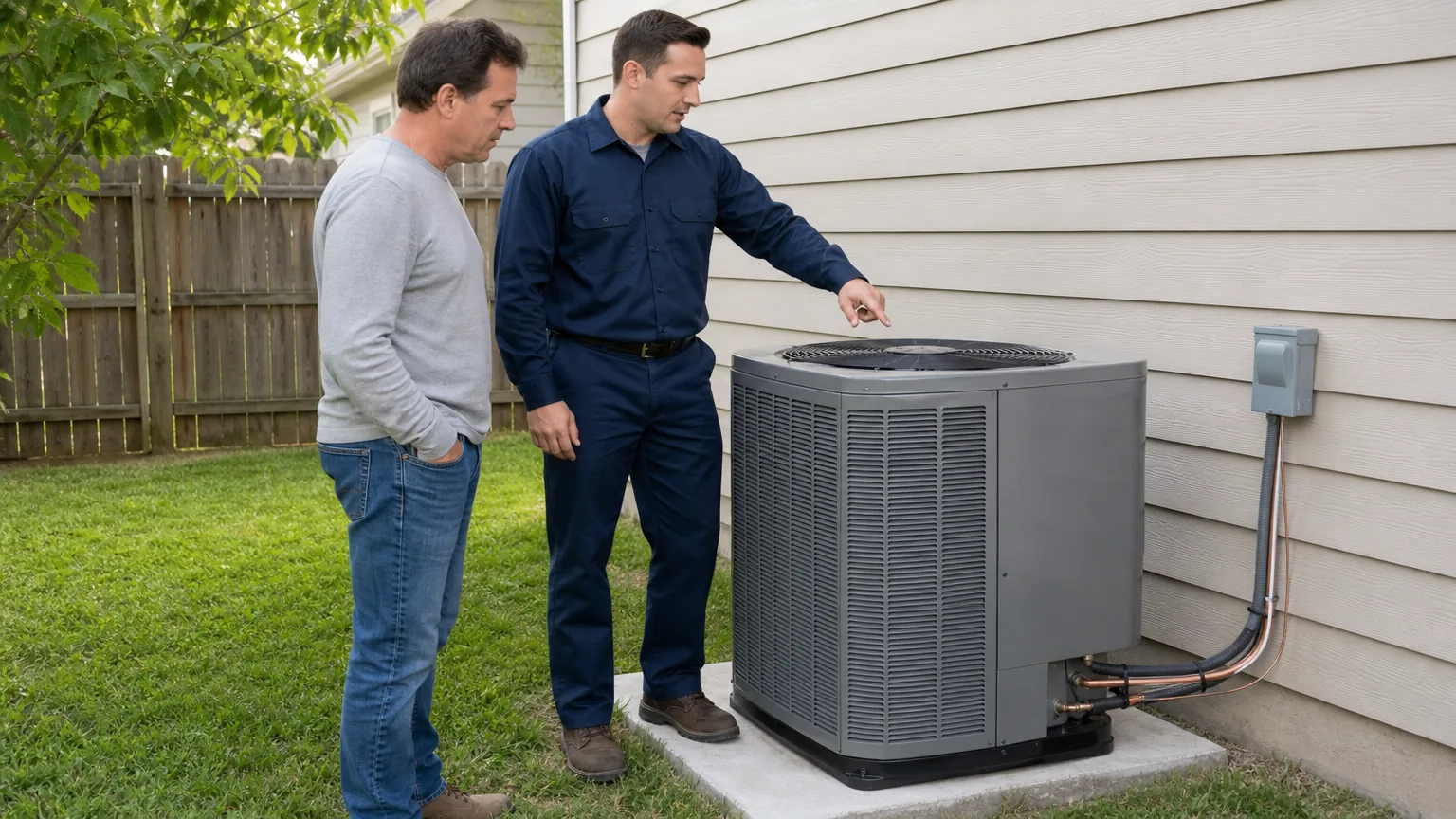
Everything below is free and public. You do not need to ask the company anything.
- Search your state’s business entity registry. Every Secretary of State or Division of Corporations runs a free entity search. Look up the legal name and read the formation date, the registered agent, the listed officers or managers, and any amendment or merger filings. A registered agent that is a national corporate services firm, and officers with an address three states away, is a strong signal on its own.
- Chase the assumed name. The name on the truck is frequently a trade name (a DBA, fictitious name, or assumed name) registered to a completely different legal entity. That filing lives with the state or the county clerk and it names the parent.
- Pull the contractor license record. License lookups show the licensed entity, the qualifying individual, the status, and often a history of changes. A license reissued to a new entity two years ago, sitting beside a “serving the area since 1991” tagline, is worth a polite question.
- Read the footer and the careers page. Ownership shows up in HR language long before it shows up in marketing. Phrases like “part of the family of brands,” a 401(k) match described at national scale, or job listings posted under a parent company’s name are the giveaway.
- Search the company name with “acquires,” “acquired by,” “joins,” and “partners with.” The press release almost always exists. It is simply not linked from the homepage.
- Notice the small operational tells. Who is the check made out to. Does the invoice header match the truck. Does the dispatcher know your street or is the call being answered four time zones away.
None of this obligates you to walk away. A well-run platform company can be an excellent choice. The point is to know which kind of company you are negotiating with before you start negotiating.
Reading the Search Results You Actually Use

Type “HVAC near me” and you get four distinct layers stacked on one screen, and they are not sorted by quality.
Paid ads sit at the top. They are labeled sponsored, and position is bought at auction. It reflects advertising budget, nothing else.
Local Services Ads carry a green check badge. The screening behind that badge is real, covering license, insurance, and background checks. But the placement is still paid, and the badge is a floor rather than a ranking. Plenty of excellent companies never enroll.
The map pack ranks on proximity, review volume, and profile completeness. It is gameable, most obviously through keyword-stuffed business names and service-area listings for addresses nobody works from.
Then the roundups. Local outlets publish “best HVAC contractors” maps, like the Midland Reporter-Telegram’s guide to contractors in Midland, and they are a perfectly reasonable starting list. Just know that these packages usually come from a commercial content team rather than the newsroom.
There is one more category worth learning to spot. Press releases get syndicated onto domains that look like news. Check the URL: a path containing “press-release” on a newspaper domain, or a “getfeatured” segment on a financial site, means the subject paid to place that article. It is legal and extremely common. It is also not reporting, and the glowing description of a contractor’s dedication to the community was written by the contractor’s marketing agency.
Badges deserve the same skepticism. Better Business Bureau accreditation is a paid membership, so the letter grade is not an independent audit. Many “top contractor” awards are sold by the directory handing them out. What is genuinely useful on a BBB page is the complaint history: how many, about what, and whether they got resolved.
The Honest Case For and Against Independents
The romantic version says the small independent is always better. That is not true, and following it blindly gets people hurt.
What the good independent genuinely offers: an owner whose reputation in one zip code is the entire business, a bias toward fixing things because a repair keeps a customer for twenty years, lower overhead, and no monthly close-rate target hanging over the person in your crawlspace. When you find one, keep the number somewhere safe.
What the small independent can genuinely lack: weekend and holiday coverage, a warranty that survives a retirement or a bad year, current training on A2L refrigerants and modern controls, and in the smallest operations, current workers’ compensation coverage. Very small shops also skip load calculations at roughly the rate everyone else does.
Which points at the thing that actually predicts a good outcome, and it is not ownership. It is whether anyone performed a Manual J load calculation before quoting a size, whether the ductwork got measured rather than assumed, and whether anyone recorded static pressure and refrigerant charge at commissioning. A platform company that does all three will outperform a beloved local independent who does none of them, and the reverse is just as true. And if the pitch is that your house simply needs more tonnage, slow down regardless of who signs that technician’s paycheck, because a house that cannot hold temperature is usually telling you about its insulation and its ducts rather than its equipment.
Five Questions for the Kitchen Table
Ask these out loud. The reaction is as informative as the answer.
- Who owns this company, and has it changed hands in the last five years?
- Is the person writing this quote paid a commission or bonus based on what I buy?
- Is this a flat-rate price from a book, and can I see the repair option priced separately from the replacement?
- Who stands behind the labor warranty, the company or a third-party administrator, and what happens to it if the business is sold again?
- If I join the maintenance plan, does it renew automatically, can I cancel it, and does it transfer if I sell the house?
Then one rule that is worth more than all five: unless the house is genuinely unheated in winter or unsafe, do not sign a five-figure agreement the same day it is presented. Every legitimate price survives until tomorrow. Our full cost breakdown by system type is a useful thing to read overnight before you decide.
The Bottom Line
The consolidation of home services is not a conspiracy and it is not going to reverse. Familiar local names will keep getting folded into regional platforms behind unchanged truck logos, and the search results homeowners actually use will keep mixing paid placement with editorial. What you can control is your own information. Spend ten minutes in the state entity registry and the license lookup, ask who is paid what, insist on seeing the repair option next to the replacement option, and judge the company on whether it measures things rather than on whose money is behind it. Ownership tells you what the incentives probably are. The load calculation tells you whether you got a good install.
Further reading (sources)
- PR Newswire on a local shop being folded into a national home-services network
- Midland Reporter-Telegram with a local best-of roundup of heating and cooling contractors
- The Des Moines Register for a press release published under a newspaper domain
- Federal Trade Commission covering when sponsored content has to say so
- Federal Trade Commission on the rules governing reviews and testimonials
- Better Business Bureau, accreditation overview, the program’s own description of what accreditation is and what it costs (named, deliberately not linked)
- California Contractors State License Board for looking up a license and the entity that holds it