Whole-House Fans: The Cheap, Eco-Friendly Cooling Most Homeowners Overlook
Published on September 6, 2026

Every summer a certain kind of homeowner gets a quote for central air, reads the number at the bottom, and starts looking for another way. There is one sitting in the hallway ceiling of a lot of houses built before 1970, painted shut and forgotten. A whole-house fan costs a fraction of what a compressor does to buy and close to nothing to run, and in the right climate it does something a five-figure system cannot do cheaply: it throws the entire volume of hot air out of your house and replaces it with outdoor air every three to five minutes. It is not a substitute for air conditioning everywhere, and there are real safety issues nobody puts in the brochure. But for a lot of houses it is the cheapest comfort upgrade available.
What a Whole-House Fan Actually Does
The machine is simple. A large fan sits in the ceiling of the top floor, usually in a central hallway, with a grille on the room side and the fan body up in the attic. You open windows around the house, switch the fan on, and it pulls outdoor air in through those windows, across every room, up through the grille, and dumps it into the attic. From there it leaves through the attic’s ridge, soffit, or gable vents.
Two things cool down at once. The house exchanges its hot indoor air for cooler outdoor air far faster than open windows alone would manage, and the attic, which has been baking at 130 degrees all afternoon and radiating that heat down through your ceiling, gets flushed out with it. That second effect is why a whole-house fan often helps most with the exact complaint covered in our guide to why the second floor runs hotter than the first. There is also a comfort effect that does not show on a thermometer: moving air across skin feels several degrees cooler than still air at the same temperature.
What it is not is a cooling machine. There is no refrigerant, no compressor, and no ability to make air colder than what is outside. The fan is a very large air mover, and everything it can do for you depends entirely on the outdoor air being worth bringing in.
A Whole-House Fan Is Not an Attic Fan
These two get confused constantly, including by contractors, and they are different products with different jobs.
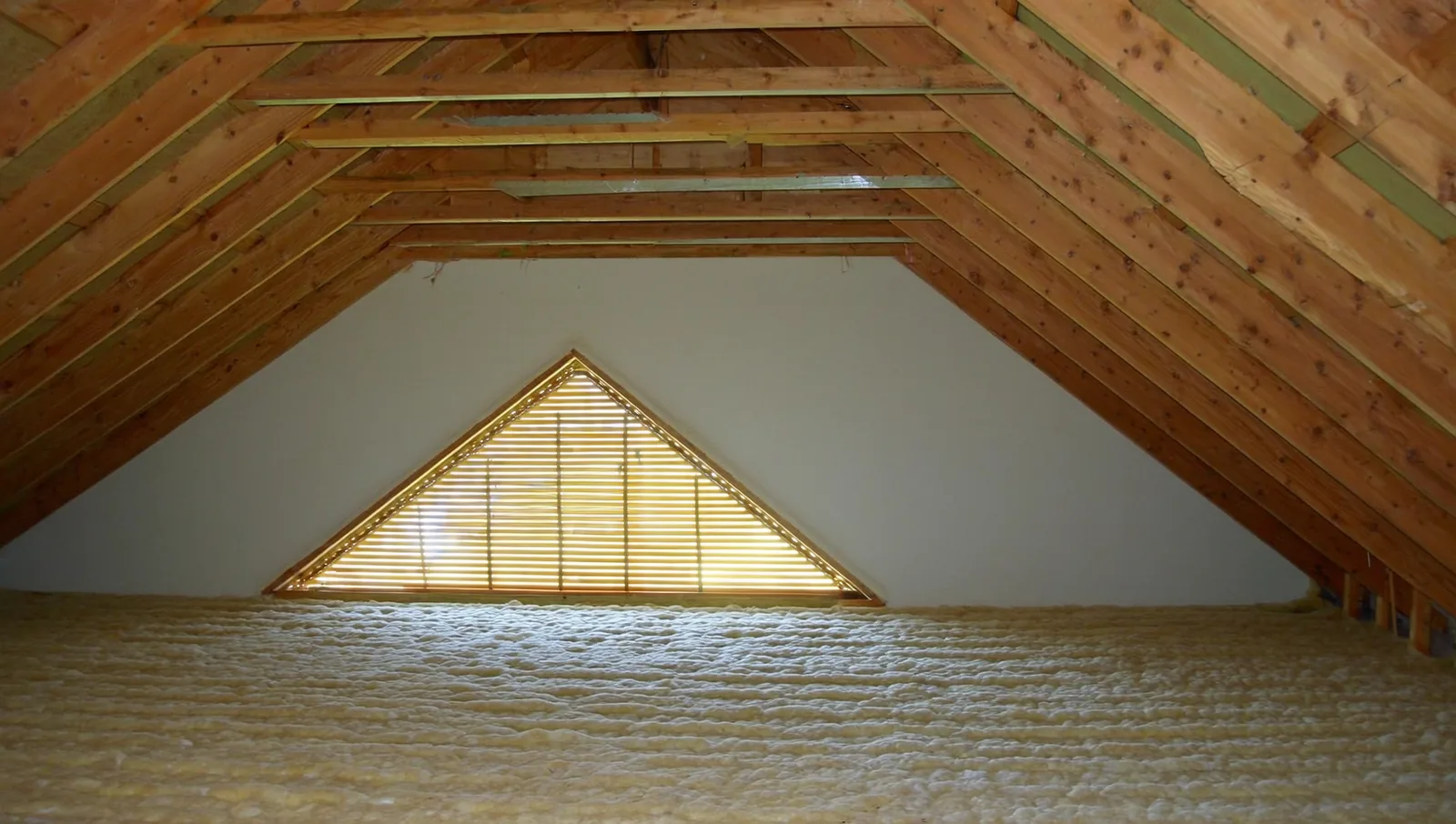
A powered attic ventilator mounts on the roof deck or in a gable wall and moves air only within the attic. It runs on a thermostat during the hottest part of the day to knock down attic temperature. A whole-house fan sits in the ceiling below the attic, runs in the evening and overnight, and moves the air in your living space.
The distinction matters because attic ventilators have a documented failure mode. Testing has repeatedly found that when a powered attic ventilator depressurizes an attic, a meaningful share of the air it pulls comes not from the outdoor vents but through leaks in the ceiling below, which means it is quietly exhausting the air conditioning you paid for. Fine Homebuilding and building science researchers have been making this point for over a decade. If someone quotes you an “attic fan” when you asked about cooling the house, ask which one they mean.
The Climates and the Hours Where It Wins
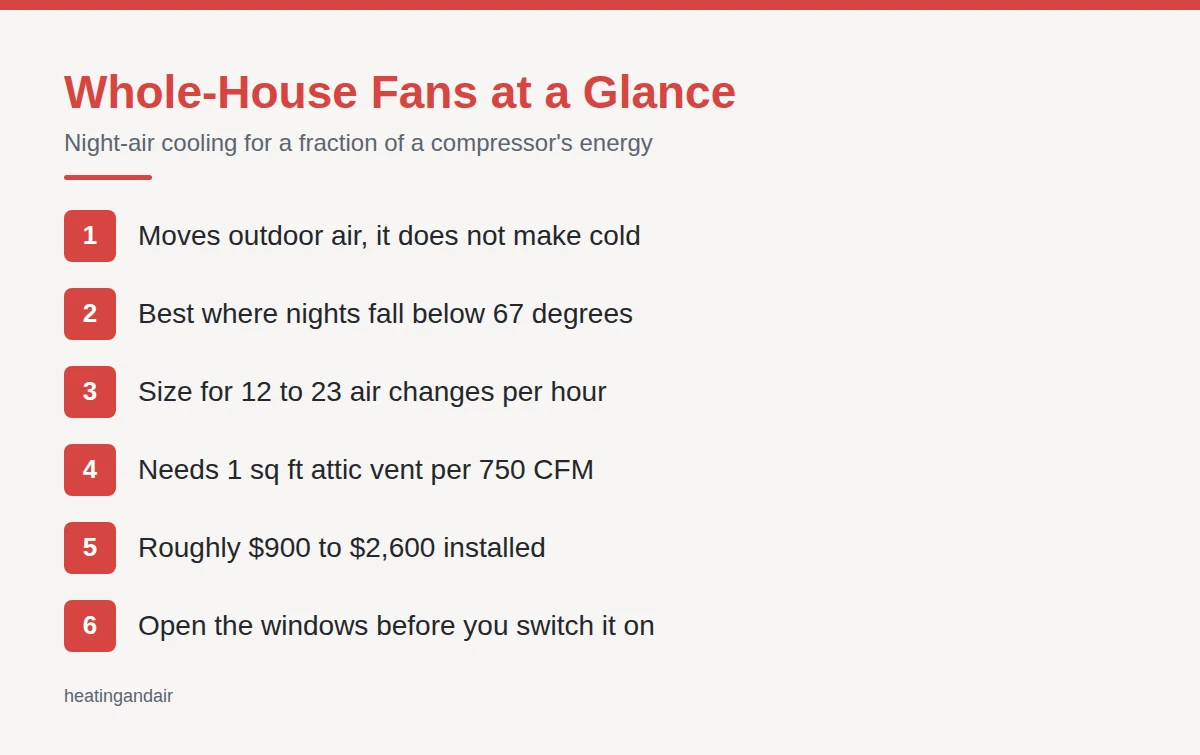
A whole-house fan is a night machine, and it needs a specific kind of night. The Department of Energy’s Building America program puts the useful conditions plainly: nighttime lows below 67 degrees during the cooling season, and a day-to-night temperature swing of 25 degrees or more. Under those conditions the fan is doing real work. Above them it is an expensive way to blow warm air around.
By climate zone, the sweet spot is IECC zones 3B, 4B, and 5B, which covers most of the interior West, the high desert, inland California, and the mountain states. Zones 1A through 3A, meaning the humid Southeast and Gulf Coast, are the worst candidates, and the reason is moisture rather than temperature. A fan cannot dehumidify. Pull in 78-degree air at a 72-degree dew point and you have made your house cooler and clammier at the same time, and then your air conditioner has to wring all that moisture back out. In humid heat the compressor wins and it is not close.
Even in a good climate, the fan owns the shoulder hours and the shoulder months, not the peak. Late May, September, and every evening in July when the temperature drops after sunset. During a genuine heat wave, when the overnight low never gets below 80, you close the windows and run the AC like everyone else. The realistic goal is not to eliminate air conditioning. It is to cut the number of hours the compressor runs, which is the same lever we cover in our piece on what temperature to set your AC to in summer.
Sizing: The CFM Math and the Part People Skip
Whole-house fans are rated in CFM, cubic feet per minute. Sizing works off the volume of your house, not its floor area, because the fan’s job is to replace that volume repeatedly.
The target is 12 to 23 air changes per hour, which works out to roughly 1.5 to 3 CFM per square foot in a house with 8-foot ceilings. Building America’s worked example: a 1,500-square-foot home with 9-foot ceilings holds 13,500 cubic feet, so the right fan lands somewhere between 2,700 and 5,060 CFM. Most residential units on the market fall in the 2,000 to 6,500 CFM range.
Insist on HVI-certified airflow. The Home Ventilating Institute certifies both CFM and sound output in sones through qualified labs, and an HVI number is a tested number rather than a marketing one. Sones matter more than buyers expect. The old belt-drive units earned whole-house fans a reputation for sounding like a plane taking off in the hallway, and modern remote-mount or ducted models are dramatically quieter for a reason worth paying for.
Now the part that gets skipped and then ruins the install. Your attic has to be able to exhale everything the fan pushes into it. The rule is at least 1 square foot of net free vent area per 750 CFM of fan airflow, and because insect screening cuts effective open area by about half, the practical target is closer to 2 square feet of gross vent area per 750 CFM. A 5,000 CFM fan therefore wants somewhere north of 13 square feet of screened attic venting. Most existing attics do not have that. Undersized venting means the fan fights back-pressure, delivers well under its rating, runs louder, and works the motor harder for years.
There is a matching rule on the intake side: about 4 square feet of screened open window per 1,000 CFM. Which means a properly sized fan is not something you run with one window cracked, and that limitation leads directly to the safety section.

What It Costs to Buy and What It Costs to Run
Installed, most whole-house fan projects land between roughly $900 and $2,600, with a national average near $1,700. Equipment alone runs about $300 to $1,500 depending on capacity, motor type, and how well the damper seals. The spread comes from attic access, whether the ceiling framing needs modifying, whether a new circuit has to be pulled, and whether the attic venting needs upgrading to meet the numbers above. That last item is a real line and a contractor who does not mention it has not sized the job.
Set that against a full central system, which our breakdown of what a new HVAC system really costs puts in five figures for most homes. That is the comparison the coverage of whole-house fans keeps making, and on the purchase price it holds up.
Running cost is where the gap gets absurd. A modern whole-house fan draws somewhere between about 75 and 700 watts depending on size and speed. A central air conditioner draws roughly 3,000 to 4,000 watts while the compressor is running. At a national-average electricity rate, that is a few cents an hour against something in the neighborhood of 60 cents an hour, so the fan uses on the order of a tenth the energy for the hours it can replace. Run one for six hours a night through a mild September instead of the compressor and the difference shows up plainly on the bill.
The honest framing is that a whole-house fan is a complement, not a replacement, for most of the country. It shortens your cooling season at both ends. If you are replacing equipment anyway and want the bigger efficiency lever, that decision is covered in why your next air conditioner should probably be a heat pump.
The Safety Caveats That Belong in Every Sales Pitch
A whole-house fan is one of the few appliances a homeowner can install that will actively depressurize the house, and that has consequences.
Backdrafting combustion appliances is the serious one. If you have an atmospherically vented gas water heater, an older furnace with a standing pilot, a gas fireplace, or a wood stove, a fan pulling thousands of CFM out of the house can reverse the draft in that flue and pull combustion products, including carbon monoxide, back into your living space. A gas water heater sitting behind a louvered closet door is a classic case. Building America’s guidance is blunt: whole-house fans are not compatible with room-air combustion appliances or standing pilots, and a furnace without a standing pilot is acceptable only with an interlock switch that prevents the fan and the furnace from running at the same time. Sealed-combustion equipment that draws its air from outdoors sidesteps the problem entirely.
Two practical habits follow. Open the windows before you switch the fan on, never the other way around, and open enough of them and spread them out, so the suction is not concentrated at one leak path. And have working carbon monoxide alarms on every level regardless. If any combustion appliance in your house is atmospherically vented, get a professional to evaluate draft before the fan goes in. This is not a wait-and-see item.
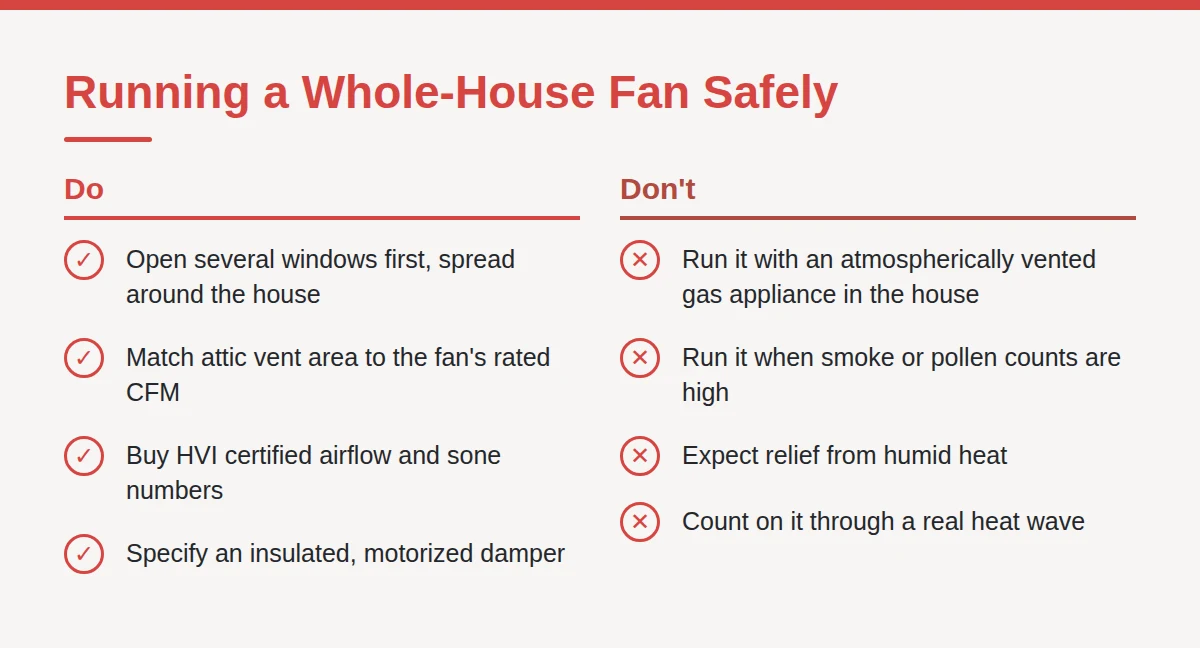
Outdoor air quality is the second caveat. The fan draws unfiltered outdoor air straight into your living space and completely bypasses the filter in your HVAC system. During wildfire smoke events the EPA’s guidance is explicit that a whole-house fan should stay off, because you would be pumping fine particulate through the house at thousands of CFM. The same applies on high pollen nights if anyone in the household has allergies. Check the AQI before you flip the switch, and understand that this appliance and the filtration strategy in our complete guide to indoor air quality work against each other on bad-air days.
Moisture and pests round out the list. A poorly sealed unit is a hole in your ceiling plane. In winter an old gravity-louver fan leaks conditioned air into the attic continuously, which is why an insulated motorized damper, commonly rated around R-5 or better, is worth specifying rather than treating as an upgrade. And in a humid climate, pushing house air into an attic night after night can deposit moisture on cold sheathing.
Five Questions Before You Buy One
- What is your typical July overnight low? If it does not reliably fall below the high 60s, the fan will disappoint you.
- What is your dew point, not just your temperature? Cool and humid still means clammy.
- How much attic venting do you actually have? Measure it, then divide the fan CFM by 750. If the math does not work, the venting upgrade is part of the project.
- Do you have any atmospherically vented combustion appliance? If yes, that gets resolved before anything gets cut into the ceiling.
- Will you actually open and close windows twice a day? This is a manual appliance. Households that will not do the routine end up with an expensive ceiling grille.
The Bottom Line
Whole-house fans are genuinely underrated, and the reason is that they were oversold decades ago to houses that were wrong for them and then remembered as loud, drafty, and disappointing. The modern version is quiet, sealed, and cheap to run, and in a dry climate with cool nights it can take a serious bite out of a cooling bill for around a tenth of what a new system costs.
The catch is that it demands more of the homeowner than a thermostat does. You have to know your climate, size the venting honestly, resolve any combustion safety issue first, and be willing to run the house manually. Do those four things and it is one of the best returns per dollar in home comfort. Skip any of them and you have bought a hole in your ceiling.
Further reading (sources)
- SlashGear on the home cooling system that beats an AC unit on price
- DOE Building America Solution Center for sizing, attic venting, and combustion-safety requirements
- Home Ventilating Institute with what a certified airflow and sone rating actually means
- Fine Homebuilding explaining how whole-house fans differ from powered attic ventilators
- U.S. Environmental Protection Agency on keeping smoke out of the house during a wildfire event
- U.S. Department of Energy for how whole-house fans work and how to size one