Can't Afford a Broken Furnace or AC? Free and Low-Cost HVAC Repair and Replacement Programs
Published on October 16, 2026
A homeowner in Bay Point, California, told ABC7 News this month that she had not been able to afford repairs to her heating and cooling system since her husband died in 2011. The manager of the contractor that eventually replaced it said the coolest the old system could get her house was about 85 to 95 degrees. As an October heat wave settled over the Bay Area, a crew installed a new furnace and air conditioner at no charge. A technician who found her air conditioner was not cooling properly had nominated her for a giveaway program, with a manufacturer supplying the equipment and the contractor installing it.
Stories like that make the evening news because giveaways are rare. The problem is not. In the Energy Information Administration’s (EIA) latest household survey, 6.8 million households said there were times in the past year when they could not use their heating equipment, and 8.2 million could not use their air conditioning, either because it broke and they could not afford the repair or because the utility had cut off service for nonpayment.
Most households in that spot get help in a less photogenic way, through programs run by agencies most people have never heard of until the furnace quits: federal crisis money, the Weatherization Assistance Program, utility programs for income-qualified customers, and local repair charities. This guide covers how each one works, who qualifies, how long it takes, what to do while you wait, and how to recognize the “free furnace” calls that are not help at all.
First, Decide Whether This Is an Emergency
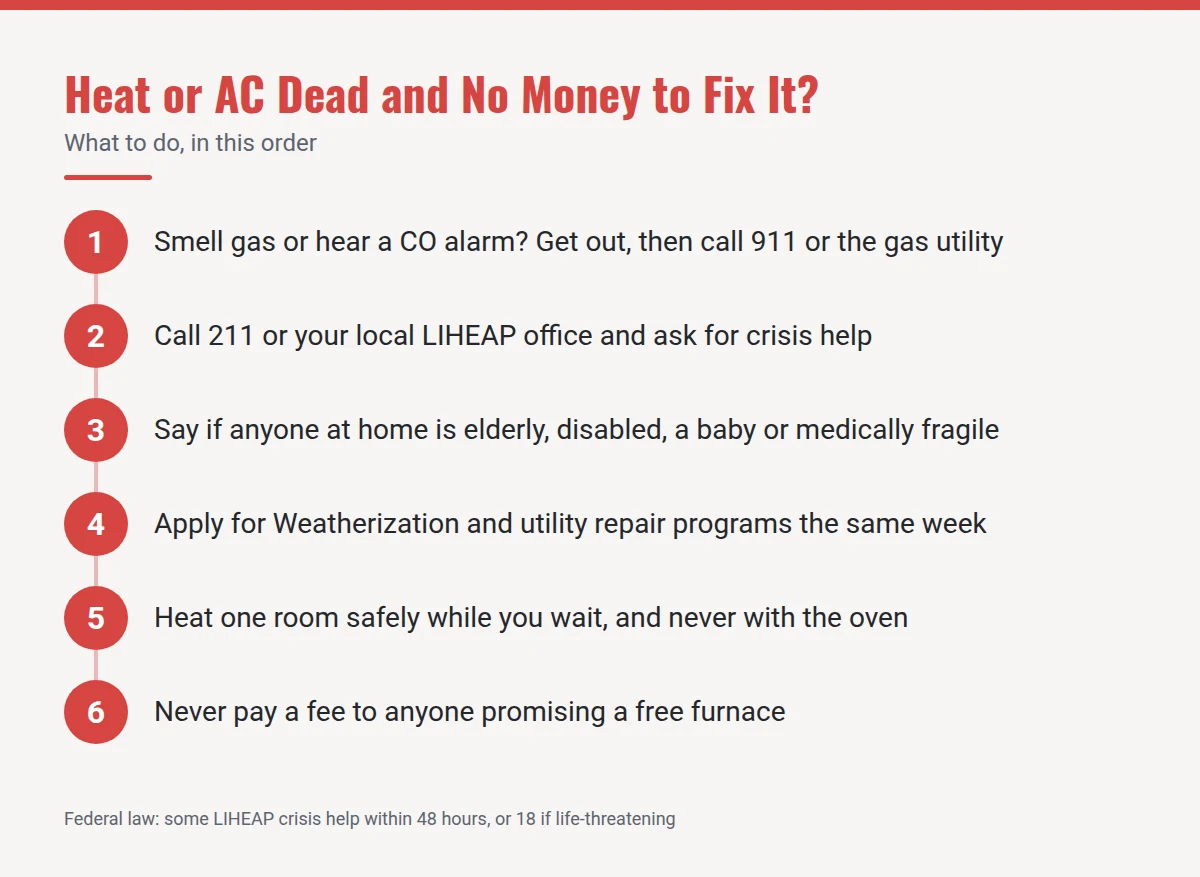
Some failures cannot wait for paperwork. If you smell gas or a carbon monoxide alarm sounds, get everyone out of the house and call 911 or your gas utility from outside. Do not flip switches or try to relight anything. A furnace that a technician has shut off as unsafe stays off until it is fixed, even if that means getting through a few nights on temporary heat.
The second kind of emergency is quieter: no heat in freezing weather, or no cooling in a heat wave, in a house where someone is elderly, disabled, an infant, or living with a medical condition that the temperature makes worse. The federal energy assistance program below sets a faster deadline for crisis cases that are life-threatening, and each state decides what counts, so say plainly when you call that someone in the house is at risk.
LIHEAP Crisis Assistance: The Fastest Help
The Low Income Home Energy Assistance Program (LIHEAP) is a federal block grant that each state runs its own way, usually through local community action agencies. Most people know it as help with the heating bill, but the federal office that oversees it lists “repairing or replacing heating equipment” among the ways the money helps, and many states spend crisis funds on exactly that. Pennsylvania’s crisis benefit covers broken heating equipment that must be fixed or replaced. New York’s heating equipment repair and replacement benefit, for homeowners 60 or older who qualify for the state’s version of LIHEAP, pays up to $4,000 for a repair or $8,000 for a replacement furnace or boiler, and this season’s round opened on October 1. Help with cooling is thinner, but it exists: Ohio’s summer crisis program can pay for central air conditioning repairs or for the purchase of an air conditioner or fans.

Who qualifies. Federal law lets states serve households with incomes up to 150 percent of the poverty guidelines or 60 percent of the state median income, whichever is higher, and bars them from turning away a household under 110 percent of poverty on income alone. In 2026, 150 percent of poverty is $23,940 a year for one person and $32,460 for two. States set their own limits within those bounds, and Iowa, for example, uses 200 percent of poverty this season. States may also treat households that already receive SNAP, SSI, TANF or certain veterans’ benefits as eligible without a separate income test.
How fast it moves. The crisis rules are what make LIHEAP the first call. Federal law requires a state to provide “some form of assistance that will resolve the energy crisis” within 48 hours after an eligible household applies, or within 18 hours if the household is in a life-threatening situation. That is not a promise of a new furnace in two days. The program’s federally funded clearinghouse explains that agencies only have to take steps to resolve the crisis within that window, such as providing electric heaters or warm clothes or arranging temporary shelter, while the repair or replacement follows. The same law makes states hold back a reasonable share of crisis money until March 15 each year.
How far the money goes. In fiscal 2025, state programs reached about 5.7 million households, roughly 14 percent of the 38.2 million that qualified, and winter crisis benefits averaged $736 in the 25 states that offered them. Many states take applications first come, first served, so apply as soon as yours opens.
This winter’s funding. The money is flowing for now. On October 9, the federal office released about $3.6 billion to states and tribes under the stopgap spending law that keeps the government funded through December 11. The White House’s 2027 budget proposes ending LIHEAP, “for the sixth time” in the budget’s own words, and Congress has kept funding it, most recently with $4.045 billion for 2026. What happens after December 11 is up to Congress, which is one more reason to apply early.
How to reach your local office. Call 211, or the National Energy Assistance Referral line at 1-866-674-6327, and ask for the agency that takes LIHEAP applications where you live. When you get through, say that the heat (or the cooling) is out and who in the house is at risk.
Weatherization: Slower, but It Can Replace the Furnace
The U.S. Department of Energy’s Weatherization Assistance Program (WAP) is the other big federal program, and it is built around the house rather than the bill. A local agency sends an auditor and then a crew to seal air leaks, add insulation and deal with the heating system. Households qualify at up to 200 percent of the poverty guidelines ($31,920 a year for one person or $43,280 for two in 2026), or if someone in the home received SSI or TANF in the past year, and federal rules put older people, people with disabilities, families with children and households with very high energy bills at the front of the line. Renters can apply too, with the landlord’s permission.
What makes the program matter here is a hard rule in its health and safety guidance: crews must “replace, repair, or install primary heating systems when existing primary heating systems are unsafe, inoperable, or nonexistent,” and in any climate that needs heat, no home may be left without a safe primary heating system once the work is done. Air conditioning is treated differently. Repairing or replacing it is allowed, not required, and only where the people living there meet the state’s own definition of “at-risk.” The program does not buy secondary heat sources such as space heaters, but it does install carbon monoxide alarms where none are working. North Carolina’s program, for one, repaired or replaced 543 heating and cooling units in 2025 while weatherizing 838 homes.
The catch is time. Eligible applicants go on a waiting list, and nobody publishes a national average wait. Pennsylvania’s auditor general counted more than 2,250 eligible clients waiting in mid-2023, plus 15,700 names on call lists, and noted that people could remain on those lists for years. So apply now, even if a crisis program fixes the immediate problem. Two more details are worth knowing. A house weatherized in the last 15 years generally cannot get the program’s help again. And because a tighter house needs a planned supply of fresh air, crews must also install ventilation to the ASHRAE 62.2 standard, the same yardstick our guide to checking whether your house is under-ventilated explains.
Utility Programs for Income-Qualified Households
Most states also run energy programs paid for through utility bills, and some of them repair or replace heating equipment at no cost to the household. They vary so much from state to state that three examples show the range better than any summary:
- California’s Energy Savings Assistance program serves households up to 250 percent of the poverty guidelines, which is $39,900 a year for one person through May 2027. In an owner-occupied home, a gas furnace that fails the program’s safety tests is serviced and, if necessary, repaired or replaced. Central air conditioner and heat pump replacements are offered only in the hottest climate zones.
- New York’s EmPower+ pays for no-cost energy upgrades for low-income single-family households, capped at $12,000 a project upstate and $14,000 downstate, and once air sealing and insulation are done, contractors can recommend heating and cooling upgrades through the program.
- Pennsylvania’s Low Income Usage Reduction Program, which utilities run under state rules, serves customers at or below 150 percent of poverty, plus some households up to 200 percent with special needs, and can include furnace replacement and air conditioner installation. The highest energy users are served first, so it is not built for emergencies. Pennsylvania handles no-heat emergencies through the LIHEAP crisis benefit described above.
To find the program in your state, call the number on your gas or electric bill and ask for the low-income or income-qualified energy efficiency program by name, not the rebate line. The agency that takes your LIHEAP application is a good place to ask, too.
One federal rebate is narrower than it was. The heat pump rebate created by the Inflation Reduction Act, now called the High-Efficiency Electric Home Rebate, can pay the full cost of a heat pump, up to $8,000, for households below 80 percent of area median income. But only about a dozen states and Washington, DC, have launched it, and since the Energy Department’s May 29, 2026 guidance it no longer pays to replace a gas, oil or propane furnace, only to upgrade existing electric equipment. If what failed is electric, such as an old heat pump, an electric furnace, baseboard heat or a central air conditioner, ask your state energy office whether its program is open.
Older Adults, Rural Homeowners and Local Charities
A few more sources of help are easy to miss:
- Area Agencies on Aging. If you are 60 or older, the federal Administration for Community Living suggests checking with your local Area Agency on Aging to see whether you qualify for home repair money under Title III of the Older Americans Act. The Eldercare Locator, at 1-800-677-1116, will connect you with yours.
- USDA repair loans and grants. In eligible rural areas, the U.S. Department of Agriculture’s Section 504 program lends up to $40,000 for repairs at a fixed 1 percent over 20 years. Homeowners 62 or older whose income is within the county’s very low limit (50 percent of area median) can get grants of up to $10,000 to remove health and safety hazards, and when money runs short, USDA’s handbook moves applications involving a hazard such as a lack of heat to the front of the line.
- City and county repair programs. Cities and counties can spend federal Community Development Block Grant money on home repairs, and the federal rules specifically allow the “replacement of heating and cooling equipment.” Ask your local housing or community development office whether it runs an emergency repair program.
- Nonprofit repair groups. Rebuilding Together affiliates make repairs, including HVAC repairs, for neighbors who are mostly veterans, people with disabilities, older adults or families with children, usually with incomes at or below 80 percent of area median. Many Habitat for Humanity affiliates also do home repairs with low-income older adults, so ask your local affiliate what it offers.
- Contractor and manufacturer giveaways. Some contractors and manufacturers donate a handful of systems a year through nominations, like the one in Bay Point. Apply if you see one, but treat it as a lottery ticket, not a plan.
What to Have Ready When You Call

Every one of these programs checks income, and complete applications move fastest. The details vary by state, but Wyoming’s application guide for the 2025-26 season is typical of what agencies ask for:
- Proof of identity for everyone who lives in the house, such as a driver’s license, birth certificate or Social Security card.
- Proof of income for every adult who has it. Wyoming wants the three most recent pay stubs from each worker and the current year’s Social Security award letter. Iowa accepts income from the past 30 days, the last 12 months or the last calendar year, whichever is easier for you.
- Your most recent heating and electric bills, showing your name, service address and account number.
- A form signed by your landlord, if you rent.
- The make, model and age of the heating system. Wyoming’s form asks for them, and so will any repair program. They are printed on the data plate inside the furnace door or on the side of the outdoor unit.
Keep any written diagnosis or estimate a technician has already given you, because the agency will want to know what failed. And apply early: Iowa, for one, takes applications first come, first served, opening on October 1 for households with someone 60 or older or disabled and on November 1 for everyone else.
What to Do While You Wait
Ask for a repair price, not just a replacement quote. A furnace that will not light or an air conditioner that hums but will not start often needs one part, not a new system. Get the diagnosis in writing, and if it says the whole system has to go, sanity-check the diagnosis before anyone quotes you five figures.
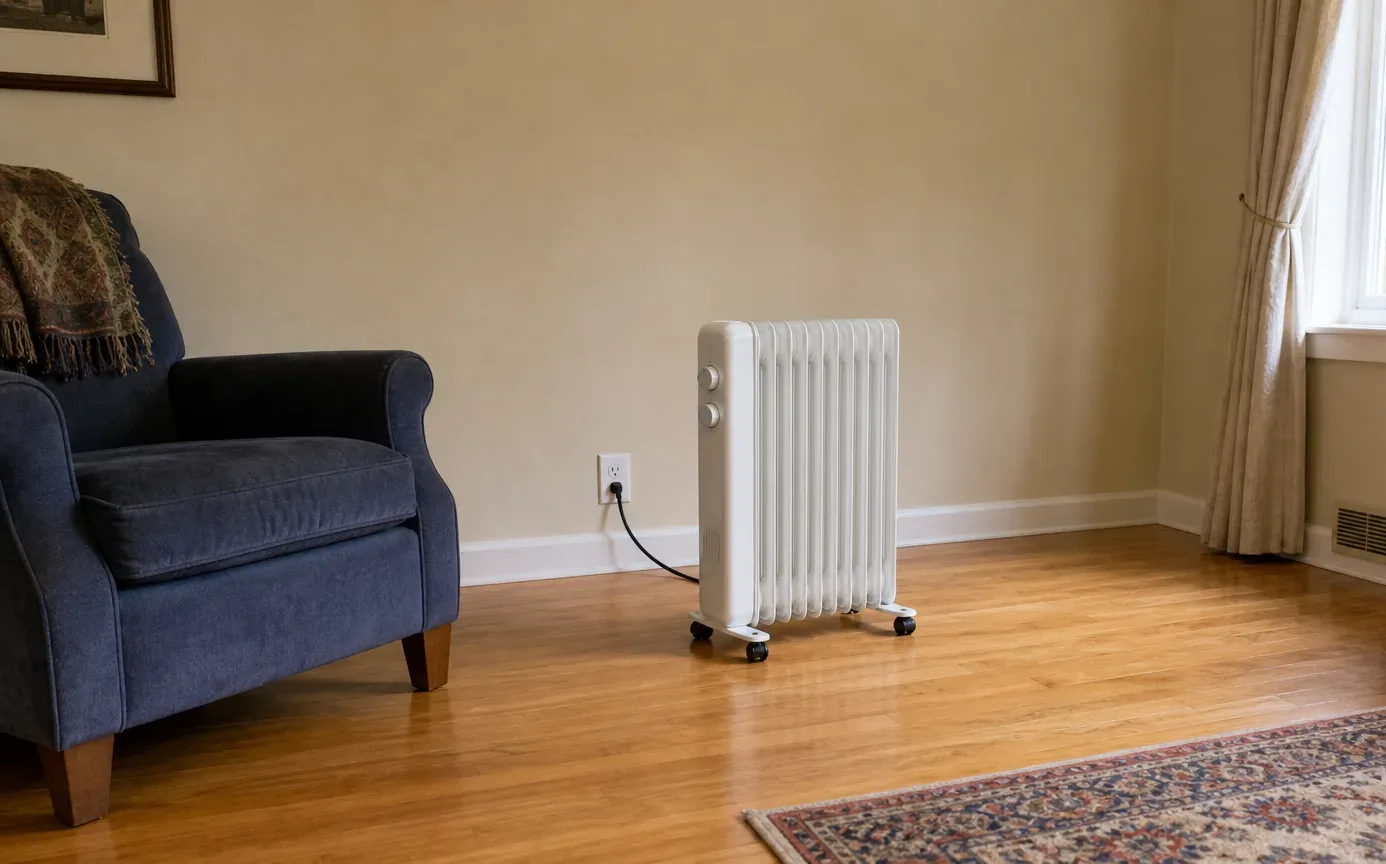
Heat one room, and do it safely. A portable electric heater can carry a household through a few cold nights if it is used the way the U.S. Consumer Product Safety Commission (CPSC) says: at least three feet from drapes, furniture, bedding and anything else that can burn, plugged directly into a wall outlet rather than an extension cord or power strip, and turned off when you go to sleep. Buy one that shuts itself off if it tips over or overheats. The care matters: in the National Fire Protection Association’s (NFPA) latest breakdown, space heaters were involved in about a third of home heating fires but nearly nine of every ten heating fire deaths.
Never heat with the oven, a grill or a generator. The Centers for Disease Control and Prevention (CDC) is blunt about it: never heat your house with a gas oven, never burn charcoal or use a camp stove indoors, and never run a generator inside your home or garage, even with the doors and windows open. Infants and older adults are more likely to get sick from carbon monoxide, so put battery-operated or battery backup CO alarms near every sleeping area, and test them if nobody has since last winter.
Keep older adults warm enough. The National Institute on Aging tells older adults to set the heat to at least 68°F, because even a mildly cool home at 60 to 65°F can lead to hypothermia in an older person. If you can only heat one room, close the door and live in it.
In a heat wave, know when a fan stops helping. The CDC says to use fans only while indoor temperatures are below 90°F, because above that a fan can raise your body temperature. Dial 211 or call your local health department to find a cooling center, and check on family, friends and neighbors, especially anyone who lives alone or has a chronic medical problem. If your block runs hot every summer, our guide to cooling a house in an urban heat island covers cheaper ways to take some of the load off.
Keep the utilities on. Most states limit shutoffs in dangerous weather. The LIHEAP Clearinghouse counts 42 states with cold-weather protections, 21 with hot-weather protections and 44 with protections for vulnerable households, such as a doctor’s certificate that someone’s health depends on service. These rules delay a shutoff rather than erase the debt, and they generally cover regulated utilities, not every energy provider, so heating oil and propane dealers may not be bound by them. A shutoff notice also counts as an emergency in many LIHEAP programs, Pennsylvania’s and Wyoming’s among them, so mention it when you apply.
How to Spot a “Free Furnace” Scam
Real help has a recognizable shape. You apply, usually through a local agency, the agency checks your income, and a contractor it works with does the job. Scammers borrow the programs’ vocabulary and skip the shape. The federal LIHEAP office says plainly that the program does not give grants directly to individuals and does not charge a fee for a benefit, and it asks anyone offered a LIHEAP “grant” or asked for a fee to call the HHS fraud hotline at 1-800-447-8477. The Federal Trade Commission (FTC) adds that government agencies will not contact you by phone, text, social media or email about a grant you did not apply for.
Hang up, or keep the door shut, when you hear any of these:
- An unexpected call, text or knock offering a free or government-paid furnace, air conditioner or heat pump. Idaho’s attorney general warned in 2025 about door-to-door salespeople falsely claiming to run a government inspection and free energy audit program as an excuse to get inside homes.
- A fee to apply, to process paperwork or to hold your place in line.
- A request for your Social Security, bank or card numbers from someone who contacted you first. You will give an agency those details on an application you start yourself, not to a caller who found you.
- A threat to shut off your gas or power unless you pay right now. The FTC calls an unexpected shutoff threat that demands payment a scam, and warns never to pay anyone who insists on a wire transfer, cryptocurrency, a payment app or gift cards.
- Pressure to sign financing at the kitchen table. “Free” equipment that turns out to come with a loan, a lease or a lien is the oldest version of the trick. The Consumer Financial Protection Bureau (CFPB) found that PACE loans, which are repaid through the property tax bill, are typically sold door to door, and that they raised borrowers’ property taxes by about $2,700 a year, an 88 percent increase. A tax bill you cannot pay can cost you the house.
If you are not sure, call 211 or your state’s energy assistance office on a number you looked up yourself. And before any company you did not call takes your furnace apart, check its license and insurance.
The Bottom Line
Here is how the main programs compare:
| Program | Who it serves | Fixes or replaces equipment? | How fast |
|---|---|---|---|
| LIHEAP crisis assistance | Up to 150% of poverty or 60% of state median income, as each state sets it | In many states, mostly heating | Some help within 48 hours, or 18 if life-threatening |
| Weatherization (WAP) | Up to 200% of poverty, or SSI or TANF households | Must fix or replace unsafe or broken heating; AC only for at-risk households | Waiting lists, sometimes for years |
| Utility income-qualified programs | Set by each state | Often, especially furnaces | Usually not built for emergencies |
| USDA Section 504 | Rural homeowners; grants at very low income and 62 or older | Repairs that remove hazards, including no heat | No-heat cases go first when money is short |
| Aging agencies, city programs, nonprofits | Mostly older or low-income homeowners | Often, on local terms | Depends on local funding |
A dead furnace or air conditioner is a money problem with a safety clock attached, and the programs meant for it run on different clocks. Call LIHEAP first, because federal law requires some help within hours, and apply to Weatherization and your utility’s income-qualified program the same week, because they are slower but can replace the equipment outright. Keep everyone safe and warm in the meantime, and treat any call or knock offering a free system as a scam until you have checked it yourself.
Further reading (sources)
- ABC7 News on a Bay Point widow’s free furnace and air conditioner during the October heat wave
- U.S. Energy Information Administration with its 2024 table of household energy insecurity
- HHS Administration for Children and Families on what LIHEAP pays for, its referral line and its fraud warning
- ACF’s Office of Community Services for the October 2026 release of LIHEAP block grant money
- ACF’s LIHEAP performance data with the fiscal 2025 national profile of households served
- 42 U.S.C. 8623, setting LIHEAP’s 48-hour and 18-hour crisis deadlines
- Legal Information Institute with LIHEAP’s income limits and categorical eligibility, 42 U.S.C. 8624
- LIHEAP Clearinghouse on how states use LIHEAP money for furnace repair and replacement
- The LIHEAP Clearinghouse’s disconnection tables for state shutoff protections in cold and hot weather
- HHS Office of the Assistant Secretary for Planning and Evaluation with the 2026 federal poverty guidelines
- Iowa Department of Health and Human Services on this season’s LIHEAP dates and income limits
- Wyoming Department of Family Services for the documents an energy assistance application asks for
- Pennsylvania Department of Human Services on LIHEAP crisis benefits for broken heating equipment
- New York State with the heating equipment repair and replacement benefit
- Ohio Consumers’ Counsel on the summer crisis program’s help with air conditioning
- White House Office of Management and Budget for the 2027 budget’s proposal to end LIHEAP
- GovInfo with the 2026 appropriations law that funded LIHEAP
- U.S. Department of Energy on weatherization health and safety rules for heating, cooling and ventilation
- DOE’s Weatherization Assistance Program for how to apply, the waiting list and the rules for renters
- 10 CFR 440.22, setting weatherization income eligibility
- 10 CFR 440.16, listing who gets weatherization priority
- 42 U.S.C. 6865 on the 15-year limit on weatherizing the same home again
- Pennsylvania Department of the Auditor General with its audit of weatherization waiting lists
- North Carolina Department of Environmental Quality on its weatherization program’s 2025 results
- North Carolina’s State Energy Office for the May 2026 changes to the federal heat pump rebate
- Legal Information Institute with the rebate’s income tiers and $8,000 heat pump cap, 42 U.S.C. 18795a
- National Association of State Energy Officials on which states have launched home energy rebates
- California Public Utilities Commission for Energy Savings Assistance eligibility and services
- The CPUC’s statewide ESA policy manual on furnace repair or replacement and where AC is offered
- NYSERDA with EmPower+ eligibility and project caps
- Pennsylvania Bulletin on the final LIURP rule covering income limits and furnace work
- Administration for Community Living for Older Americans Act repair help and the Eldercare Locator
- USDA Rural Development on Section 504 repair loans and grants
- USDA’s direct housing field handbook with the priority given to applicants without heat
- 24 CFR 570.202, allowing Community Development Block Grant money to replace heating and cooling equipment
- Rebuilding Together on who its repair programs serve
- Habitat for Humanity for home repair with low-income older adults
- U.S. Consumer Product Safety Commission on space heater, furnace and generator safety this winter
- National Fire Protection Association with its report on home heating fires
- Centers for Disease Control and Prevention on preventing carbon monoxide poisoning at home
- CDC’s heat and health program for when fans stop helping and how to find a cooling center
- National Institute on Aging with cold weather safety for older adults
- Federal Trade Commission on government grant scams that promise free money
- FTC consumer advice for scammers who pose as your utility company
- Idaho Office of the Attorney General with its alert on door-to-door sellers posing as a government energy audit
- Consumer Financial Protection Bureau on PACE loans sold door to door and what they do to property taxes