Building Codes Are Quietly Choosing Your Next HVAC System: Heat-Pump-First Rules and What They Mean at Replacement Time
Published on October 5, 2026
The air conditioner quits at the end of a hot September, and the contractor who comes out to quote a replacement says something you did not expect: it has to be a heat pump now, because that is the code. Maybe it is. In a handful of California cities, that is exactly what the code says. In Oregon, where a new heat pump rule took effect on October 1 and made the news, it is not, because that rule is written for houses that have not been built yet. And in the San Francisco Bay Area, where a regional rule will eventually stop new gas furnaces from being installed, a furnace that works can keep working until it dies.
Heat pumps are being written into building codes, air district rules and city ordinances, and news coverage tends to lump them together as “mandates” or “gas bans.” They are not one thing. Each rule fires on a specific trigger: building a house, replacing equipment, remodeling past a size threshold, or selling. Whether your next system gets chosen for you depends on which of those your project sets off. This guide sorts the current rules by trigger so you can work out where your own house stands before a contractor tells you. It sticks to codes and permits; which heat pump to buy, if you end up needing one, is the job of our heat pump buying guide.
Every Rule Has a Trigger
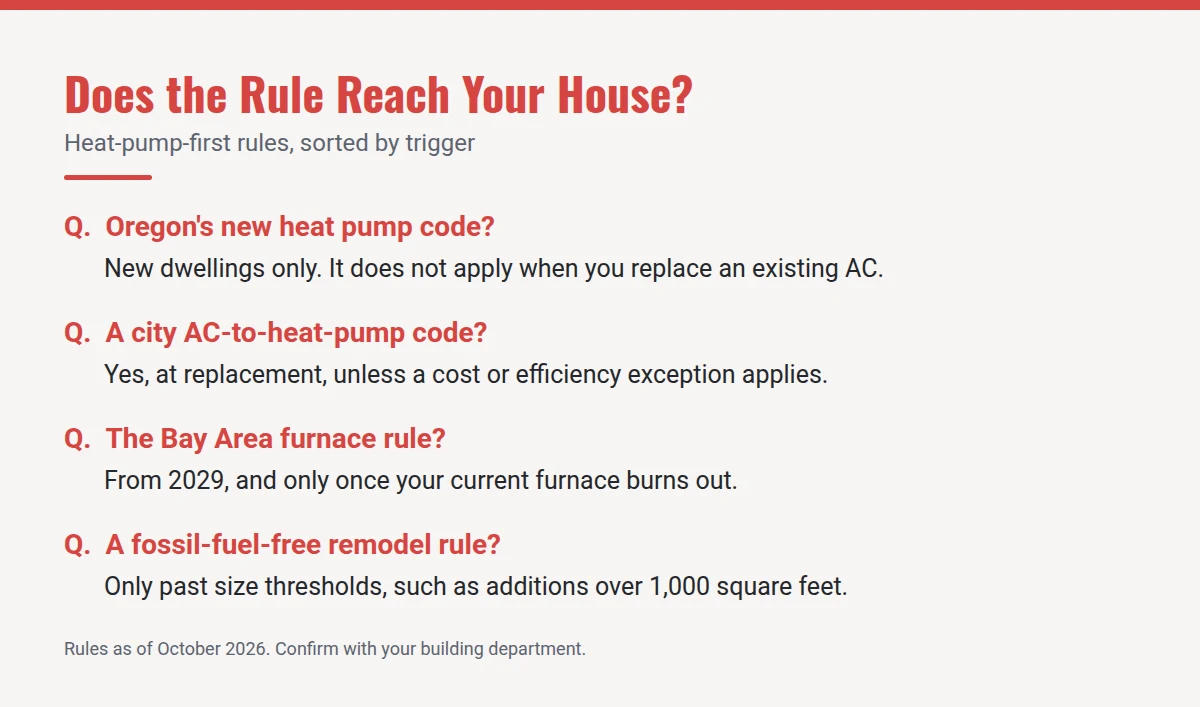
Building codes are not retroactive. A code governs the work you are about to do and leaves the rest of the house alone. Oregon’s Building Codes Division says so plainly in its summary of the state’s new heat pump section: the requirement “is for new dwellings only and does not apply to the replacement (alteration) of an existing cooling system.” Keep that sentence in mind, because it is the key to reading every rule below.
Four triggers cover nearly everything being adopted right now:
- New construction. Rules for houses that do not exist yet. Most heat-pump-first rules live here.
- Replacing equipment. Rules attached to the permit for a swap. They are still rare, but they are the ones that reach a house you already own.
- Major renovation. Rules that switch on once a remodel or addition passes a size threshold.
- Sale. Rules attached to a change of ownership rather than to any construction at all.
New Homes: Where Most Heat Pump Rules Live
Oregon’s rule is the clearest example of how these provisions are actually built. In February 2026 the state’s Residential and Manufactured Structures Board voted 7 to 1 to adopt new energy standards for homes. The heat pump section, N1105.8 of the 2026 Oregon Residential Specialty Code, says that in new dwellings “where split-system air-conditioning is installed,” the outdoor unit and indoor coil must have heat pump operation that provides both heating and cooling, and the heat pump must be the first stage of heating.
Read the state’s own summary and the rule turns out to be narrower than “Oregon requires heat pumps.” It does not dictate the heating fuel: a furnace burning natural gas or propane, or an electric one, still carries the house when the heat pump cannot keep up, the hybrid arrangement our piece on making your next air conditioner a heat pump walks through. It does not require a bigger system, because the heat pump is sized for the cooling load. A new home built without split-system air conditioning is not touched at all. And a builder who would rather install a cooling-only unit has five alternative compliance routes, from adding two extra energy measures elsewhere in the house to modeling the energy performance of the whole building. The code took effect on October 1, 2026, with a six-month phase-in, and becomes mandatory on April 1, 2027.
New York took the blunter route and banned the fuel. Its All-Electric Buildings Act requires most new buildings of seven stories or fewer, single-family homes included, to use electric heat and appliances, and extends to nearly all new construction on January 1, 2029. The state agreed to pause the law while a group of gas and HVAC companies, trade associations and unions challenged it in federal court. The Second Circuit upheld it on June 30, 2026, and the stay is set to lift on October 28 unless the challengers appeal to the U.S. Supreme Court. Even then, the law does not reach existing buildings. Owners can keep using, repairing and replacing gas equipment, and can renovate or build additions, without it applying.
Washington shows how unsettled this can get. The state’s 2024 legislature steered the building code toward discouraging gas heat in new buildings. Voters then approved Initiative 2066, which, among other things, barred the State Building Code Council from adopting code provisions that discourage gas use. On September 17, 2026, a six-justice majority of the state Supreme Court threw the initiative out for violating the state constitution’s single-subject rule.
If you own an existing house, none of these three rules changes your next replacement. They matter if you are building, or buying a newly built home, because the builder made the choice before you arrived.
Why the Rules Say “Heat Pump First” Instead of “No Gas”
If heat pumps are the goal, why would Oregon write a rule with five ways around it? The answer runs through a federal law from 1975. The Energy Policy and Conservation Act is the law behind the national efficiency standards for furnaces, air conditioners and water heaters, and it limits how far states and cities can go in regulating the energy use of those appliances. Berkeley found the edge of that limit. Its ban on gas piping in new buildings was struck down by the Ninth Circuit Court of Appeals, in an opinion that begins: “By completely prohibiting the installation of natural gas piping within newly constructed buildings, the City of Berkeley has waded into a domain preempted by Congress.”
The Second Circuit read the same federal law the other way in the New York case, holding that limiting “the type of energy an appliance consumes” is different from limiting “the amount of energy it consumes.” With two federal appeals courts now split, the question could reach the Supreme Court. Rules built like Oregon’s step around that fight. The heat pump is the default path through the code, the alternatives stay open, and a builder can still choose gas by making up the energy savings somewhere else.
Replacement Time: The Rules That Reach Existing Homes
This is the trigger most homeowners care about, and it is where rules are still scarce. Two kinds exist today.
City AC-to-heat-pump codes. A group of Bay Area cities, among them Menlo Park, Sunnyvale, Mountain View and Palo Alto, adopted local amendments in 2025 that require a ducted heat pump in place of a conventional central air conditioner when the old unit burns out or a new system is installed. Menlo Park’s version shows how these work. When a permit covers replacing or upgrading an air conditioning condensing unit, a heat pump has to go in instead, with two exceptions. If the price difference between the air conditioner and the heat pump exceeds 20 percent of the cost of construction, the heat pump is not required, and you document that on a hardship form. Or you may keep a cooling-only unit if the system meets a list of efficiency requirements: verified airflow and refrigerant charge, duct leakage no higher than 5 percent of the system’s airflow, R-8 insulation on any new ducts in unconditioned space, and a thermostat that meets the state energy code.
That second exception is rarely the easy road. Five percent is a demanding target for older ductwork, and reaching it usually means sealing and retesting, the work our ductwork guide explains. Note also what the requirement is written around: the outdoor unit you are replacing, not the furnace.
Air district appliance rules. In the Bay Area, the regional air district regulates the appliance itself, through its emissions rather than through the building code. Rules amended in 2023 set zero nitrogen oxide standards for residential water heaters starting in 2027 and for furnaces starting in 2029. Burning gas produces nitrogen oxides, so in practice a compliant replacement is electric, and for most homes that means a heat pump. The district is explicit that these requirements “apply only upon burn out of one’s current equipment.” A furnace still working in 2029 can keep running.
The dates move, too. In July 2026 the district proposed pushing the water heater deadline back a year, to January 2028, and exempting low-income owners and homes where an undersized electrical panel or a lack of space makes the switch especially hard. Its board is scheduled to take up the change on November 4, 2026, and the next phase of the district’s implementation review turns to the 2029 furnace rule.
Outside places like these, most building departments still require a mechanical permit for a replacement, and the permit is where any local requirement gets enforced. Our guide to installation day covers what the inspector checks and why the contractor, not you, should pull it.
Big Remodels and Additions: The Gut-Renovation Trigger
Between a new house and a straight swap sits a gray zone: the project big enough that the code starts treating part of the house as new. Massachusetts draws that line most precisely. A 2022 state law lets up to ten cities and towns require new buildings and “major renovation” projects to be fossil fuel free, enforced by withholding or conditioning building permits. Arlington, Newton and Northampton are among the communities the state’s Department of Energy Resources has accepted into the program.
The state regulation defines a major renovation of a house in square feet: additions of more than 1,000 square feet and additions larger than the existing home’s conditioned floor area, alterations that rework more than half of the existing floor area once that work tops 1,000 square feet, and changes of use above 1,000 square feet. Each town writes its own bylaw within that frame, so read the local version. A furnace swap does not come close. Gutting most of the house, or adding a second story, might.
Some Bay Area cities use the remodel trigger more gently, attaching electric-readiness requirements (preparatory wiring and panel work for future electric equipment) to additions and alterations of existing buildings. Contrast New York, where even a major renovation of an existing building falls outside the all-electric law.
Selling the House: Berkeley Made the Sale a Trigger
Berkeley has added a trigger that has nothing to do with construction. Since January 1, 2026, anyone selling a single-family home or duplex in the city must get a Home Energy Score and then either complete upgrades worth at least six credits or defer them to the buyer, who gets two years to finish. Deferring means a $5,000 deposit with the city, $2,500 each from seller and buyer. A heat pump HVAC system earns all six credits by itself, and so does a heat pump water heater. Triplexes and fourplexes follow on January 1, 2028. Homes that are already all-electric with a capped gas line are exempt, as are buyers enrolled in an income-qualified first-time buyer program.
If you are selling there, the score that starts the process is the subject of our guide to what a Home Energy Score means for HVAC.
How to Find Out Whether Your Own Swap Is Affected
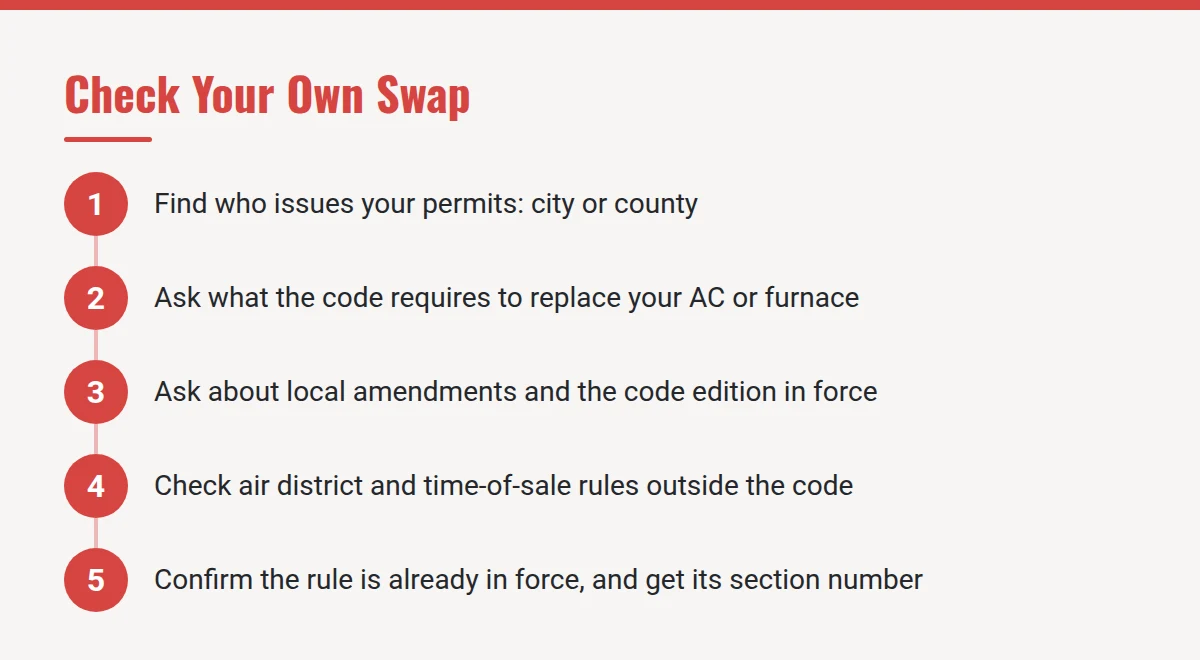
You can usually settle the question with one phone call, as long as you ask the right office the right question.
Find out who issues your permits. Usually that is the city building department, or the county if you live in an unincorporated area. Local amendments like the Bay Area AC-to-heat-pump codes live at this level and will not show up in a statewide summary.
Ask about your project, not about heat pumps in general. “Do I have to get a heat pump?” invites an answer about new construction. Ask instead: “What does your code require when I replace a central air conditioner, or a furnace, in an existing single-family house, and are there local amendments?” Ask which code edition they enforce and whether a new one is about to take effect.
Check the rules that sit outside the building code. In California, air districts set appliance emission rules on their own schedule. Some cities, like Berkeley, attach requirements to a sale.
Check the dates. Oregon’s new code has a six-month phase-in, New York’s law has been on hold for most of a year, and the Bay Area’s water heater deadline is under review. A rule that has been announced is not necessarily a rule in force.
If you plan to do any of the work yourself, the permit rules shift again, because some cities issue refrigeration permits only to licensed contractors. Our guide to DIY mini-split kits covers who may pull the permit where.
When a Contractor Says “It’s Code Now”
Treat it as a claim to check, not an accusation. Sometimes it is simply true: in a city with an AC-to-heat-pump code, a like-for-like air conditioner may not pass permitting unless it qualifies for an exception. Sometimes it is half true, a new-construction rule described as if it covered your house. And sometimes it is early. A furnace rule that starts in 2029 is not a reason to tear out a working furnace in 2026, because the Bay Area rule applies only once the old one burns out.

Ask for the section number, in writing if you can. A real requirement has one, and a contractor who works under it will know where to find it. Then confirm it with the building department. If the requirement is real, ask about the exceptions in the same conversation; Menlo Park’s cost exception, for one, applies when the price difference between the two units exceeds 20 percent of the construction cost. Our guide to reading a diagnosis and sanity-checking a quote covers the broader habit of verifying what you are told before you sign.
The Bottom Line
Most heat-pump-first rules are written for houses that do not exist yet. The ones that reach an existing home are local, specific and usually come with exceptions, and each fires on a trigger: a replacement permit, a burnout after a deadline, a renovation past a size threshold, or a sale. Find out which of those your jurisdiction has before your system fails, while there is time to read the rule and price both paths, rather than hearing it first from the person writing the quote.
Further reading (sources)
- Oregon Building Codes Division on what the new first-stage heat pump provision requires and what it leaves alone
- Oregon’s residential code adoption page, with the 2026 code’s effective and mandatory dates
- Canary Media for the board vote that pushed Oregon’s new homes toward heat pumps
- Carter Ledyard & Milburn on where New York’s all-electric buildings law stands after the Second Circuit ruling
- Beveridge & Diamond with the Washington Supreme Court decision striking down Initiative 2066
- U.S. Court of Appeals for the Ninth Circuit, the amended opinion in the Berkeley gas piping case
- SPUR on Bay Area cities adopting AC-to-heat-pump and electric-readiness codes
- City of Menlo Park for its heat pump requirement at AC replacement and the two exceptions
- Bay Area Air Quality Management District on the zero-NOx furnace and water heater rules and when they apply
- The air district’s July 2026 announcement of the proposed water heater delay and exemptions
- Massachusetts Department of Energy Resources with the regulation that defines a major renovation
- Mass.gov’s program page listing the communities accepted into the fossil-fuel-free demonstration
- City of Berkeley on time-of-sale upgrade rules for single-family homes and duplexes