Cold-Climate Heat Pumps in 2026: What Actually Works Below Freezing
Published on August 31, 2026
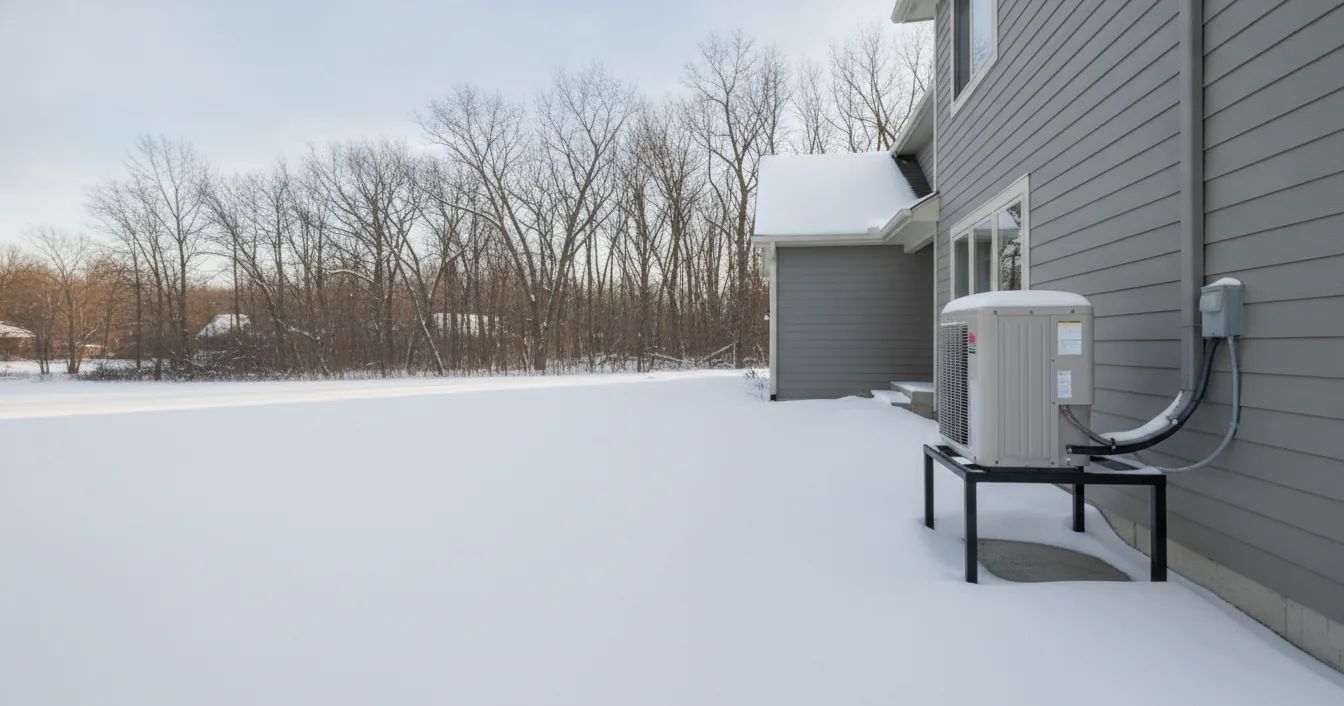
“Heat pumps don’t work when it gets really cold” is the most durable piece of HVAC misinformation in North America, and like most durable myths it used to be true. Twenty years ago a standard air-source unit lost so much capacity below freezing that electric strip heat carried the house through January, and the power bill made the point loudly. That is not the equipment being sold now. Inverter-driven cold-climate models hold their full rated heating capacity at 5 degrees Fahrenheit and keep producing useful heat into negative territory. What has not changed is that a cold-climate install can still go badly wrong, and the failure modes are specific: the wrong model, the wrong sizing temperature, the wrong backup heat strategy, or ductwork that cannot move the air. Here is the engineering answer for homeowners in zones 5 through 7.
Why the Old Answer Stopped Being Right
A heat pump does not create heat, it moves heat, which is how it delivers two to four times more energy than it consumes while a gas furnace can never exceed the fuel it burns. The catch in winter is that the outdoor coil has to pull that heat from cold air, and the colder the air, the harder the compressor works per BTU. Older single-stage units handled this by falling off a cliff: a nominal 3-ton system might deliver barely half its rated capacity at 10 degrees, exactly when the house needed the most.
Inverter-driven compressors changed the shape of that curve. Instead of one fixed speed, the compressor modulates and can overspeed in cold weather, trading efficiency for capacity precisely when capacity is what you need. Add vapor injection, larger outdoor coils, and better low-temperature refrigerant control, and you get a machine still delivering rated output at 5 degrees. Research on cold-region air-source performance confirms both halves of the story: the low-temperature penalty is real physics, and engineering the air side is what claws the performance back. The market has already voted, with more than 5 million heat pumps sold in the United States in 2024, outselling gas furnaces for the first time and much of that growth in northern states.
The Two Specs That Separate Real Cold-Climate Units From Marketing
Every manufacturer now has a product line with “cold” or “hyper” in the name. Two independent benchmarks tell you whether the badge means anything.
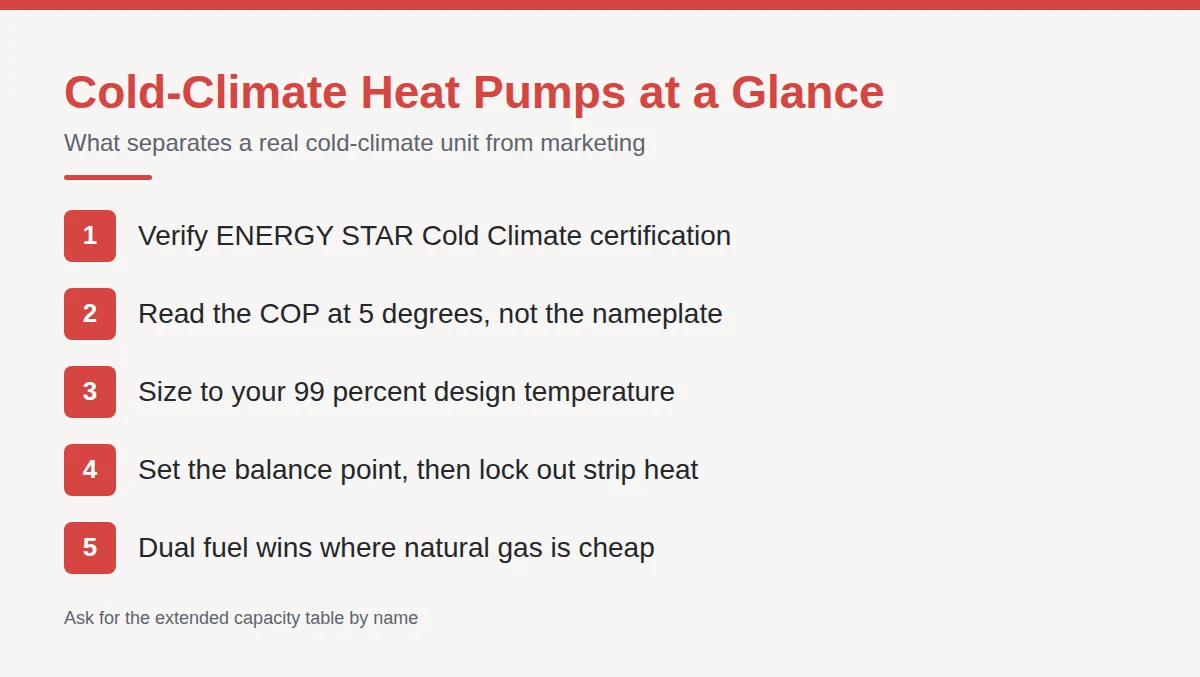
The DOE Cold Climate Heat Pump Technology Challenge. The Department of Energy launched this in 2021 with a deliberately hard target: hold 100 percent of rated heating capacity at 5 degrees Fahrenheit, hit a coefficient of performance of at least 2.4 at that temperature, and keep operating down to 15 below. Prototypes from Lennox, Carrier, Trane, Daikin, Rheem, Bosch, Johnson Controls, and Midea went through lab testing at Oak Ridge National Laboratory, then field trials in genuinely cold places. Several are shipping products today.
ENERGY STAR Cold Climate certification. This is the one to check yourself, because it is a public database. Cold Climate is a separate tier within the ENERGY STAR air-source heat pump specification, and the number defining it is COP at 5 degrees Fahrenheit, with a floor of 1.75 in the current spec. A much lower bar than the DOE Challenge, but a published and independently tested one. Look up the exact model number in the ENERGY STAR product finder before you sign, because manufacturers sell cold-climate and standard variants under nearly identical names.
Neither badge replaces the document that actually matters: the manufacturer’s extended capacity table, listing heating output and input watts at 47, 17, 5, and often minus 5 degrees. Ask for it by name. A salesperson who cannot produce it for the model they are quoting is not the person to buy a five-figure system from. Our heat pump buying guide for 2026 covers how SEER2 and HSPF2 fit around these low-temperature numbers.
Size to Your Design Temperature, Not the Nameplate
This is where most cold-climate projects are won or lost. A Manual J load calculation tells you how many BTUs your house loses at your local 99 percent design temperature, the temperature your area stays above 99 percent of the winter. That is not the coldest night on record, and it is not what the nameplate assumes. Minneapolis sits around 12 below, Burlington near 7 below, Boston around 9 above, Denver in the low single digits.
The correct process: calculate the load at your design temperature, read capacity at that same temperature off the extended table, then decide how much of the gap backup heat covers. The balance point is the outdoor temperature where output exactly equals the load. Above it the heat pump carries the house alone; below it, something else helps.

Where you set that balance point is a judgment call, because it costs money in both directions. Push it down to your design temperature and the heat pump covers the whole season, but you have bought a larger machine that short-cycles through the mild months. Set it around 5 to 15 degrees and a properly sized unit still delivers roughly 90 to 95 percent of annual heating hours on the compressor, which in most zone 5 and 6 houses is the better buy. What you must not do is let anyone size the system off square footage or off the old furnace’s rating, which was almost certainly oversized already.
One more thing belongs in the same conversation. Cold-climate heat pumps deliver supply air around 95 to 110 degrees, not the 130 to 140 a furnace produces, so they must move considerably more air for the same heat. Undersized ductwork is the most common install defect in the trade and it quietly caps the capacity of a perfectly good machine, so ask what your total external static pressure measures and read our ductwork design and sizing guide before approving a quote.
Defrost Cycles and What They Actually Cost
When the outdoor coil runs below freezing in humid air, water vapor freezes onto the fins and blocks airflow. Every air-source heat pump handles this by briefly reversing into cooling mode, sending hot refrigerant out to melt the ice, then switching back. That is a defrost cycle, and it is normal. Expect one every 30 to 90 minutes in the conditions that produce the most frost, which is not the coldest weather but the damp band roughly between 25 and 40 degrees. Each cycle runs a few minutes, and the steam plume afterward is exactly what should happen. The indoor coil goes cold during defrost, so most systems energize a little strip heat to keep the supply air from feeling like a draft.
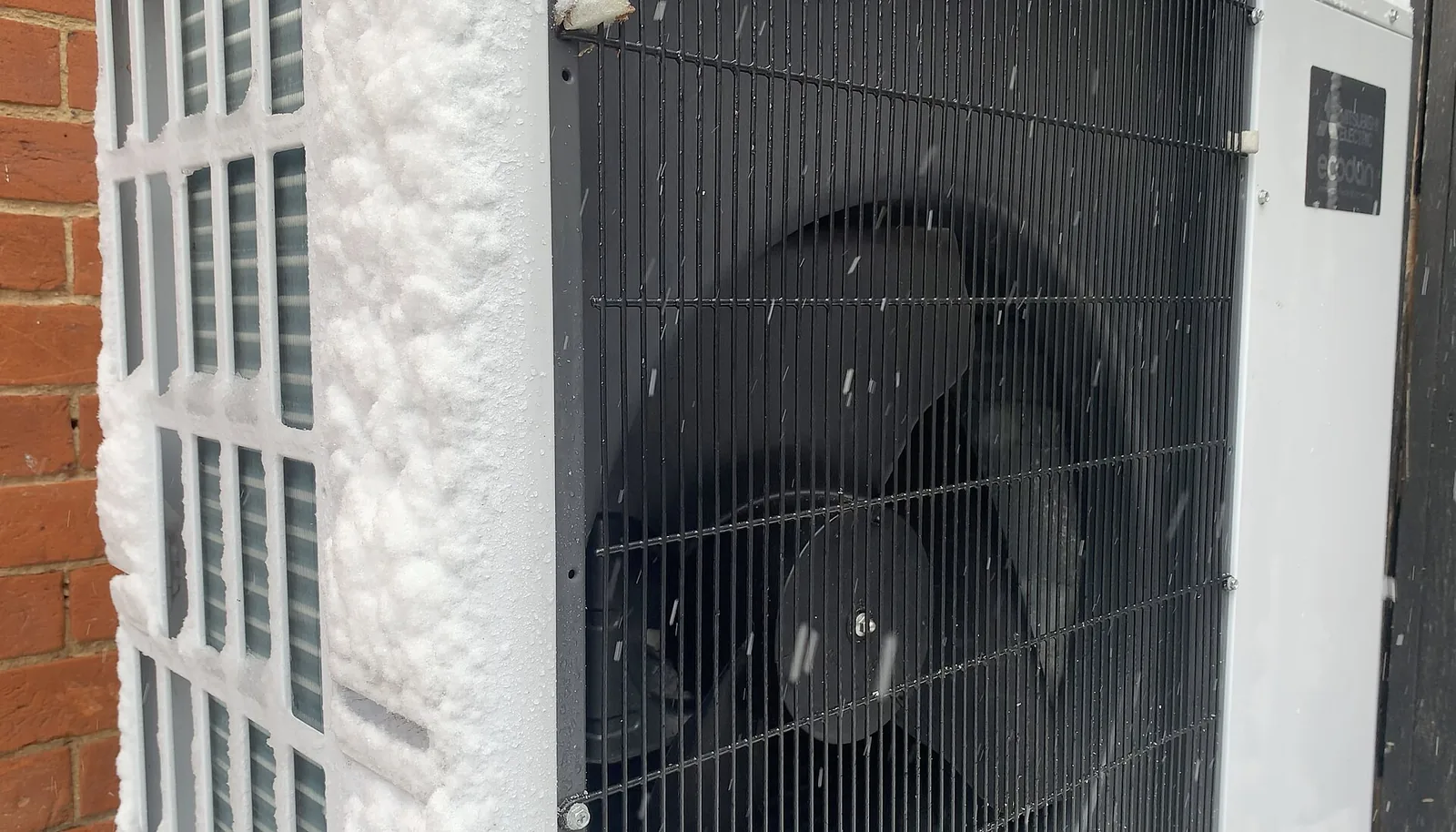
The efficiency cost is real but modest: a few percent of seasonal heating in dry climates, up to roughly 10 to 15 percent where winters are wet and hover near freezing. Coastal New England pays more of this tax than Colorado does. Two things make it worse, and both are avoidable. Older units use timed defrost, running the cycle on a schedule whether or not there is frost; demand defrost uses coil sensors and is worth specifying. And the outdoor unit needs a stand keeping it 12 to 24 inches above your typical snow depth, clear of roof drip lines and gutter discharge. Ice in the base pan, as opposed to frost on the coil, means the defrost or drainage system is not working, and that is a service call.
Backup Heat: Electric Strips or Dual Fuel
Every cold-climate system needs a plan for the hours below the balance point. There are two, and fuel prices decide which.
Electric resistance backup is a bank of elements in the air handler, typically 5 to 20 kW. Cheap to install, completely reliable, and running at a COP of exactly 1.0, which makes it the most expensive heat in the house. Two rules keep it from wrecking your bills: size it to the gap between your load and the heat pump’s output at design temperature rather than to the whole load, and insist on an outdoor lockout so the strips cannot energize above the balance point. Everyone in the house should also know that “emergency heat” locks the compressor out and runs on strips alone, which is a setting for a broken compressor, not a cold Tuesday. Large strip banks carry a hidden electrical cost too, since 15 kW draws over 60 amps at 240 volts and can force a panel upgrade.
Dual fuel pairs the heat pump with your existing gas furnace and switches between them at a set outdoor temperature. It is often cheaper up front than full replacement because you can buy a smaller heat pump, and it is the strongest play in cold regions with inexpensive natural gas. The switchover setting should be the economic balance point, the temperature where gas becomes cheaper per delivered BTU, and you can calculate it. At 16 cents per kWh and a COP of 2.5, heat pump heat costs roughly $19 per million BTU; a 95 percent AFUE furnace burning $1.40 gas costs about $15. Those particular rates favor gas once the COP drops below about 3.0. Change either price and the crossover moves, so the setting deserves a calculation against your own rates instead of whatever the installer defaulted it to. Where fuel oil or propane is the incumbent the math tilts hard the other way, and the heat pump usually wins down to the bottom of its range.
Regional Notes
Upper Midwest. Design temperatures from roughly 10 below to 25 below, plus cheap natural gas. Dual fuel is frequently the right answer, and the dry cold means less defrost penalty than the raw numbers suggest.
New England. Design temperatures around 10 above to 5 below, expensive oil and propane, and aggressive utility programs. Whole-home electrification with modest electric backup is a proven configuration here. Wet winters make defrost matter more, so specify demand defrost.
Mountain West. Big daily swings and very dry air that nearly eliminates frost, but thinner air carries less heat: capacity falls roughly 3 percent per 1,000 feet of elevation, so insist on an altitude-corrected load calculation.
Canada. Ottawa, Winnipeg, and points north sit well below anything the United States design tables cover, and provincial incentives are meaningful. Ground-source systems get more common the farther north you go, because a buried loop does not care what the air is doing. If your air-source options look marginal, our geothermal guide covers that alternative.
What It Costs, and What to Ask Before You Sign
The National Renewable Energy Laboratory puts installed costs for ducted systems at roughly $9,000 for minimum-efficiency equipment up to about $24,000 for high-efficiency cold-climate models. That premium buys the low-temperature capacity, and in a cold climate it is generally worth paying. Federal tax credits changed at the end of 2025, so verify what is currently available rather than trusting older guidance, and check state and utility programs. Our 2026 guide to HVAC rebates, credits, and scams tracks what is left.
Before you sign, ask for five things: the Manual J run at your actual 99 percent design temperature, the extended capacity table for the exact model quoted, the calculated balance point, the backup heat sizing and lockout setting, and the measured total external static pressure of your ducts. Industry estimates cited by home performance consultants put the share of installs with a significant measurable defect as high as 70 to 90 percent, which means the contractor matters more than the brand. When heating season ends, our spring switchover checklist covers the transition to cooling on the same equipment.
A cold-climate heat pump is not a leap of faith anymore. It is a well-instrumented piece of engineering with published performance at the temperatures that scare people. The only question left is whether the person installing it will read those numbers as carefully as you just did.
Further reading (sources)
- U.S. Department of Energy on the cold climate heat pump technology challenge and its target spec
- ENERGY STAR for how air-source heat pumps earn the cold climate designation
- Consumer Reports with lab testing of whole-house heat pumps across six temperatures
- The New York Times on what a homeowner needs to understand before buying a heat pump
- Computational Intelligence and Neuroscience covering why air-source performance deteriorates in cold regions and how heat storage helps