Canada's $2B National Heat Pump Rebate: Who Gets $10,000, Who Gets $2,000, and How to Use It When Your Furnace Dies
Published on October 27, 2026
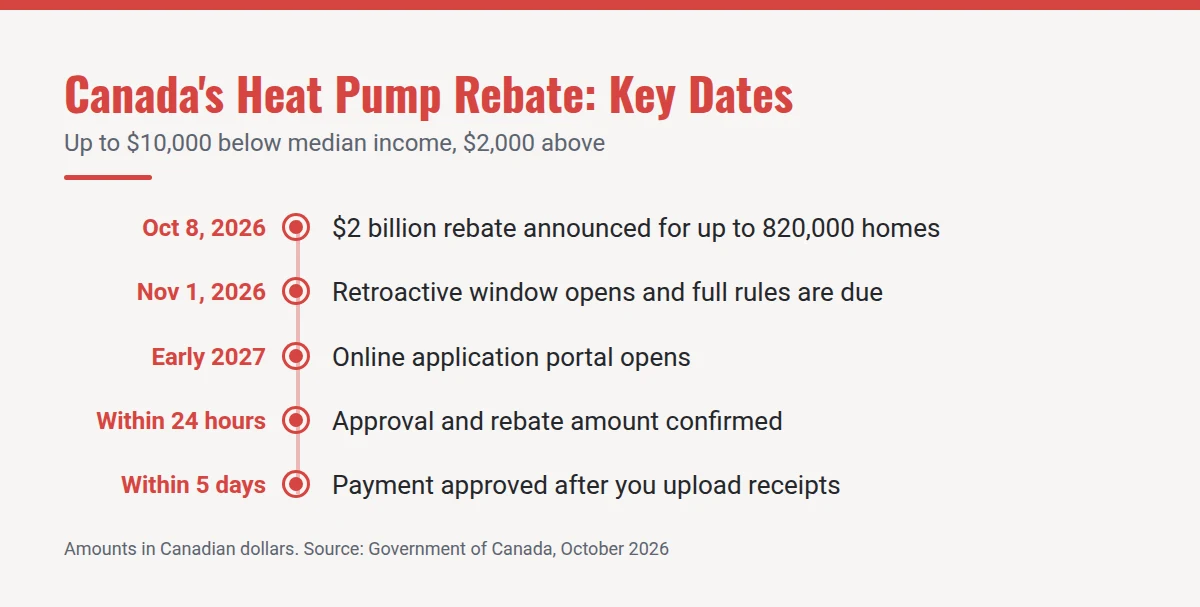
On October 8, in Sherbrooke, Quebec, Prime Minister Mark Carney announced a $2 billion National Heat Pump Rebate aimed at a moment almost nobody plans for. About one million Canadian homes replace their heating system every year, and more than 80 percent of the time it is because the old system broke down without warning. In the vast majority of those cases, federal officials said, people put back the same kind of system they had before, and a cold house leaves little time to weigh anything else. The new rebate is designed to fit inside that emergency: apply online, get an answer within 24 hours, and get paid by direct deposit after the install.
It is not open yet. The application portal launches in early 2027, but installs from November 1, 2026 onward count, and the government said its full rules would be posted that day. This guide covers what has been announced, who gets which amount, how to handle a furnace that quits before the portal opens, and what to settle before you sign a quote. All amounts are in Canadian dollars, and the details reflect what had been published by late October 2026, so check them against the final rules.
What the Federal Government Announced
The rebate has $2 billion over eight years to help up to 820,000 households switch to electric cold-climate air-source heat pumps. The government’s backgrounder and announcement set out the basics:
- Two amounts. Households below the median income can receive up to $10,000. Other eligible households receive $2,000.
- Any heating fuel. The closed Oil to Heat Pump Affordability (OHPA) grant only paid to replace oil heat. The new rebate also covers homes heated with natural gas, propane, diesel and electricity.
- Listed equipment only. The heat pump must be on an Eligible Products List that the government describes as more than 100,000 options suited to the Canadian climate.
- No energy audit, before or after the install.
- One rebate per person. A landlord who claims it for a rental property cannot also claim it for their own home.
- No breakdown required. You can apply when the old system fails or while it is nearing the end of its life. The government told CTV News a failure will not be a condition of eligibility.
- Stackable. Both amounts can be combined with existing provincial programs.
Some quick arithmetic shows the program’s reach. Spread over eight years, 820,000 rebates is about 102,500 a year, or roughly one for every ten heating systems Canadians replace annually. And $2 billion divided by 820,000 works out to about $2,440 per household, before a dollar goes to running the program. That average only holds if most rebates are the $2,000 kind. If more households than expected qualify for the larger amount, the same money stretches over fewer homes.
Who Gets $10,000 and Who Gets $2,000
The dividing line is your province’s median after-tax household income. Officials have said the cut-off will be calculated the same way it was for the OHPA grant, which took its last applications on July 31, 2026. Under that program, the test worked like this:
- On your tax return, take line 23600 (net income) and subtract line 43500 (total taxes payable).
- Do the same for a spouse or common-law partner, and add the two together.
- Compare the total with the limit for your province and household size, counting yourself, your partner and any dependants your income supports.
The oil program’s final table, revised for inflation, shows how much the line moves from place to place. A single person qualified with up to $48,760 in after-tax income in Alberta, but only up to $39,560 in Quebec. For a household of four, the limit was $139,150 in Alberta, $120,750 in Manitoba and $128,800 in both Quebec and Saskatchewan. Treat those as a rough guide, not a promise. That table covered only the places where the federal government delivered the program itself; in co-delivery provinces such as Ontario, British Columbia and Nova Scotia, the provincial program handled the income check. The new program’s own thresholds are part of the rules due on November 1.
Two more details are worth knowing. The larger amount is a ceiling (“up to $10,000”), while the smaller one is a flat $2,000. And according to CTV News, the 24-hour approval will confirm your rebate amount along with your eligibility, so you will know which tier you are in before you commit to anything.
How It Works When the Furnace Has Already Quit
One thing no rebate changes: if you smell gas or a carbon monoxide alarm goes off, get everyone out of the house and call 911 or your gas utility from outside. A furnace that a technician has shut off as unsafe stays off until it is repaired or replaced.
Once the portal is open, the government describes a short path:
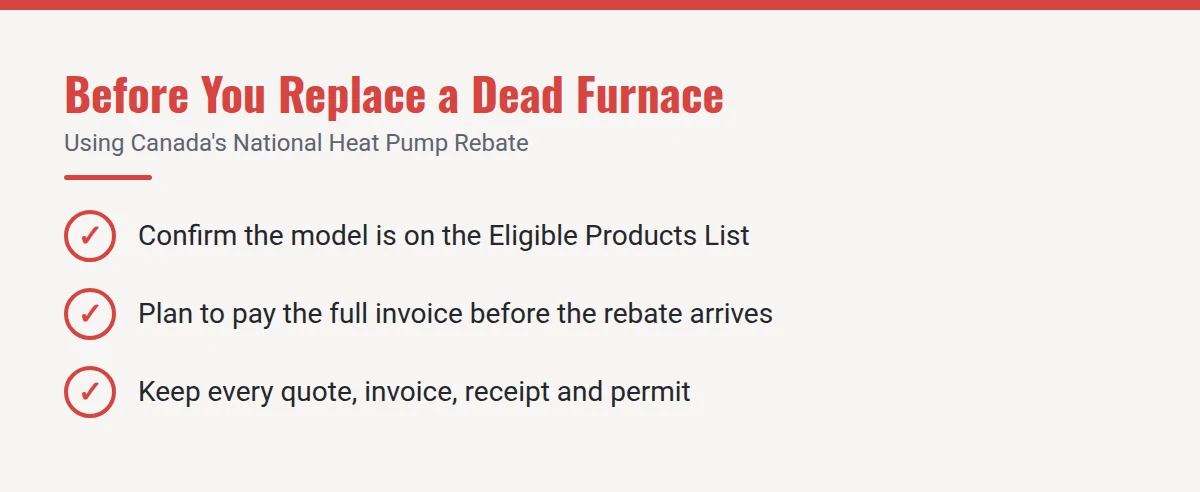
- Get a written quote that names the exact heat pump, with the model numbers of the outdoor and indoor units.
- Apply online. The form asks for basic personal information and the details of the heat pump you plan to buy.
- Get approval within 24 hours.
- Have it installed and pay for it. The government says a heat pump “can be installed as quickly as a furnace.”
- Upload your receipts. Payment is approved within five days and arrives by direct deposit.
Read step 4 twice. The rebate reimburses you; it does not pay the contractor. A household approved for $10,000 still has to cover the whole invoice and then wait for the deposit, and that is hardest on exactly the households the larger amount is meant for. If that describes you, check whether your province delivers the Canada Greener Homes Affordability Program (CGHAP). It provides no-cost retrofits, heat pumps included, to low-to-median-income homeowners and tenants, through provincial programs in British Columbia, Manitoba, Newfoundland and Labrador, Nova Scotia, Prince Edward Island and Quebec. You apply through your province, not to the federal government.
“As quickly as a furnace” also depends on your electrical panel. A house moving off gas, oil or propane is adding a large new electrical load, and a panel with no room for it can add time and cost to the job. Our guide to whether your panel can handle a heat pump shows how to check before the emergency, not during it.
If Your Furnace Dies Before the Portal Opens
The retroactive window turns a bad week into a manageable one, as long as you know where its edges are:
- Before November 1, 2026. The government’s wording covers households that “install eligible heat pumps starting on November 1, 2026.” An install finished before then falls outside it.
- From November 1 until launch. You can install now and apply once the program opens, if your household and your heat pump meet the criteria. There is no 24-hour approval in this stretch, so you carry the risk that something on the invoice does not match the rules.
- After launch. Apply first, then install.
If you install during the retroactive stretch, protect the claim:
- Read the final criteria and check the model before you sign. The rules and the list of eligible heat pumps were due on November 1. Ask the contractor to show you that the exact outdoor and indoor combination on your quote is listed.
- Keep every document. That means the dated quote, an invoice listing the model numbers and install date, proof of payment and the permit. The portal will ask for receipts, and nobody yet knows what else a retroactive claim will need.
- Apply yourself. The application is the homeowner’s, built on your personal information and your bank account for the deposit. Be wary of anyone who offers to file it for you, especially for a fee.
- Count the money as expected, not guaranteed, until the portal confirms it.

Should you wait? If your system works and is years from retirement, nothing here requires you to rush. If it is old, do the slow parts now: a room-by-room heat-loss calculation, a check of the electrical panel and quotes from contractors who install cold-climate heat pumps regularly. Then the 24-hour approval can do its job when the furnace finally quits.
And apply early once the portal opens. When the Parliamentary Budget Officer costed the enhanced oil grant in January 2024, the government had set aside $750 million, while the watchdog projected $797 million in costs on the uptake so far, and up to $2.7 billion if all of the roughly 244,000 eligible households applied. The same note found that applications to the earlier Greener Homes Grant peaked in its first week. A fixed budget facing open-ended demand gives nobody a reason to be late.
Will a Heat Pump Lower Your Bill? It Depends What You Heat With Now
The government’s headline saving, an average of more than $1,400 a year, is for households heating with oil, propane and electric resistance. Natural gas is not on that list, even though gas-heated homes can claim the rebate.
- Electric furnaces and baseboards. The clearest win. A senior official told reporters that heat pumps use less than half the electricity of electric furnaces or baseboards. If you have a ducted electric furnace, our guide to replacing an electric furnace with a heat pump covers reusing the ducts and the big circuit.
- Oil and propane. Usually a strong case. A general manager at an HVAC company in Sault Ste. Marie said many rural households on forced-air oil or propane have added central heat pumps, because those fuel prices are “astronomical these days.”
- Natural gas. It depends on your rates. Where gas is cheap relative to electricity, a heat pump can cost as much as gas to run, or more, and the rebate does not change the running cost. Before switching, run the break-even calculation in our guide to why a heat pump bill can go up with your own gas and electricity prices.
The rebate funds cold-climate models, and how cold yours needs to go depends on where you live. Contractors in northern Ontario told CBC News that the most efficient heat pumps sold in Canada handle temperatures down to around minus 35°C (minus 31°F), and both recommended keeping another heat source, whether gas, propane or electric, for the days at minus 40 and below. If you want to keep a gas or propane furnace as that backup, ask how the final rules treat the pairing before you sign. Our guide to cold-climate heat pumps explains how capacity holds up as the temperature drops and how to size the backup.
Choose the installer with that in mind. Martin Luymes of the Heating, Refrigeration and Air Conditioning Institute of Canada told CBC News that some contractors still believe the latest heat pumps cannot handle the cold, and steer customers to a gas furnace or boiler instead “because that’s what they’re comfortable with.”
Stacking the Federal Rebate With Provincial Money
The federal government says both rebate amounts can be combined with existing provincial programs, and in some provinces that adds up quickly. Ontario’s Home Renovation Savings program, offered through the province’s Save on Energy brand, pays up to $7,500 for a cold-climate air-source heat pump as a single upgrade, with no home energy assessment required. The amount depends on the size of the unit, and the heat pump must be on Natural Resources Canada’s qualified products list. On paper, a household below the median there could pair up to $10,000 in federal money with up to $7,500 from the province. Whether both pay in full depends on each program’s terms, so read them before the install, not after.
For other provinces, start with your provincial energy efficiency program and your electric or gas utility, and, if your income is at or below the median, the no-cost CGHAP route described above.
How Installers Price Around a Rebate, and the Calls to Ignore

A $10,000 figure that every customer has heard about can turn into a pricing anchor. Protect yourself the way you would on any large install:
- Get at least three written quotes for the same job, and compare the price before any rebate. A quote that shows only an “after rebate” number hides what you will actually pay up front.
- Compare like with like: the same capacity and cold-climate rating, the same electrical work and the same backup heat.
- Walk away from a deadline. A “rebate price” that expires tonight is a sales tactic, not a program rule.
- Ignore the door-knockers. The government says it never solicits by phone or email, and never goes door to door asking to inspect, sell or rent heating and cooling equipment. Anyone at your door offering to sign you up for the federal rebate is not from the government.
Then vet the company itself. Our guide to choosing a local HVAC contractor covers licensing, insurance, review patterns and what a real estimate includes.
The Bottom Line
The National Heat Pump Rebate is built for the week your furnace quits: approval within a day, payment approved within five days of your receipts, and up to $10,000 for households below their province’s median after-tax income. Plan around its weak points. You pay the contractor first, the full rules only arrive on November 1, the savings depend on the fuel you are leaving, and a fixed budget rewards early applicants. If your system is aging, get the heat-loss calculation, the panel check and the quotes done now, so that when it fails you choose a heat pump on purpose rather than a furnace by default.
Further reading (sources)
- Prime Minister of Canada on the October 8 announcement of the National Heat Pump Rebate
- Environment and Climate Change Canada with the backgrounder on eligibility, 24-hour approval and payment after receipts
- Environment and Climate Change Canada’s rebate page for the early 2027 launch and the November 1 retroactive start
- CBC News on how the rebate works, which fuels it covers and how the income cut-off will be set
- CBC News Sudbury, quoting northern Ontario contractors and an industry group on heat pumps in deep cold
- CTV News with the officials’ briefing on approval times, rebate tiers and eligibility without a breakdown
- Natural Resources Canada for the oil program’s median income table and how after-tax income is calculated
- Natural Resources Canada’s Greener Homes Affordability page on no-cost retrofits for lower-income households and its warning about unsolicited sales
- Office of the Parliamentary Budget Officer and its costing of the enhanced oil-to-heat-pump grant
- Save on Energy with Ontario’s Home Renovation Savings rebates for heat pumps