Buy One, Get Heat Free: Why Your Next Air Conditioner Should Probably Be a Heat Pump
Published on September 2, 2026
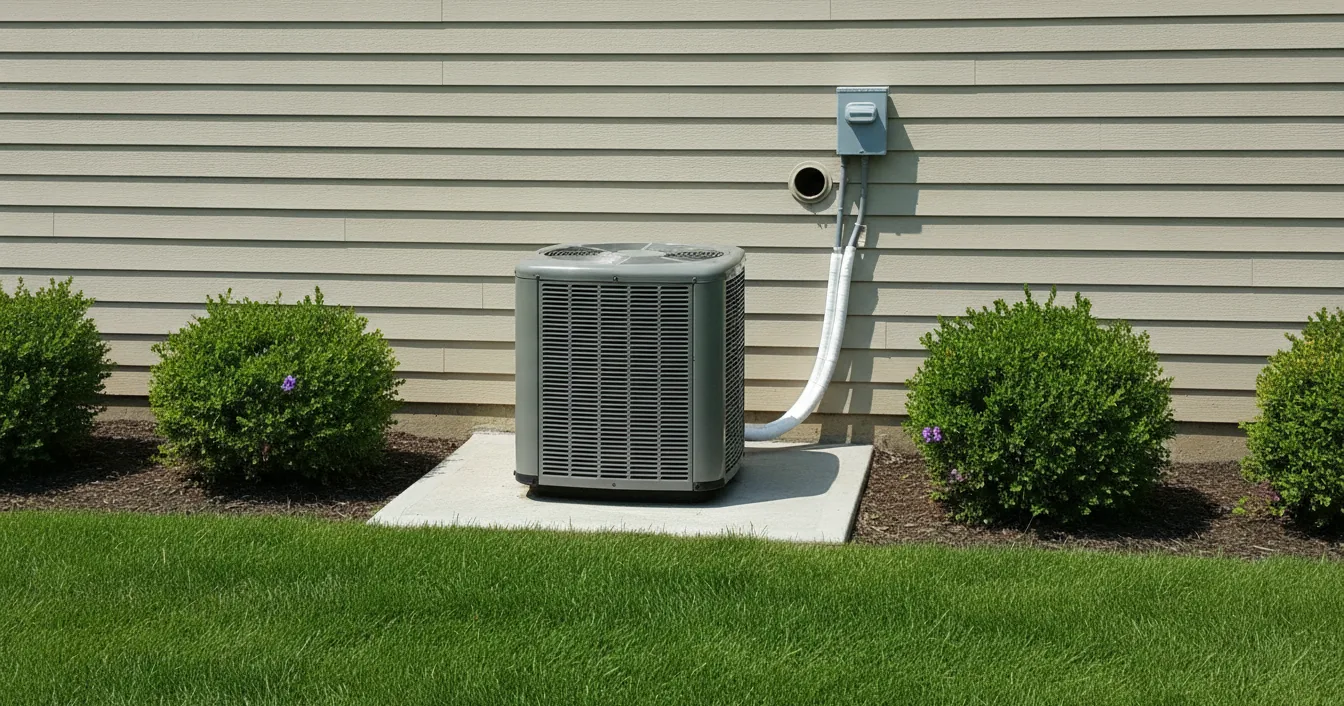
The air conditioner dies on the second day of a heat wave. You call three numbers, one company can come tomorrow, and by mid-afternoon a technician is writing up a quote for a new outdoor unit that does exactly what the dead one did. Nobody in that conversation says anything wrong. But a decision just got made in about twenty minutes that will govern how your house is heated until sometime in the 2040s, and almost nobody realizes they made it. The machine sitting on that concrete pad could have been the same size, the same brand, the same efficiency tier, and heated the house all winter too. The difference between the two versions is roughly one part.
The One Part That Separates the Two Machines
An air conditioner does not make cold. It moves heat from inside your house to the outside, using a compressor to push refrigerant around a loop between two coils. The indoor coil absorbs heat from your air, the outdoor coil dumps it into the yard, and your living room gets cooler as a side effect of that transfer.
A heat pump is the same loop with a valve in it. Add a reversing valve to the refrigerant circuit and the flow can run the other direction, so the outdoor coil absorbs heat from the outside air and the indoor coil releases it into the house. Same compressor, same coils, same refrigerant, same ductwork. One component decides which way the heat travels.
Home performance expert Nate Adams, speaking on Latitude Media’s Open Circuit podcast, put it about as bluntly as it can be put: “It’s reverse gear guys. Come on. This is not some major shift. It’s one extra part, essentially.” His co-host, clean energy investor Jigar Shah, compressed it further into four words that are a fair summary of the whole decision: “Buy one, get heat free.”
It is not literally free, and we will get to the real number below. But the framing is honest, and it explains why the same physics that gives you air conditioning at a few hundred percent efficiency also gives you heating at a few hundred percent efficiency. A furnace burning gas can never return more energy than the fuel contains. A heat pump is not making heat, it is relocating heat, which is why it routinely delivers two to four units of heating for every unit of electricity it draws.
Why This Decision Gets Made Badly
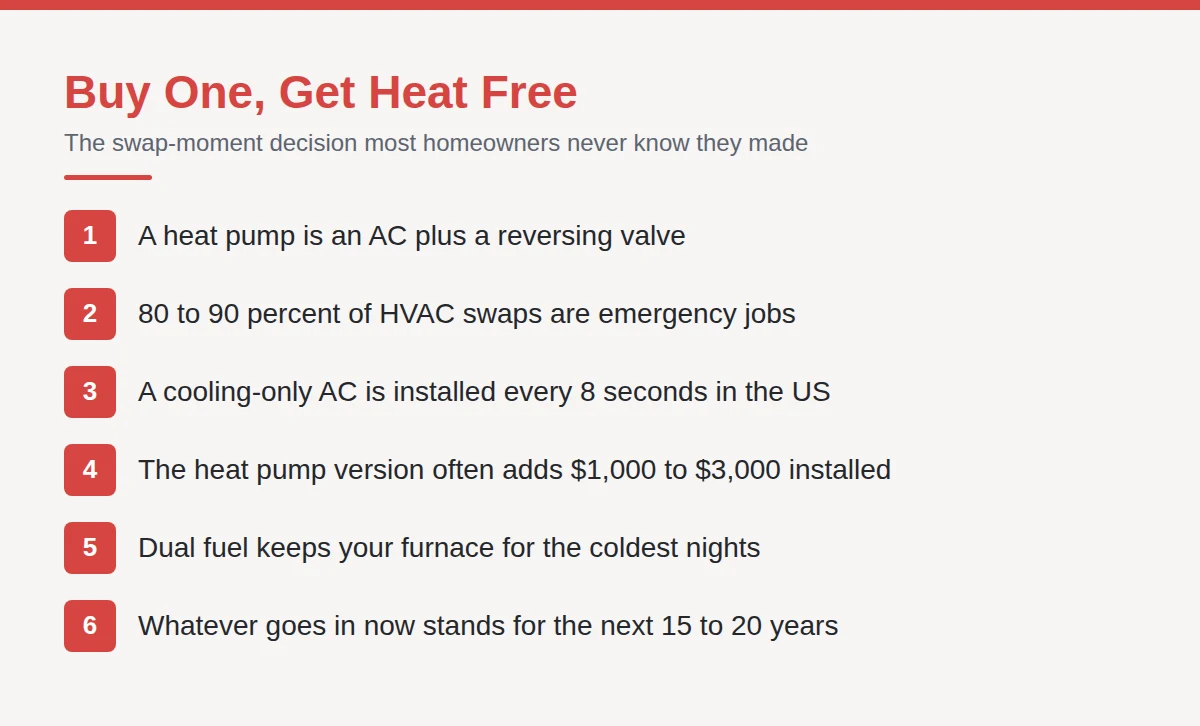
Here is the uncomfortable part. Adams estimates that “every eight seconds in the US, an HVAC contractor installs an air conditioner that has only one mode, cooling.” And roughly 80 to 90 percent of HVAC replacements are emergency jobs, not planned upgrades. Those two facts multiply into a national habit.
When your system fails, you are not a shopper. You are a person with a hot house, a work schedule, and a contractor who can start Thursday. Under those conditions almost everybody takes what is available, and what is available is whatever sits on the distributor’s shelf. Adams’ phrasing for this is worth remembering: “If it’s not on the shelf, it doesn’t get installed.” Rebate paperwork, efficiency comparisons, and load calculations all assume a homeowner with time to think, which is precisely the homeowner who is not in the room during the 80 to 90 percent of replacements that happen as emergencies.
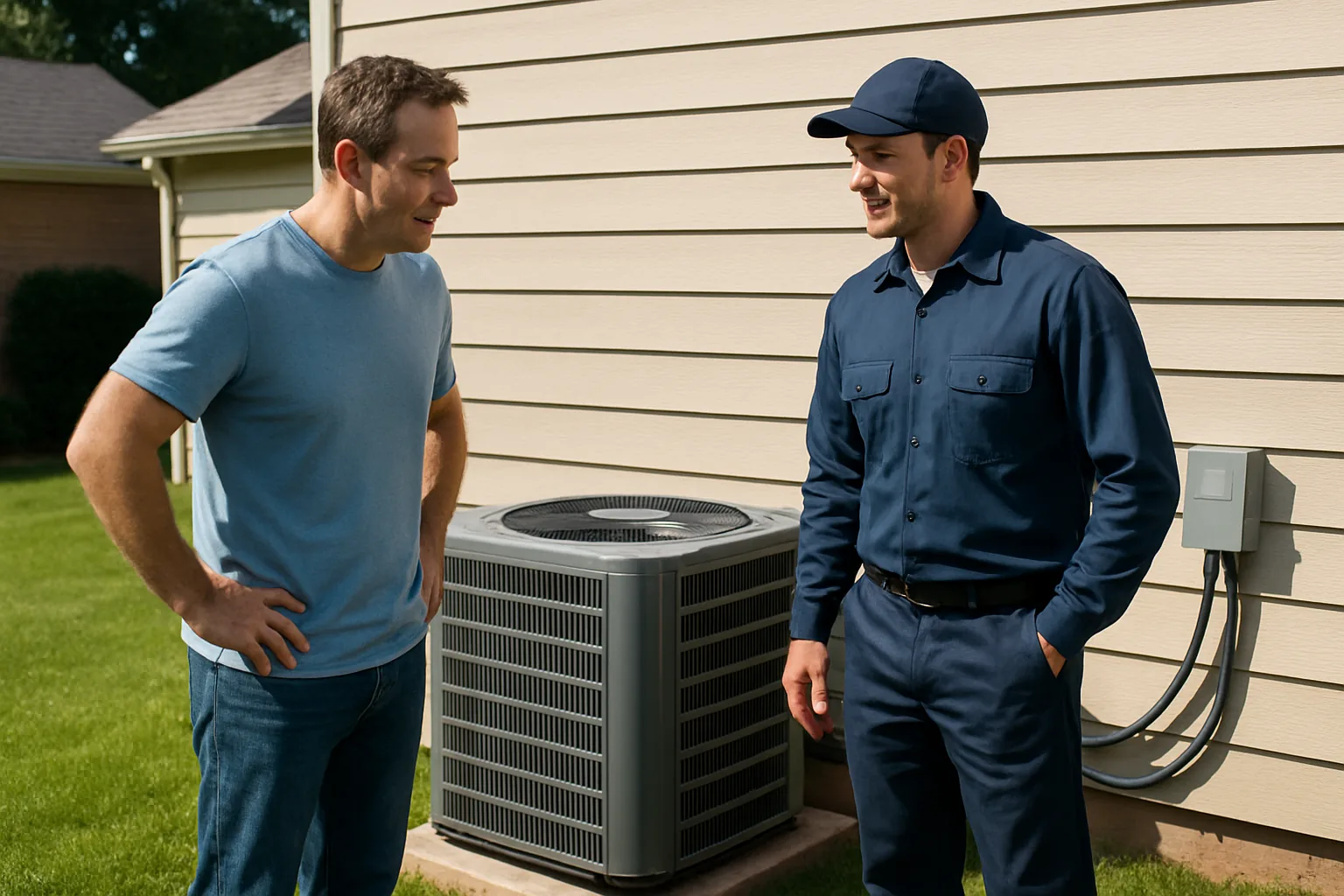
The cost of that default is not the equipment. It is the lock-in. A condenser installed this summer will still be there in 15 to 20 years, and for every one of those winters the house stays committed to whatever burns in the basement. You do not get another chance to reconsider until the next failure. Meanwhile the indoor half of the job is already being touched: with the industry transition away from R-410A toward R-32 and R-454B, most AC replacements now involve a new matched indoor coil regardless, a change our central air conditioner buying guide covers in detail. The labor to open the system is being paid for either way. That is what makes the swap moment the cheapest possible time to change direction, and skipping it the most expensive kind of non-decision.
What the Two-Way Version Actually Costs
The reversing valve itself is a modest piece of hardware. At the equipment level, a heat pump condenser typically carries a premium of a few hundred to about a thousand dollars over a same-tier air conditioner from the same manufacturer.
The installed difference is bigger than the part, because a few other things change with it. The indoor coil has to be matched to the heat pump. The thermostat needs a reversing valve terminal (labeled O/B) and, in a hybrid setup, the logic to decide which heat source runs. Sometimes control wiring gets pulled, and in cold climates the outdoor unit should sit on a raised stand rather than flat on a pad so defrost meltwater and snow have somewhere to go. Add it up and the practical delta on a straight swap in a ducted house most often lands somewhere around $1,000 to $3,000 over a like-for-like cooling-only replacement, against total project numbers our full price breakdown by system type puts in the five figures for most homes. Regional labor rates move that spread considerably, which is the usual reason to collect three written quotes instead of one.

Then run the incentives against the delta, because heating equipment has historically attracted far more support than cooling equipment, and a heat pump can qualify where an air conditioner cannot. Federal credit rules changed at the end of 2025, so verify what applies on the day you sign rather than trusting last year’s article, and check your utility and state programs separately. Our guide to HVAC rebates, credits, and scams tracks what is still on the table and how to confirm an offer is real. When an incentive lands, it frequently exceeds the upgrade delta outright, which is how a genuinely better machine ends up costing less than the ordinary one.
You Do Not Have to Get Rid of the Furnace
The objection that stops most of these conversations is the winter one, and it deserves a real answer rather than a sales answer. If you have a working gas furnace, nothing about this requires you to remove it.
That configuration has a name, dual fuel, and it is the compromise Shah pointed to in the same conversation: the heat pump carries the great majority of the heating season, and the furnace stays in place for the coldest stretch. The thermostat switches between them at a balance point your contractor sets, usually somewhere in the 25 to 40 degree range depending on your gas price and electric rate. You are not betting the house on new technology. You are adding an efficient heat source in front of the one you already trust, and keeping the old one as backup for the handful of nights it earns its keep.

If your winters are genuinely severe, the equipment question narrows but does not close. Modern inverter-driven models hold rated capacity down to 5 degrees Fahrenheit and keep working below that, which our guide to cold-climate heat pumps covers with the specs to demand and the sizing mistakes to avoid. Cheap natural gas plus a brutal design temperature is the one combination where a cooling-only unit paired with the existing furnace can still pencil out honestly, and a contractor who says so is telling you the truth. That is a conclusion to reach with numbers, though, not a default to fall into because the truck was already loaded.
The Questions to Ask When the AC Dies in July
You will be making this call under pressure, so keep it to four questions.
“Can you quote the heat pump version of this same unit?” Most major manufacturers build a heat pump in the same product family as the air conditioner being proposed. You are asking for a line item, not a redesign.
“What is the price difference, installed, including the coil and thermostat?” Compare complete numbers. A quote that shows only the equipment premium hides the parts that actually differ.
“Can we run it dual fuel with my existing furnace?” If the furnace has useful life left, this is usually the fastest path to yes, and it removes the winter risk from the decision entirely.
“What incentives does the heat pump version qualify for that this one does not?” Have the contractor name the program. Then verify it yourself before signing.
If the answer to the first question is that they do not stock it or cannot get one this week, that is worth knowing plainly. Sometimes the honest tradeoff is a cooling-only unit today versus three more days without air conditioning, and in a house with an infant or an elderly resident that is not a close call. But ask. The industry defaults to one-way equipment partly because so few people ever do.
The Bottom Line
An air conditioner and a heat pump are close to the same machine, and the version that heats costs modestly more than the version that only cools. The reason so many houses end up with the cooling-only one is not economics, it is timing: the choice gets made during a breakdown, from whatever inventory is nearby, and then it stands for the next 15 to 20 years. If your system is over a decade old, the useful move is to decide now, in a comfortable house, which one you want installed. Then when the call comes, you are not choosing under duress. You are just placing an order. If you want the full specification detail before that day arrives, our heat pump buying guide covers ratings, sizing, and what a good install looks like.
One last note that applies no matter which way you go: refrigerant is not a homeowner-serviceable substance. Anyone opening that circuit is legally required to hold EPA Section 608 certification, and that requirement covers the reversing valve too.
Further reading (sources)
- The Cool Down on the one overlooked part that would make heat pumps an easier upgrade
- U.S. Department of Energy for how an air-source heat pump moves heat in both directions
- ENERGY STAR with what earns an air-source heat pump its certification
- Consumer Reports covering lab testing of whole-house heat pumps across a range of temperatures
- U.S. Environmental Protection Agency and the certification anyone handling refrigerant must hold