Your New Heat Pump Made the Bill Go Up: Diagnosing the Savings That Never Arrived
Published on October 8, 2026
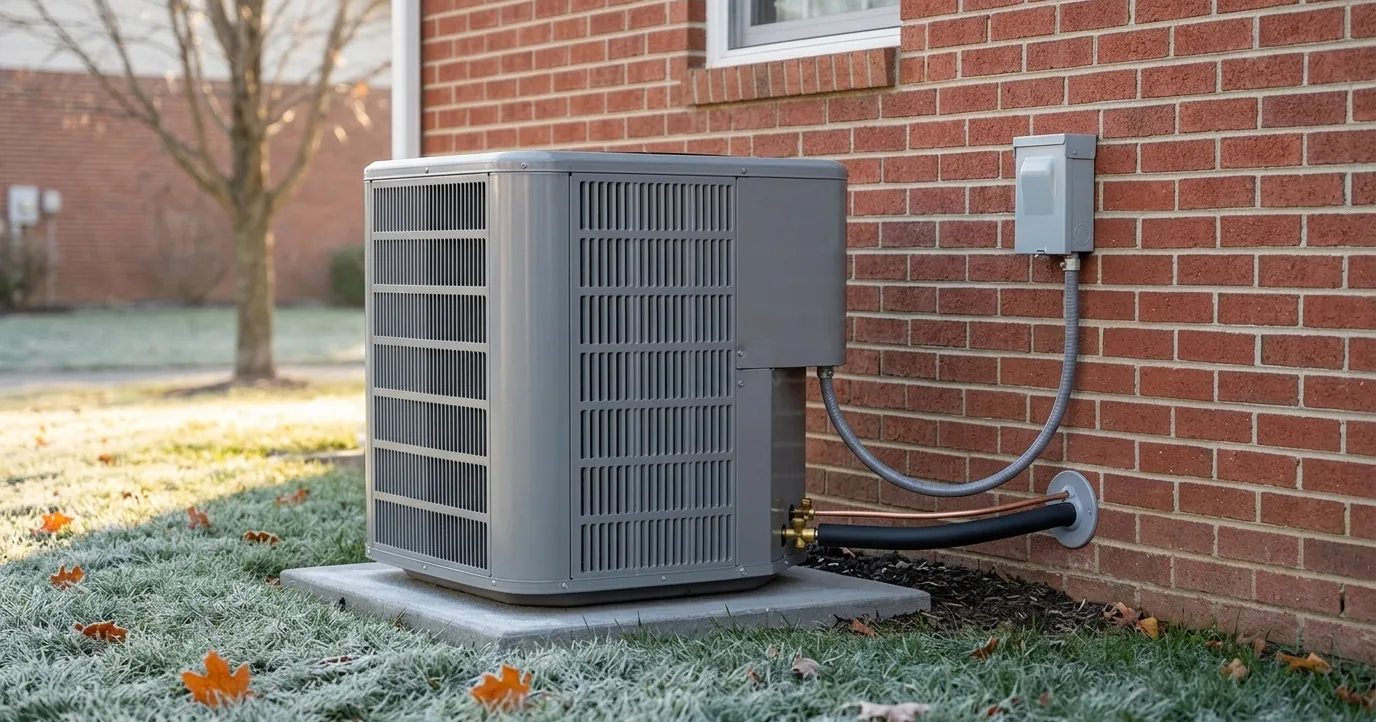
The quote said the heat pump would pay for itself. It went in last fall, the house has been comfortable all winter, and then the January electric bill arrived as the biggest you have ever paid. A neighbor says heat pumps never save money. The installer says it was a cold month.
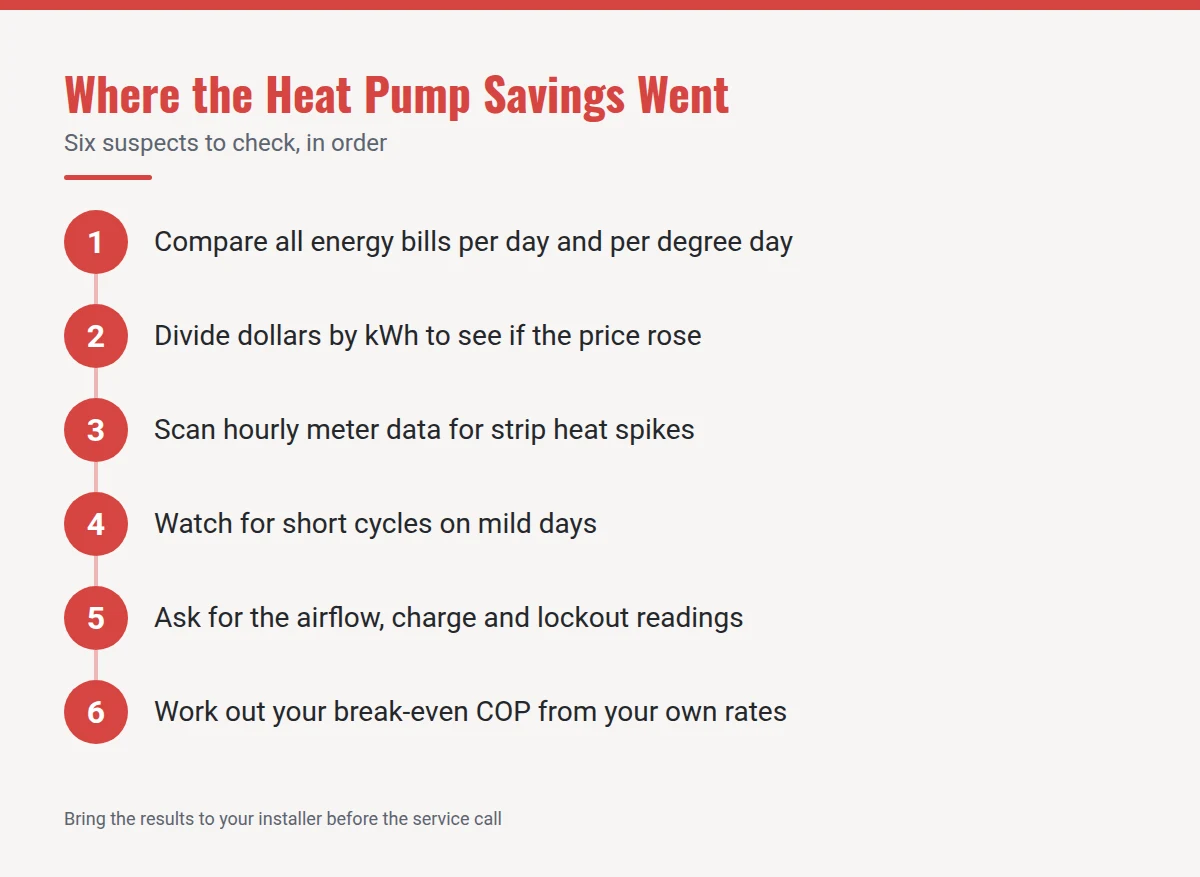
Either of them could be right, and your own bills can settle it. When a heat pump costs more than promised, the cause is nearly always one of six things. Four of them can be checked at the kitchen table: an unfair comparison, a price change, backup heat that runs too often, and local rates that simply favor gas. The other two, an oversized unit and an installation defect such as low refrigerant charge or weak airflow, need a technician to confirm, but the evidence you collect first decides whether that visit finds them.
Make the Comparison Fair First
Before blaming the equipment, make sure the number that alarmed you is the right one to compare. Three adjustments settle a surprising share of “my bill doubled” scares.
Count every heating bill, not just the electric one. If the heat pump replaced a gas, oil or propane furnace, the electric bill is supposed to go up, because it now pays for heat the other fuel used to cover. The real question is whether the total went down. Add last winter’s electric and fuel bills together, including any oil or propane deliveries, and compare that sum with this winter’s.
Compare use per day. Billing periods vary by several days from month to month, and any bill can rest on an estimated meter read rather than an actual one (the bill will say so). Divide the kilowatt-hours (kWh) by the days in each period before comparing months.
Adjust for the weather. Heating degree days measure how cold a period was. As the U.S. Energy Information Administration (EIA) explains, you subtract the day’s average temperature from 65°F, so a day that averages 29°F counts as 36 degree days. A January with 20 percent more degree days than the last one needs roughly 20 percent more heat, and a heat pump will use a little more electricity than that, because it works less efficiently in the cold. EIA notes that some utilities print degree days on the bill, and the National Weather Service’s Climate Prediction Center publishes historical figures. To isolate heating, subtract the daily use from a mild month when neither heating nor cooling runs, then divide what is left by the degree days.
Finally, ask whether the house is doing something new. A home that never had air conditioning will now pay to cool in summer, and rooms you used to leave cold may be warm now simply because the heat pump makes it easy. Both are real benefits, and both show up on the bill.
Check Whether the Price Changed, Not Just the Usage
Divide each electric bill’s total by its kWh to get your all-in price per kWh, and do the same for the same month a year earlier. If the price rose 12 percent, that alone makes the bill 12 percent bigger on identical use.

Prices have been climbing. EIA’s October 2026 Short-Term Energy Outlook puts the national average residential price at 17.3 cents per kWh for 2025 and about 18.2 cents for 2026, a rise of roughly 5 percent in a single year. Three rate details catch heat pump owners in particular:
- Time-of-use plans. If your utility moved you to a time-of-use plan, or you chose one, heat bought during the morning and evening peaks costs more. In a worked example in Natural Resources Canada’s (NRCan) heat pump sizing guide, a heat pump heated more cheaply than a 95 percent gas furnace on off-peak power whenever it was warmer than 35°F outside, but only above 47°F at the mid-peak price, and never at the on-peak price.
- A heat pump rate you are not on. Some utilities discount winter power for homes that heat with a heat pump. Since November 1, 2025, the three investor-owned electric utilities in Massachusetts have offered a seasonal heat pump rate that cuts the base distribution charge from November through April, on all of the household’s electricity. At one of them, that charge drops from about 6.3 cents to about 2.1 cents per kWh. Customers whose heat pump came with a Mass Save rebate are enrolled automatically, but the state notes that some are missed, for instance after a change of ownership, and have to sign up themselves. Check the rate name printed on your bill, and ask your utility whether it offers anything similar.
- Fixed charges that never go away. If you kept gas service for a stove or water heater, the monthly customer charge stays the same however little gas you burn. That slice of the old heating cost never leaves, so the savings look smaller than what the heat pump actually delivers. The same sizing guide tells installers to leave fixed charges out when comparing fuel costs, for exactly this reason.
Find the Strip Heat in Your Hourly Data
Once the comparison is fair and the price is accounted for, the most common reason a working heat pump costs too much is backup heat. Most ducted heat pumps carry electric resistance strips, and as our guide to heat pump setbacks explains, every hour the strips carry the house costs two to three times what the compressor would charge for the same heat. That article covers what aux and emergency heat mean and how to read aux runtime in a thermostat app. Here, the evidence comes from the meter.
Many utilities put a “Green Button” on their website that downloads your detailed usage in a standard file, as the U.S. Department of Energy describes it. Open the hourly data and sort it by usage. Strip heat has a signature: an hour or two on a cold morning that uses several times what the hours around it use. In one metered home in the Pacific Northwest, Christian Douglass and Josh Rushton found the circuit feeding the strips and blower spiking to 8 to 11 kilowatts on winter mornings after a deep overnight setback. If your spikes line up with a schedule change, the setback article has the fix. If they show up at 40°F, or through a mild afternoon, suspect the settings.
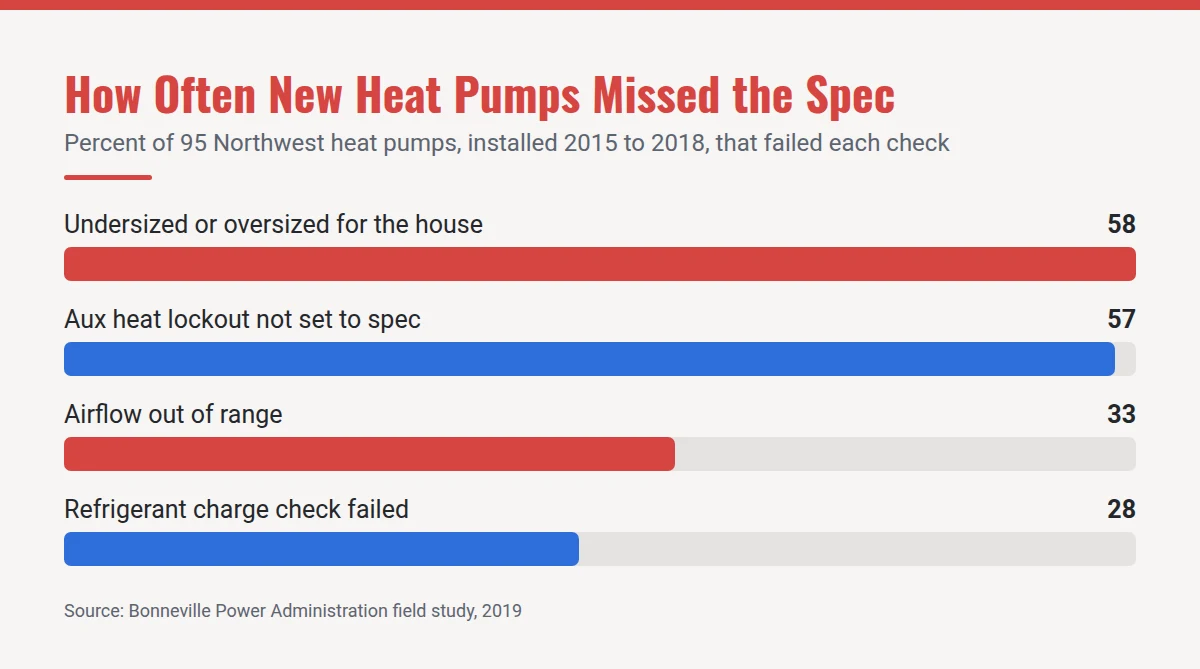
Those settings are often wrong from the first day. When Bonneville Power Administration (BPA) researchers visited 95 Northwest homes with heat pumps installed between 2015 and 2018, only 43 percent had the auxiliary heat lockout set to the program’s specification. The fix is not simply to lock the strips out at a lower temperature, though. Douglass and Rushton call a 35°F lockout inadvisable if the compressor cannot carry the whole house at 35°F, and note that some heat pumps call for strip heat anyway when the unit is undersized or the ducts are too small to move its heat. BPA found 32 percent of its heat pumps undersized, and an undersized unit, the report says, “must use more auxiliary heat.” Changing a lockout is a job for the installer, working from the house’s heat loss and the unit’s capacity in cold weather.
Dual-fuel systems, which pair the heat pump with a gas furnace, can fail in either direction. Set the switchover too warm and the furnace heats most of the winter, so the gas bill barely moves and the savings never appear. Set it too cold on expensive power and the heat pump keeps running when gas would have been cheaper. NRCan tells installers to set that point from the household’s own electricity and fuel prices rather than a default, and with time-of-use rates to use more than one switchover temperature.
Short Cycling and the Oversized Unit
A heat pump that is too big for the house reaches the setpoint in a few minutes, shuts off, and starts again soon after, especially in mild weather. The signs are a compressor that runs in short bursts several times an hour on a 45°F day, rooms that swing warm and cool, and a summer house that feels cool but clammy. BPA found 26 percent of its heat pumps oversized and says grossly oversized units “cycle more than properly sized units during milder winter conditions, which can shorten the equipment’s life and also reduce overall efficiency.” The Northeast Energy Efficiency Partnerships (NEEP) sizing guide adds poor summer dehumidification to the list.
Be realistic about what that does to the bill. A literature review in a National Institute of Standards and Technology (NIST) report notes that modern equipment loses far less to cycling than older test assumptions allowed for, and cites a simulation in which a system oversized by 30 percent in a Miami house used only 2 percent more energy. The costly version is an oversized unit forcing its full airflow through ducts too small for it: NIST’s own simulations put that combination at 15 percent more annual energy in a Houston house. Short cycling on its own is mostly a comfort and equipment-life problem. If your bill is up 40 percent, keep looking.
Ductless systems have their own version. When one large outdoor unit serves several small indoor heads, it may not be able to slow down far enough when a single bedroom calls for heat. NEEP tells installers to avoid an outdoor unit whose minimum steady output is higher than the smallest indoor unit’s heating capacity, and, without reliable data on that, to avoid outdoor units rated at more than triple the smallest connected head.
Installation Defects: Refrigerant Charge and Airflow
The last two suspects are inside the equipment, and both are common. In the BPA study, 67 percent of heat pumps met the program’s airflow specification of 325 to 500 cubic feet per minute per ton, and 72 percent passed a temperature-based check of refrigerant charge. Put the other way, about one in three moved the wrong amount of air, and more than one in four looked wrongly charged.
Each fault has a price. In NIST’s simulations of a heat pump in five U.S. climates, a system 30 percent short on refrigerant used about 20 percent more energy over a year, regardless of climate or house type. A 30 percent overcharge cost 10 to 16 percent, and low indoor airflow did similar damage. Leaky ducts in unconditioned space were the worst single fault in the slab-on-grade houses, adding 26 percent in Chicago and Minneapolis. The same report cites a study of seven new high-efficiency heat pumps that turned up a faulty expansion valve, a thermostat not built for heat pumps, the wrong indoor unit, and control wiring that kept the system from staging properly. Once those were fixed, the systems performed as expected.
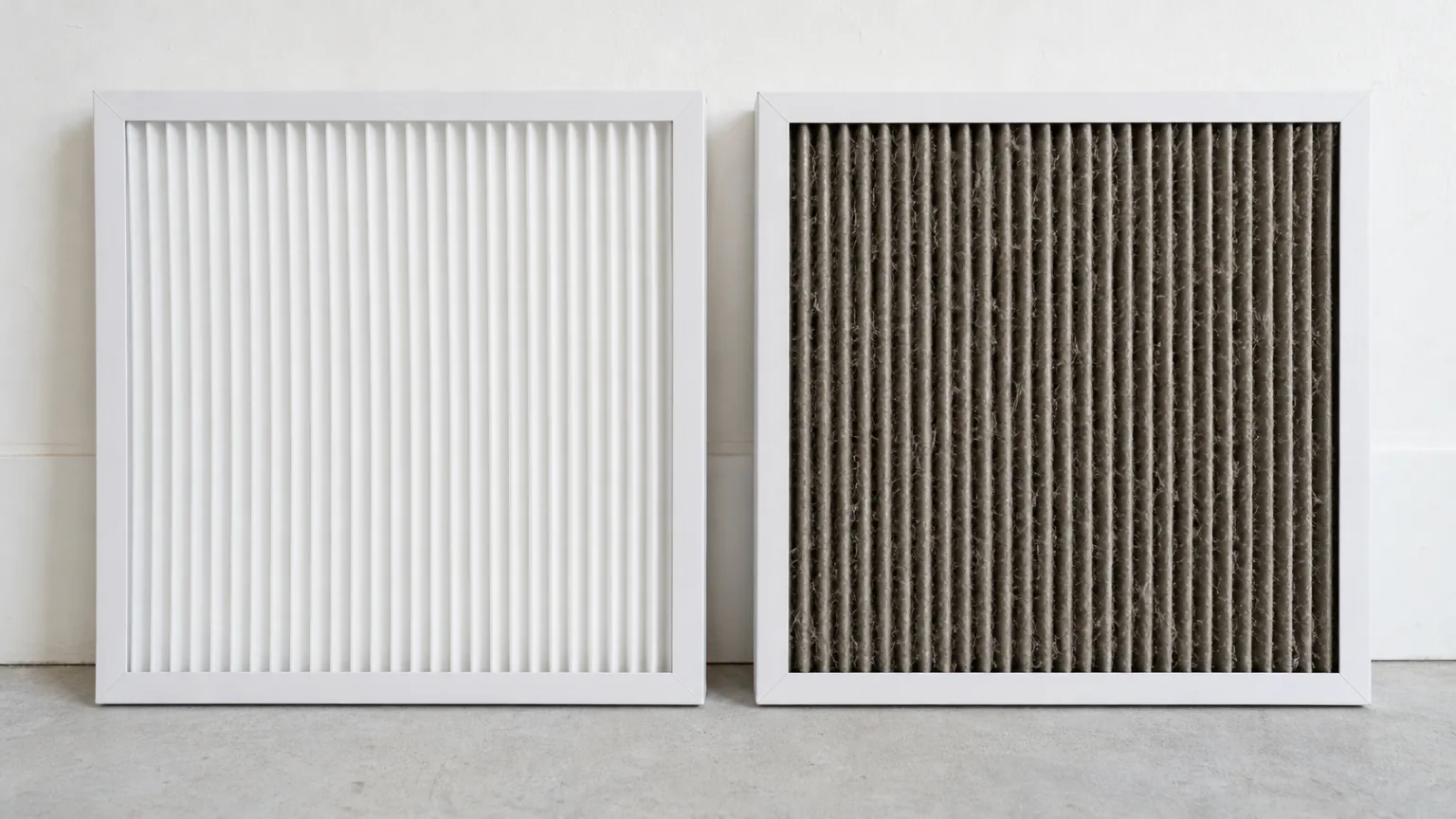
A few checks are yours to make. Replace a dirty filter, and remember that a denser filter restricts airflow too: one field study in the NIST review found that high-efficiency replacement filters typically cut airflow by about 5 percent. Open closed supply registers and pull furniture away from return grilles. On a cold, damp day, watch the outdoor unit: frost that builds and then melts off during defrost cycles is normal, but a coil that stays encased in ice is not.
Everything else needs a technician. Checking the charge means attaching gauges to the refrigerant circuit, and the EPA requires Section 608 certification for anyone who does that. A low charge means the system was either never charged correctly or is leaking, and a top-off does not fix a leak, as our refrigerant guide explains. On a system a year or two old, call the installer first and ask for the commissioning numbers: measured airflow, external static pressure, the refrigerant charge readings and every lockout setting. Our installation-day guide lists the paperwork you should have received at handover, and if the ducts turn out to be the bottleneck, Ductwork 101 covers testing and sealing them.
The Honest Case: When Your Rates Make the Math Lose
Sometimes every check comes back clean and the bill is still higher than the gas furnace’s used to be. That is not a defect. It is arithmetic.
A heat pump wins when the electricity it uses, divided by its efficiency, costs less than the fuel it replaces. Harvard researchers Roxana Shafiee and Daniel Schrag ran that comparison for an average-size home in every U.S. county, in a 2026 study in the journal Energy Policy. In Shafiee’s summary of the work, households heating with oil, propane or electric resistance heat would save with a heat pump in every part of the country. Gas-heated homes in colder northern regions are the exception: their heating bills could rise by as much as $1,200 a year where electricity costs up to five times as much as gas per kilowatt-hour.
You can run the same test with the method NRCan gives installers. It produces a break-even coefficient of performance (COP), the efficiency your heat pump has to beat to heat more cheaply than gas:
Break-even COP = your electricity price per kWh × 28 ÷ your gas price per therm
That multiplier assumes a 95 percent furnace; use 23 for an older 80 percent one. Use usage-based prices, leaving out fixed monthly charges, and if your electric rate is tiered, use the highest tier you reach in winter.
At EIA’s national averages for the first quarter of 2026, about 17.8 cents per kWh and $14.77 per thousand cubic feet of gas (roughly $1.42 a therm), the break-even COP works out to about 3.5 against a 95 percent furnace and 2.9 against an 80 percent one. Compare that with your heat pump’s COP at typical winter temperatures in the manufacturer’s extended performance tables. Do not use the rated figure, which the guide warns is usually higher than real performance. If the break-even sits above what your unit delivers in January, the bill went up because of your rates, not your equipment.

That does not make the heat pump a mistake. Its COP is highest in mild weather, so the same math can favor it in spring and fall, and it may also have replaced an aging air conditioner. Against propane or oil it usually wins outright: the guide’s propane example breaks even at a COP of just 1.3. What the math does mean is that the fixes are financial and operational: a heat pump rate if your utility offers one, a dual-fuel switchover set at your own break-even temperature, heating off-peak on a time-of-use plan, and weatherization that shrinks the load the expensive kilowatt-hours have to carry. Our cold-climate heat pump guide covers dual-fuel setups and sizing to your design temperature.
Take the Evidence to Your Installer
Whatever you find, write it down before anyone comes out. A useful file holds:
- Twelve months of electric and fuel bills, converted to use per day and per degree day
- The all-in price per kWh for each month, and the rate name printed on each bill
- A few days of hourly data showing any spikes, with the outdoor temperature at the time
- Photos of the thermostat’s installer settings: equipment type, aux heat lockout, compressor lockout and any switchover temperature
- Your break-even COP, worked out from your own prices
That file turns “the bill seems high” into a specific question a contractor can answer, and it keeps the diagnosis from stopping at “heat pumps cost more in winter.” If the installer cannot explain your numbers, a second technician with the same file is worth the service call.
Further reading (sources)
- U.S. Energy Information Administration on how heating degree days measure a cold month
- EIA’s Short-Term Energy Outlook for residential electricity and natural gas price forecasts
- Massachusetts Department of Public Utilities on seasonal heat pump rates and who gets enrolled
- U.S. Department of Energy explaining the Green Button download of utility usage data
- Douglass and Rushton, in the ACEEE 2024 Summer Study proceedings, with metered heat pump homes, backup lockouts and sizing
- Bonneville Power Administration for a field study of commissioning, controls and sizing in 95 Northwest homes
- Domanski, Henderson and Payne at NIST on how installation faults raise a heat pump’s annual energy use
- Natural Resources Canada with the economic switch-over temperature and break-even COP method
- NEEP on sizing cold-climate heat pumps without oversizing them
- Roxana Shafiee, writing in The Conversation, on where heat pumps raise or cut heating bills
- EPA listing who needs Section 608 certification to work on refrigerant