DIY Mini-Split Kits: What You Can Legally Install Yourself, and What the Savings Really Cost
Published on September 30, 2026
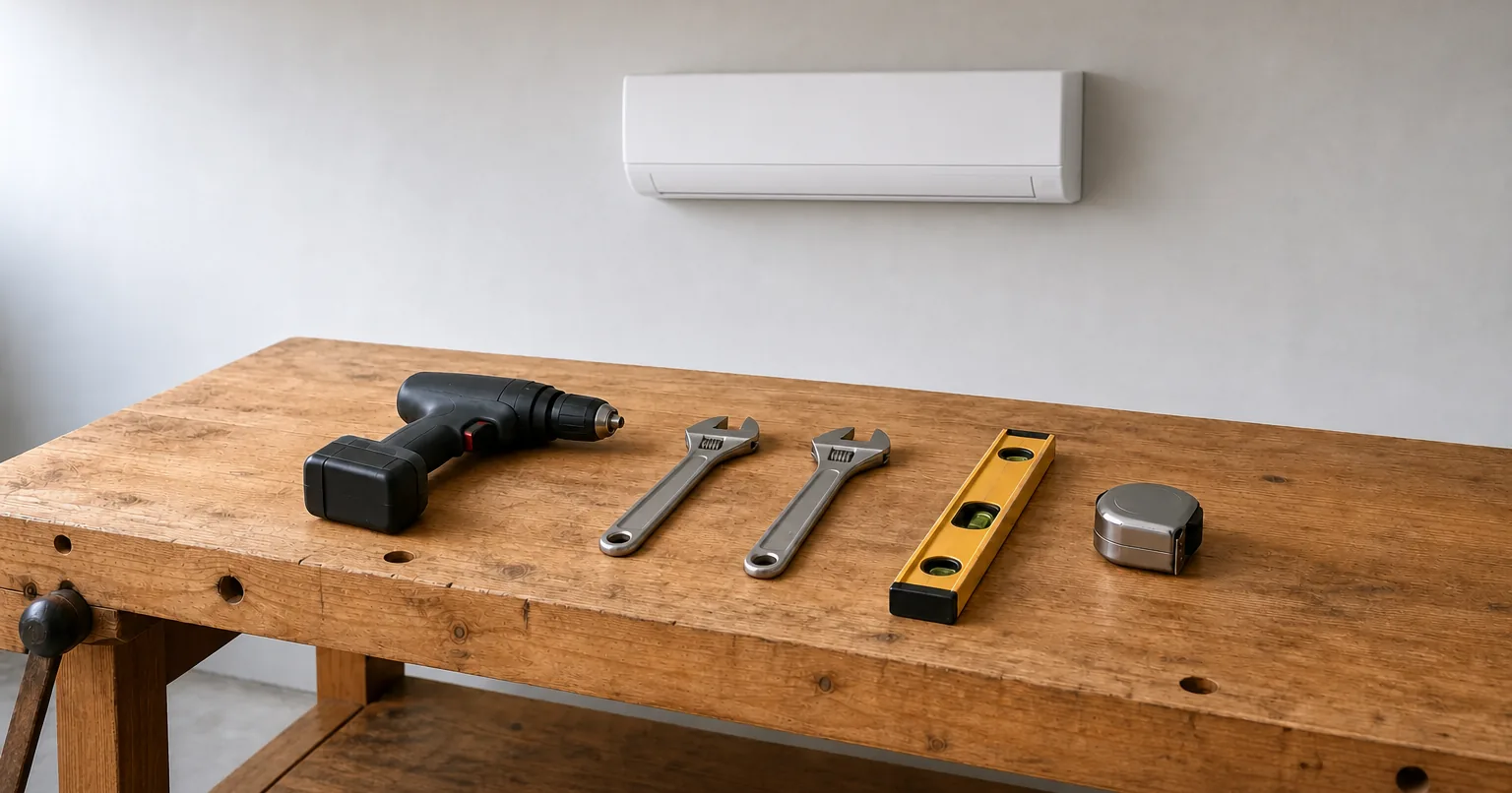
Joe Wachunas rates himself “a 4 or 5 on a scale of one to ten” as a do-it-yourselfer. He still installed five ductless heat pump heads and two outdoor units on one side of a Cleveland duplex, almost entirely on his own, from a kit that arrived in boxes on a pallet. Writing in CleanTechnica, he put the project at $8,767 against contractor quotes of more than $15,000, and the labor at 60 to 70 hours of his own time.
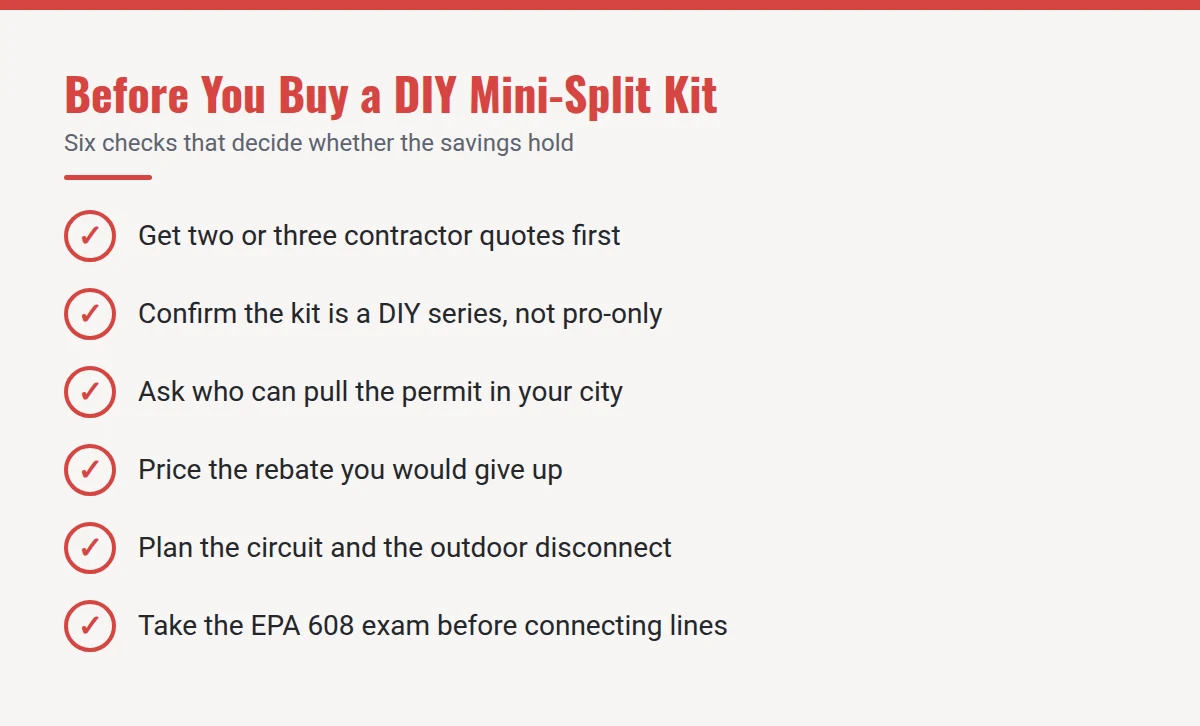
That is the promise of a DIY mini-split kit. The refrigerant lines arrive precharged and sealed, the fittings tighten with a pair of wrenches, and the vacuum pump, gauges, and refrigerant cylinder that make a normal installation a trade job never come out. The savings are real. The fine print is where people get hurt, and it sits in four places a product page barely mentions: federal refrigerant law, the warranty, the permit, and the rebate. Price all four before you order.
The Savings Are Real, and So Is the Work
Most of a contractor’s price is not equipment. SPUR, a San Francisco Bay Area policy nonprofit, put installation at about 70 percent of a heat pump’s cost in an August 2026 analysis. A kit hands that share of the bill back to you, on the condition that you become the installer.
Wachunas’s account shows both halves of that bargain. The equipment cost $6,500. Parts and hired help added about $2,000, including $1,000 for a handyman to finish the covers over the refrigerant lines, and an electrical engineer neighbor helped wire the outdoor units. He called half a dozen HVAC contractors looking for backup, and none would work on equipment they had not supplied. He finished about $7,000 ahead and reports that the system has worked well since. He also writes that he would not take on a system that large again, though he would consider one with one or two indoor units.
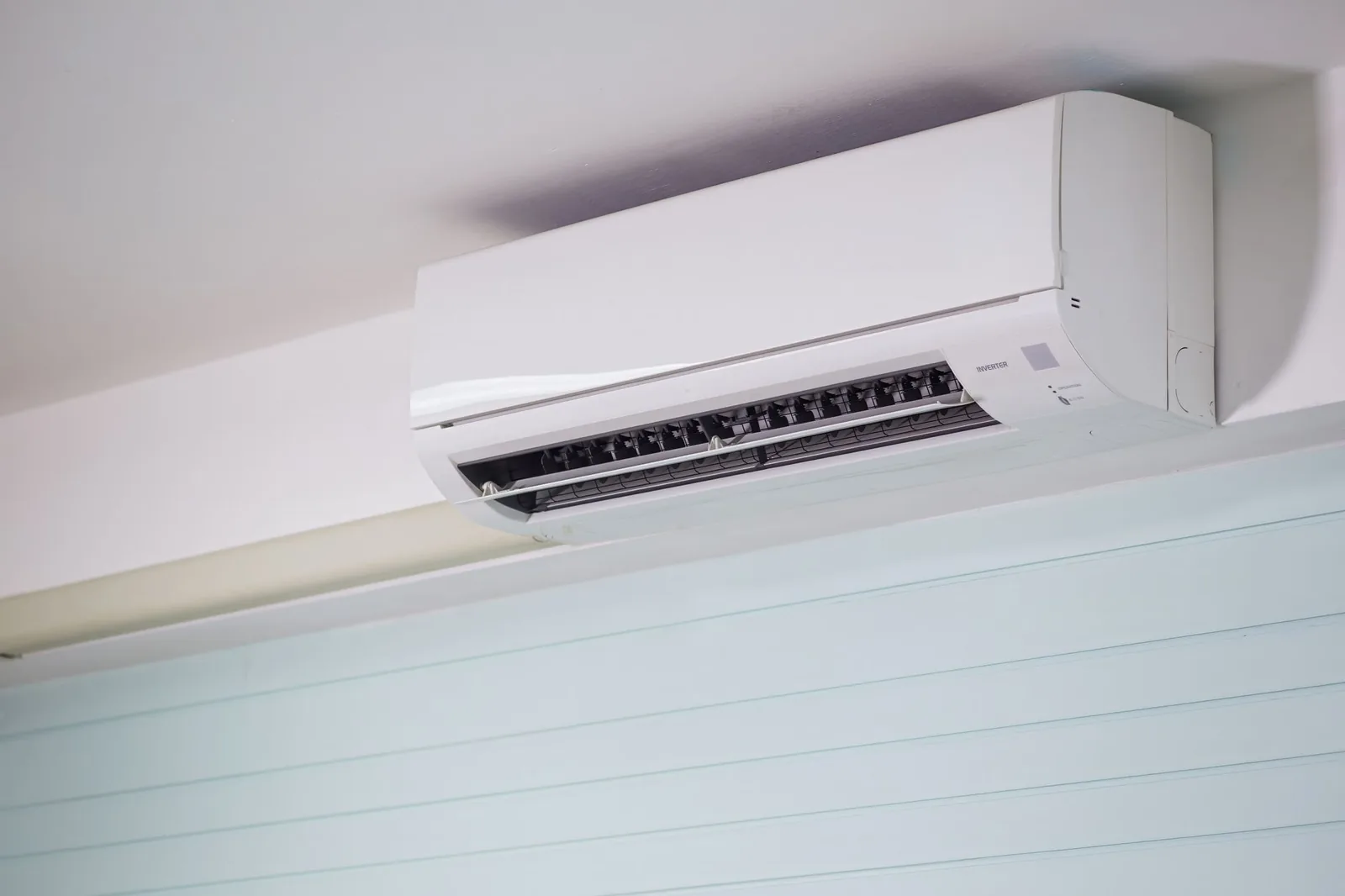
That is the honest shape of the DIY case. One head in a garage, a workshop, or an addition is a contained project. Five heads on a two-story house is a second job. Before you assume how big the gap is, get two or three professional quotes, because pricing varies widely by region and by contractor. A professionally installed single-zone system typically runs $3,500 to $6,000, as our price breakdown by system type shows, and the difference between a quote like that and a kit is the most you can save before the costs below.
What EPA Section 608 Says About Installing It Yourself
The federal refrigerant rule is written around what you do, not who you are. Under 40 CFR 82.152, a “technician” is any person who, in maintaining, servicing, or repairing an appliance, “could be reasonably expected to violate the integrity of the refrigerant circuit.” The rule names the activities that count: attaching or detaching hoses and gauges, adding or removing refrigerant, adding or removing components, and cutting the refrigerant line. It then notes that technicians can include installers and “owners and/or operators of appliances.” There is no homeowner exemption.
The same definition lists what does not count: “painting the appliance, rewiring an external electrical circuit, replacing insulation on a length of pipe, or tightening nuts and bolts.” Mounting the units, drilling the wall, running the drain line, and wiring the circuit are not refrigerant work under federal law, though your city may regulate them anyway.
Why a precharged kit seems to sidestep the rule. Buying one is legal. The federal restriction on refrigerant sales does not apply when the refrigerant is “contained in an appliance with a fully assembled refrigerant circuit or an appliance component,” which describes a charged outdoor unit and a charged line set. And a quick-connect installation uses no gauges, no vacuum pump, and no added refrigerant, so sellers argue that none of the listed activities takes place and no certification is needed.
Where that reasoning breaks down. The EPA does not read its own rule that way in print. Its FAQ for homeowners asks whether you can install a mini-split yourself, and the answer begins “No.” It continues: “Adding or removing refrigerant from a mini-split as part of installation, and/or connecting or disconnecting hoses or pre-charged lines requires a Section 608 technician certification.” The agency’s question-and-answer page for technicians says the same. Both answers name R-410A, the refrigerant these kits used until the recent changeover, and neither makes an exception for quick-connect fittings. The rule itself applies the same way to the R-454B and R-32 in current kits.
The fix is smaller than it sounds: take the exam. Section 608 certification is a test, not a trade license. The tests are given by EPA-approved certifying organizations, and the credential does not expire. A split system is not a “small appliance” under the rule, a category for equipment “fully manufactured, charged, and hermetically sealed in a factory,” such as a window unit, so the entry-level Type I credential does not reach it. The one that fits is Type II or Universal. Passing puts you on the right side of the EPA’s own answer. It does not make you a licensed contractor, and it does not change what your city will let you permit.
Certification also does nothing about what comes after installation day. A precharged kit avoids refrigerant work only for as long as nothing goes wrong.
- The lines come in fixed lengths. You order each run long enough and coil the excess beside the outdoor unit, as Wachunas did. Cutting a refrigerant line to fit is one of the activities the EPA rule names.
- A leak, a move, or a replacement is refrigerant work. The best-known maker of DIY kits says its DIY units have no service ports and cannot be pumped down, so removing the charge takes a recovery machine run by certified professionals. You cannot buy refrigerant for a home system without certification, and knowingly venting it is prohibited for everyone.
- Somebody has to be willing to do that work. The contractors who turned Wachunas down were worried about liability for equipment they had not ordered. Find out who in your area services owner-installed equipment before you need them.
- The refrigerant has changed. Kits now ship with R-454B or R-32, which are mildly flammable, so the manual’s room-size and clearance limits are not suggestions. Our refrigerant guide explains what the switch changes.
The Warranty: Check Whose Installation It Covers
The brands that sell through contractors generally do not stand behind equipment a homeowner installs, or buys online in the first place.
- Mitsubishi Electric states that “Our Limited Warranty only applies to Products installed by a licensed contractor,” and that protection is unavailable on internet and other resale purchases “even if that product was not previously opened or installed.”
- Fujitsu General says “Internet sales are strictly prohibited and unauthorized,” that a system bought from an online retailer “WILL NOT BE COVERED BY WARRANTY,” and that its 10-year coverage is for systems installed by a licensed contractor and registered online.
So a contractor-channel unit bought from a web store and installed by you has no manufacturer behind it, however good the hardware is.
DIY-series kits are the exception, and the distinction runs by product line, not by brand. MRCOOL, the best-known of the DIY makers, says no installation invoice is required for a warranty claim on its DIY systems, which carry five years on parts and seven on the compressor. “For all other systems, a valid installation invoice is required to initiate the warranty claim process,” its warranty summary adds. Check which series a listing actually is before you buy.
Even a valid DIY warranty has limits worth pricing:
- It covers parts, not labor. A free compressor still has to be installed, which means recovering and recharging refrigerant, and that puts you back in the Section 608 problem above.
- It is shorter. Five and seven years, against the 10 to 12 that contractor-channel brands put on registered, professionally installed systems.
- It does not follow the house. The coverage is non-transferable and applies only to the original purchaser, which matters if you sell.
Permits: Whether You May Do the Work at All
Whatever federal law allows, the installation is building work. Portland, Oregon, lists mini-split systems among the projects that require a mechanical permit and adds that most mechanical equipment needs an electrical permit as well. Whether you are allowed to pull those permits yourself depends on where you live.
- Portland says “Homeowners can do their own mechanical work,” as long as the homeowner is the recorded property owner and not an LLC.
- Seattle requires a refrigeration permit “for any split system heat pump” and issues it only to licensed refrigeration contractors. Its FAQ is blunt: “Homeowners need to hire a contractor to get the permit.”
A kit you can legally buy can be one you cannot legally permit on your own. One call to the building department before you order answers three questions: which permits the job needs, whether an owner-occupant can pull them, and which edition of the electrical code applies. Note the Portland condition, too. A property held in an LLC does not qualify, which catches many rentals.

Plenty of people skip this step. SPUR reports permit compliance for electric heating equipment below 20 percent in parts of the Bay Area. Washington’s Department of Labor & Industries spells out what that risks: the lack of a permit and inspection “could affect the safety of your home or business, your ability to obtain financing, and your ability to sell your property, obtain insurance or collect on insurance claims.”
The Electrical Work Is Where Inspectors Look Hardest
A kit includes the cable that links the indoor and outdoor units. It does not include the circuit: the breaker, the wire, and the outdoor disconnect are yours to supply. Saint Paul, Minnesota, publishes a checklist of common requirements under the 2023 National Electrical Code, and it is a fair preview of any inspection.
- A disconnect within sight of the outdoor unit, with three feet of clear working space in front of it.
- Breaker, wire, and disconnect sized from the unit’s nameplate, not from a rule of thumb.
- A 120-volt service receptacle within 25 feet of the equipment.
- Wiring methods rated for outdoor use. The checklist adds: “Cord wiring is not permitted to be used between a mini-split and fan coil unit.” Ask whether the cable supplied in your kit is acceptable where you live.
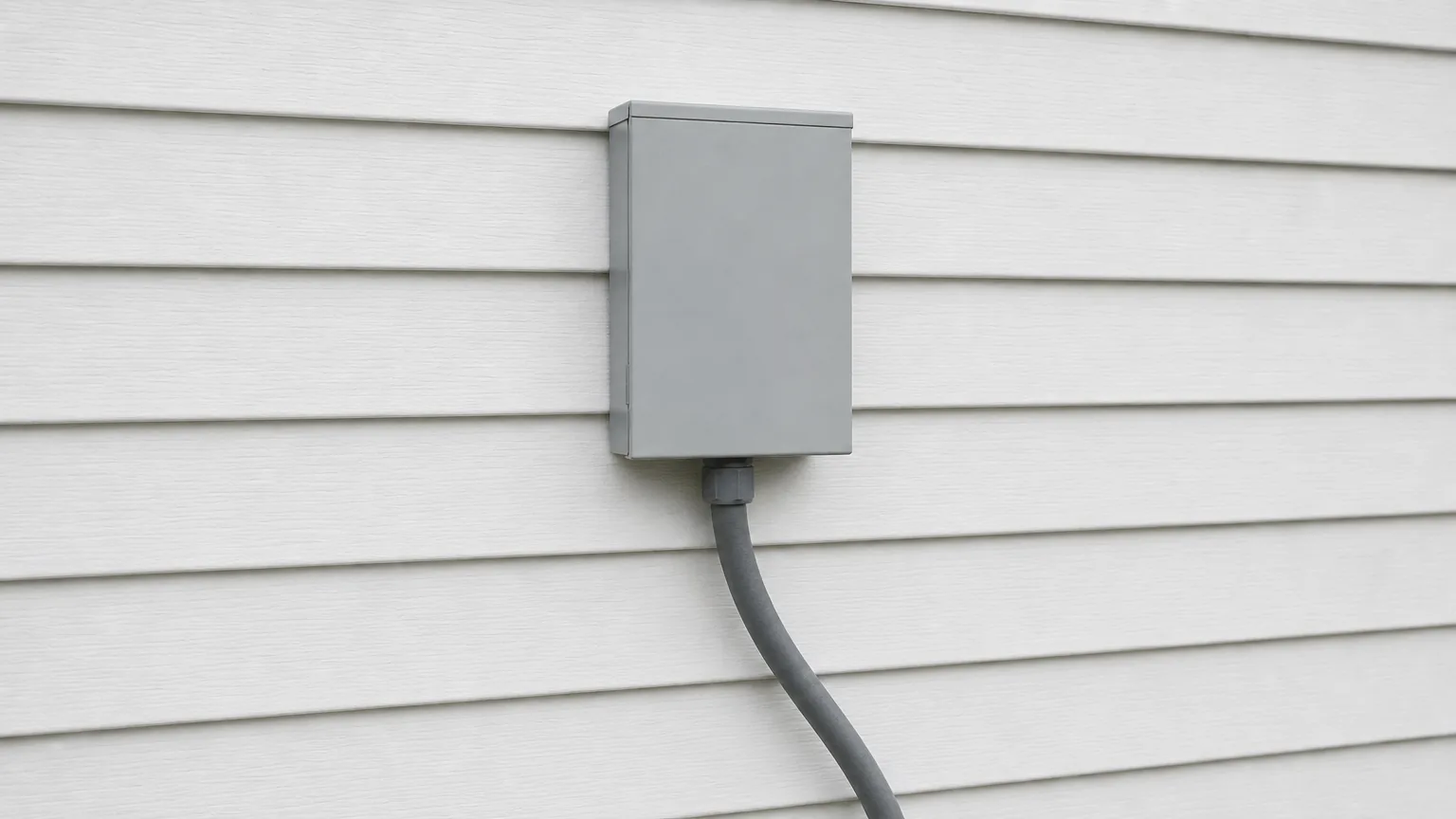
One requirement is in flux. A National Electrical Code exception that spared outdoor HVAC equipment from ground-fault (GFCI) protection expired on September 1, 2026. ACCA, the contractors’ trade association, has appealed for an extension, citing unresolved questions about nuisance tripping, including on the inverter-driven equipment that nearly every mini-split is. States and cities have handled the rule differently, so ask your inspector what the outdoor unit’s circuit needs before you buy a breaker.
A new circuit also has to fit in your panel, which our guide to panel capacity covers. If the wiring is beyond you, hire an electrician and let them pull the electrical permit. Washington’s rule is explicit that the permit “must be purchased by the person, company or organization doing the work.” Mistakes here are the dangerous kind. A mis-sized breaker or a loose connection on a heat pump circuit is a fire and shock hazard, not a comfort problem.
Rebates: The Money a DIY Install Leaves Behind
The federal tax credit is gone either way. The IRS says the energy efficient home improvement credit applies to improvements made through December 31, 2025. What remains in 2026 runs through state and utility programs, and those are built around contractors.
- Federal HEAR rebates. Where a state has launched the program, households under 150 percent of area median income can get up to $8,000 toward a heat pump. The Department of Energy’s program rules tell every state to require that a heat pump for space heating and cooling be “installed by a contractor on the qualified contractor list.” Wisconsin’s program shows where the line falls: a heat pump water heater can be bought at a store and self-installed, while a space-heating heat pump has to go through a registered contractor.
- State and utility rebates. Efficiency Maine pays $1,000 to $3,000 per eligible outdoor unit, depending on income, and requires that the equipment be installed by one of its registered vendors.
So price the rebate before you price the kit. Efficiency Maine’s own example is a two-head system at $10,000 installed, which a $2,000 to $6,000 rebate brings down to between $8,000 and $4,000. In Wisconsin’s version of HEAR, a household under 80 percent of area median income can have 100 percent of project costs covered, up to the cap. In cases like those, doing it yourself saves little or nothing. Where no program applies to you, the labor saving is yours to keep.
So What Do the Savings Really Cost?
Put the pieces together and the price of the discount looks like this:
- A rebate you may forfeit, anywhere from nothing to $8,000.
- A warranty that covers parts only, with you as the service department.
- Service risk, because contractors may decline equipment they did not supply.
- Your hours, 60 to 70 of them for a five-head system.
- The extras: a disconnect, wire, a breaker, line covers, a pad or bracket, permit fees, and possibly an electrician.
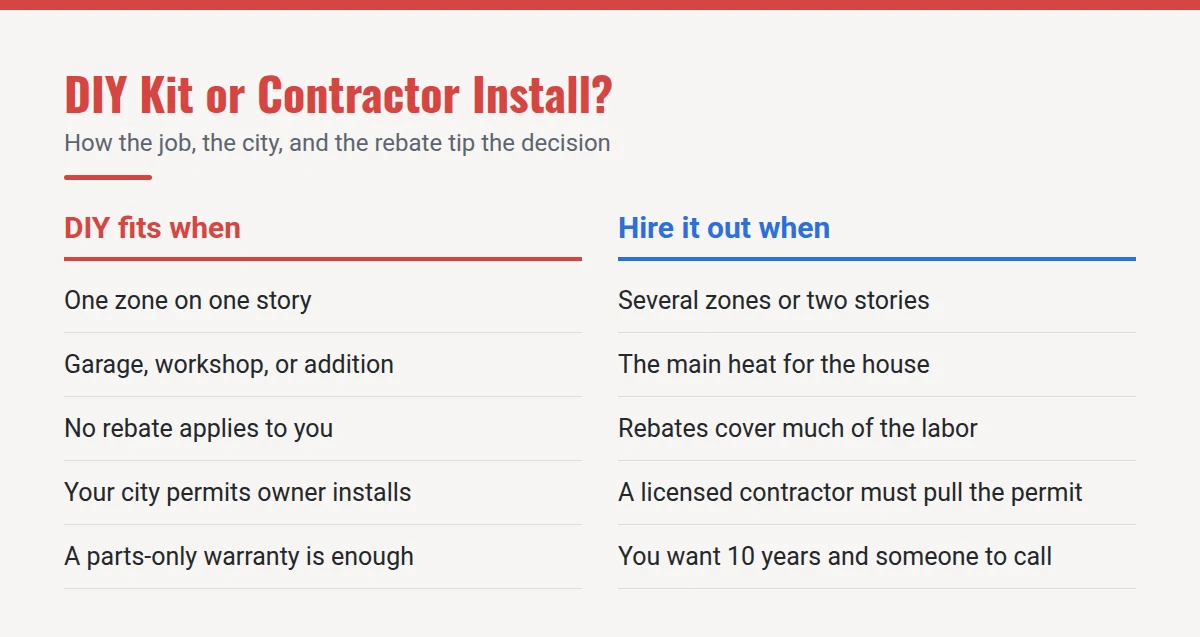
DIY fits when the job is one zone on one story, in a garage, workshop, or addition where a failure is an inconvenience and not a no-heat emergency; when your building department issues permits to owner-occupants; when no sizable rebate applies to you; and when you are willing to take the Section 608 exam first.
Hire it out when the system has several zones or is the main heat for the house, when rebates would cover much of the labor, when your city requires a licensed contractor for the permit, or when you want a decade of registered warranty and someone to call in January. Our guide to choosing a contractor covers how to vet one.
Either way, size the system before you buy it. A kit comes with no load calculation, and an oversized head short cycles, costs more, and dehumidifies poorly. If you have a home energy score or an audit report, our guide to reading one shows how it feeds the sizing.
The Bottom Line
A DIY mini-split kit is easy to buy and harder to install by the book than the box suggests. The EPA says connecting precharged lines takes Section 608 certification, which a homeowner can earn. Your city decides whether you can pull the permit, the manufacturer decides whether the warranty survives, and the rebate program decides whether the labor you saved was going to be paid for anyway. Make those four checks before you order, and a saving like the one Wachunas describes is real. Skip them, and the kit turns out to be the cheap part.
Further reading (sources)
- CleanTechnica with one homeowner’s account of a five-head DIY install and what it cost
- SPUR on installation’s share of heat pump costs and low permit compliance
- U.S. Environmental Protection Agency answering whether a homeowner can install a mini-split
- EPA’s Section 608 program for the certification types and who gives the exam
- Code of Federal Regulations, 40 CFR 82.152, defining a technician and a small appliance
- Code of Federal Regulations, 40 CFR 82.154, the venting ban and the refrigerant sales restriction
- MRCOOL explaining why its DIY units cannot be pumped down
- MRCOOL’s warranty summary, listing which systems need an installation invoice for a claim
- Mitsubishi Electric on its warranty limits for internet and resale purchases
- Fujitsu General with warranty terms that exclude systems bought online
- City of Portland on which mechanical projects need a permit and who can do the work
- Seattle Department of Construction and Inspections answering who can get a refrigeration permit
- Washington State Department of Labor & Industries on who buys the electrical permit and what skipping it risks
- City of Saint Paul with its 2023 electrical code checklist for air conditioners and mini-splits
- ACCA on the expired GFCI exception for outdoor HVAC equipment
- Internal Revenue Service confirming the home improvement credit ended with 2025
- U.S. Department of Energy with the Home Energy Rebates rules states must follow
- Focus on Energy for Wisconsin’s HEAR rebates and which ones need a registered contractor
- Efficiency Maine listing its heat pump rebate amounts and installer requirement