Refrigerant in 2026: Finding Out What You Have, the A2L Switch, and What a Leak Costs
Published on September 20, 2026
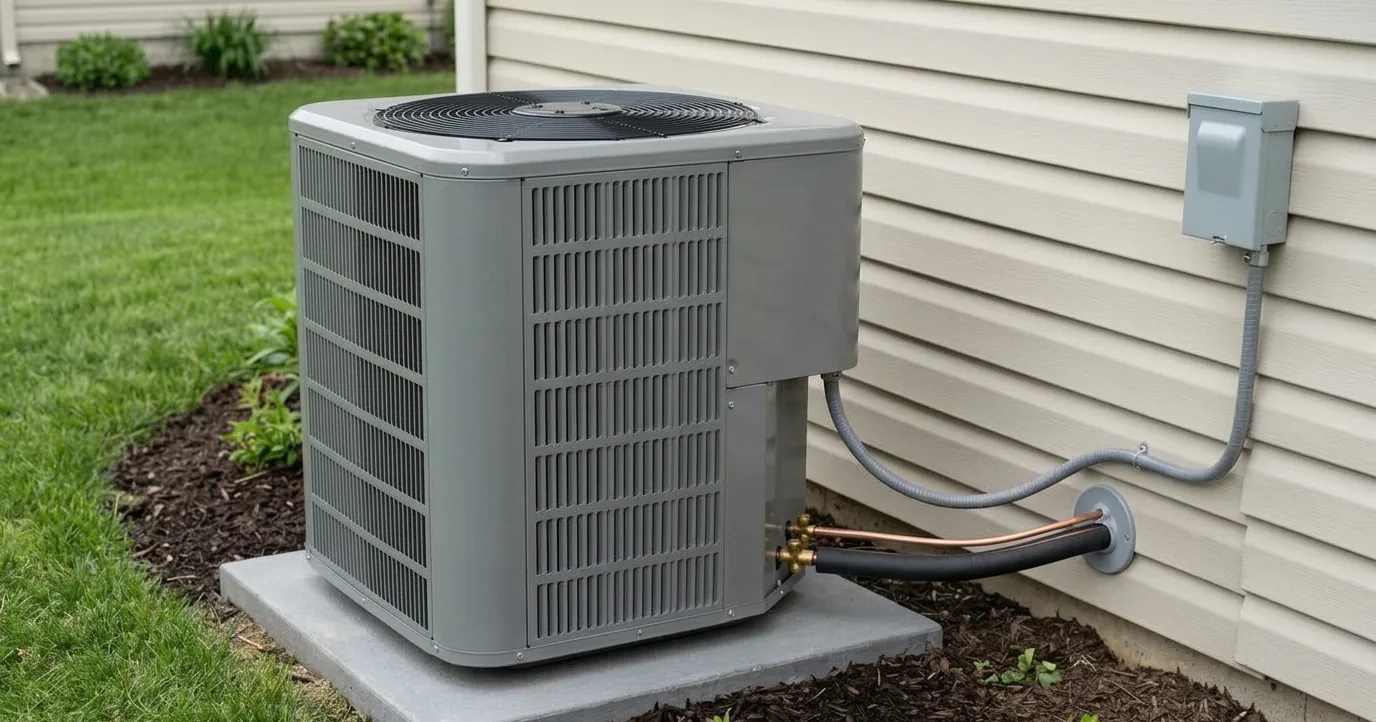
Nearly every air conditioner buying guide published this year, including ours, gives the refrigerant transition a short section and then moves on to efficiency ratings. That section leaves the three questions a homeowner actually has sitting untouched on the table: what is in the machine outside right now, whether it can still be serviced, and what it should cost when a technician says the charge is low.
This is the reference for those three questions. It is not a buying guide, though it will help you read one. It is the thing to open when a truck is in the driveway and somebody has just said a word that starts with R and ends in a number.
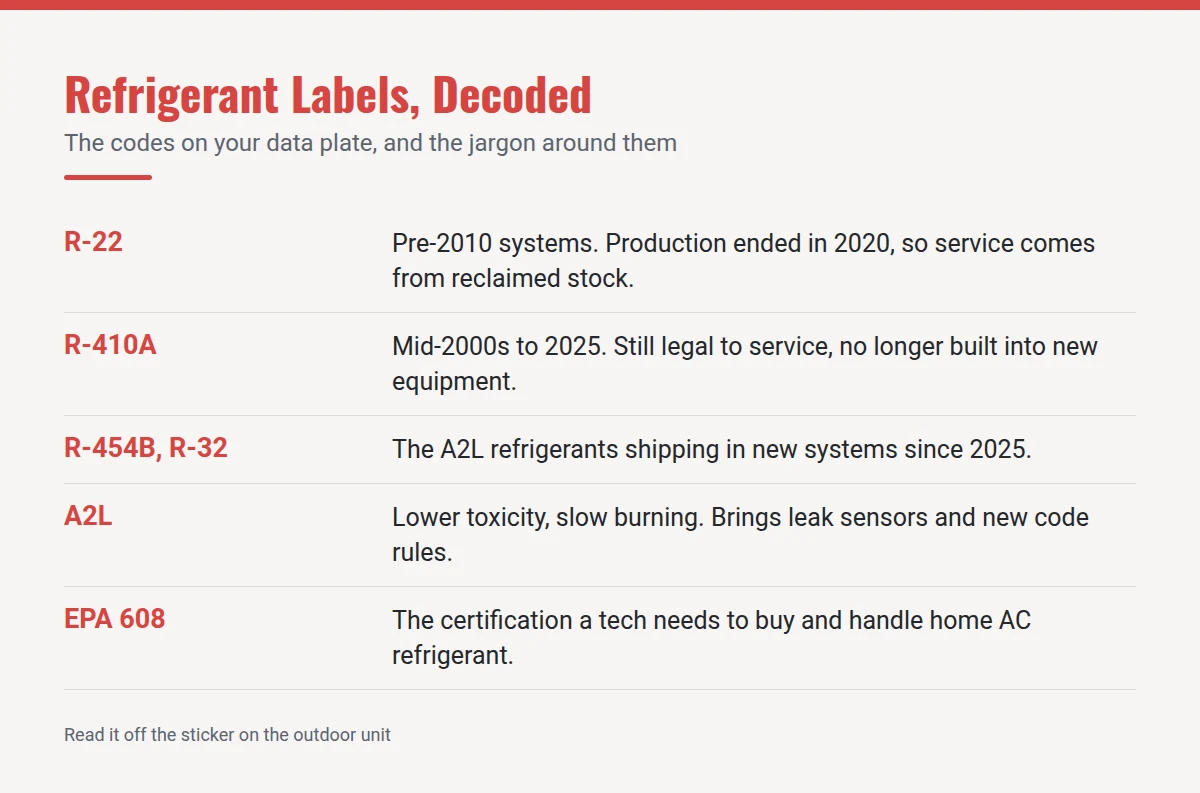
Go Outside and Read the Data Plate
The answer is printed on the equipment. On the outdoor condenser there is a rectangular metal or foil label, usually on the cabinet side facing away from the house, occasionally hidden behind the small service valve access panel. Four things on it are worth writing down or photographing.
Refrigerant type. Printed next to the word REFRIGERANT, or sometimes FACTORY CHARGE. It will read R-22, R-410A, R-454B, or R-32.
Charge weight. Given in pounds and ounces. This is the factory charge for the outdoor unit alone, before the installer added whatever the line set length called for. Most residential systems end up holding somewhere between five and twelve pounds total, depending on tonnage and how far the copper runs.
Model and serial number. You will need both for warranty lookups and for a second opinion.
Manufacture date. Many plates print it outright. Where they do not, the serial number usually encodes it, but the format varies by manufacturer, so the faster route is often the refrigerant itself, which dates the machine well enough for a repair-or-replace decision.
Do not trust the vocabulary a technician uses in passing. Freon is a brand name, not a refrigerant type, and it has been applied to several different chemicals over sixty years. Puron is one manufacturer’s brand for R-410A, and Puron Advance is the same company’s brand for R-454B. If someone tells you the system takes Freon, you have learned nothing and should go read the plate.
If the plate is unreadable or the unit is boxed in, three other places carry the answer: the installer’s sticker inside the indoor air handler door, the mechanical permit record at your building department, and the AHRI certificate that came with the original paperwork. The indoor coil has its own data plate too, and on a properly matched system it will name the same refrigerant.
Three Generations, and Which One You Have
R-22. An ozone-depleting HCFC, classified A1 for lower toxicity and no flame propagation. Production and import into the United States ended on January 1, 2020. If your plate says R-22, the equipment is almost certainly pre-2010, which makes it fifteen years old at the youngest.
R-410A. The HFC blend that replaced it, also A1, with no ozone impact but a global warming potential of roughly 2,088. Standard on residential equipment from the mid-2000s until the manufacturing cutoff in 2025.
R-454B and R-32. The A2L refrigerants now shipping in new equipment, at a GWP of about 466 and 675 respectively. Most major brands chose R-454B; a couple went with R-32.
The dividing line between those last two generations is a number. Under the American Innovation and Manufacturing Act, the EPA set a GWP limit of 700 for residential and light commercial air conditioning and heat pumps, with a manufacturing compliance date of January 1, 2025. R-410A sits at nearly three times that limit, which is why it stopped being built into new systems. R-454B and R-32 clear it, which is why they are what the factory now fills.
None of that makes an existing R-410A system illegal, unsafe, or unserviceable. Service refrigerant is a separate question from new equipment, and nothing in the rule requires you to touch a working machine.
What Changed in 2026: The Install Deadline Disappeared
This is the part that has moved most recently, and it matters if you are shopping right now.
The original 2023 rule let equipment manufactured or imported before January 1, 2025 be installed for one more year, until January 1, 2026. On May 21, 2026, the EPA finalized a reconsideration that removed that installation date entirely, allowing pre-2025 inventory of residential and light commercial air conditioning systems to be installed until the supply runs out. The change took effect on July 27, 2026.
So if a contractor offers you a new R-410A system at a discount this year, that is a legitimate offer and not a clearance scam. Whether it is a good buy is a different matter, and the trade’s own objection tells you why. AHRI and other industry groups argued against the extension precisely because keeping demand alive for a refrigerant on a legal phasedown pushes the price of service refrigerant up for everyone. One distributor association projected the change could add close to $8 billion in refrigerant costs.
Read that as the honest version of the trade-off. The R-410A unit saves you money at the register today, and the system you are buying will need service for the next fifteen years out of a supply that is shrinking on a schedule. That is exactly the road R-22 already walked. Our central air conditioner buying guide covers how this sits alongside SEER2 and sizing when you are actually comparing quotes. One more caution: states can be stricter than the federal rule. New York passed a law keeping the original January 1, 2026 deadline in place, so the federal answer is not automatically the answer in your county.
If the Plate Says R-22
Start with what is not true. Your system is not illegal, you are not required to replace it, and the refrigerant has not run out. The EPA is explicit that there is no requirement for homeowners to convert or scrap existing HCFC-22 equipment, and that servicing can continue using recovered and reclaimed stock plus material produced before the 2020 cutoff. Reclaimers reported more than 140 million pounds of HCFC-22 recovered and cleaned between 2000 and 2018.
What is true is that the supply is finite and the price reflects it. A recharge on an R-22 system costs multiples of the same job on a current system, and that gap widens every year.
The second true thing is that there is no drop-in replacement. Retrofit blends exist and are sometimes sold that way, but the EPA’s own guidance is blunt that alternative refrigerants will not work properly without changes to system components. A real conversion means a different lubricant (R-22 systems ran on mineral oil, the HFC alternatives need polyolester), often a metering device change, and usually some capacity loss. On a fifteen year old condenser that is a lot of money spent to make an old machine slightly less orphaned.
The practical rule is simple. On an R-22 system, the first significant leak is the decision point, not an annual inconvenience. Price the repair against replacement once, honestly, and then stop revisiting it. Our breakdown of what heating and air service calls actually cost gives you the ranges to measure a quote against.
One trap to avoid on the way out: replacing only the outdoor unit and leaving the old indoor coil in place. A mismatched pair loses efficiency, voids most manufacturer warranties, and leaves an aging coil as the next failure. If the outdoor unit goes, the coil goes with it.
Topping Off Is a Rental Payment, Not a Repair
A residential air conditioner is a sealed system. It does not burn refrigerant, consume it, or use it up the way an engine uses oil. The charge that left the factory is meant to stay in the loop for the life of the machine. So a system that is low is a system that is leaking, and there is no other explanation.
This is not a fringe opinion held by consumer advocates. AHRI, the trade body that represents the manufacturers themselves, tells equipment owners in plain language to request that technicians locate and repair leaks rather than topping off leaking systems.
What makes the top-off persist is that it works, briefly. Add refrigerant to a leaking system and the house cools again that afternoon. The leak is still there, the charge bleeds back out over weeks or months, and next July you buy the same gas again. Meanwhile the system runs undercharged for most of the interval, which means higher electricity bills, poor humidity removal, and in the worst case a compressor running hot on inadequate oil return.
If a technician proposes adding refrigerant, three questions settle it. How did you search for the leak. What did you find. What were the superheat and subcooling readings before and after. A real answer names a location. Our guide to reading a repair diagnosis and sanity-checking a quote covers how this one fits alongside the other classic plays.
Why You Cannot Just Buy a Can
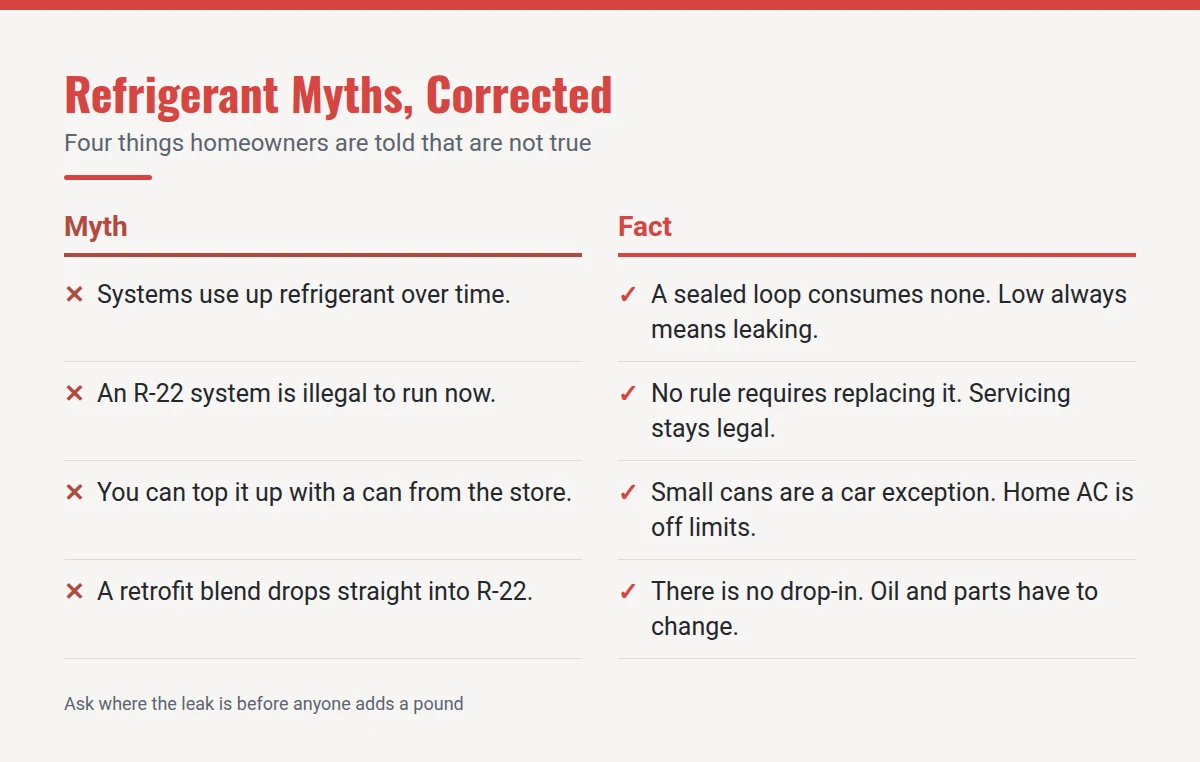
People ask this constantly, and the answer has two independent halves, either of which would be enough on its own.
The legal half. Under the EPA’s Section 608 sales restriction, refrigerant intended for stationary air conditioning may only be sold to certified technicians or to their employers with written proof of employment. The small self-sealing cans you can buy off a shelf are a motor vehicle exception: they cover car air conditioning under Section 609 and do not extend to the system in your side yard, regardless of container size. Intentionally venting refrigerant during service, repair, or disposal is separately prohibited.
The practical half. Even if the law vanished tomorrow, a sealed split system is not a top-up job. The correct charge is set by weight and verified by superheat or subcooling measurements taken with a manifold and probes at a stable operating condition. Overcharging is not a harmless surplus; it raises head pressure, can flood liquid back to the compressor, and kills the most expensive component in the system. There is no gauge on the side of the unit telling you when to stop.
What you can safely do yourself is everything upstream of the sealed loop: filters, the outdoor coil, drainage, thermostat settings, breakers. Our walkthrough for an AC that runs but will not cool draws that line explicitly, DIY checks on one side and EPA-certified work on the other.
How a Leak Actually Gets Found
A proper leak search is a sequence, not a glance. It starts by confirming the system really is undercharged rather than suffering an airflow problem that looks identical from the thermostat. Then the technician narrows the field:
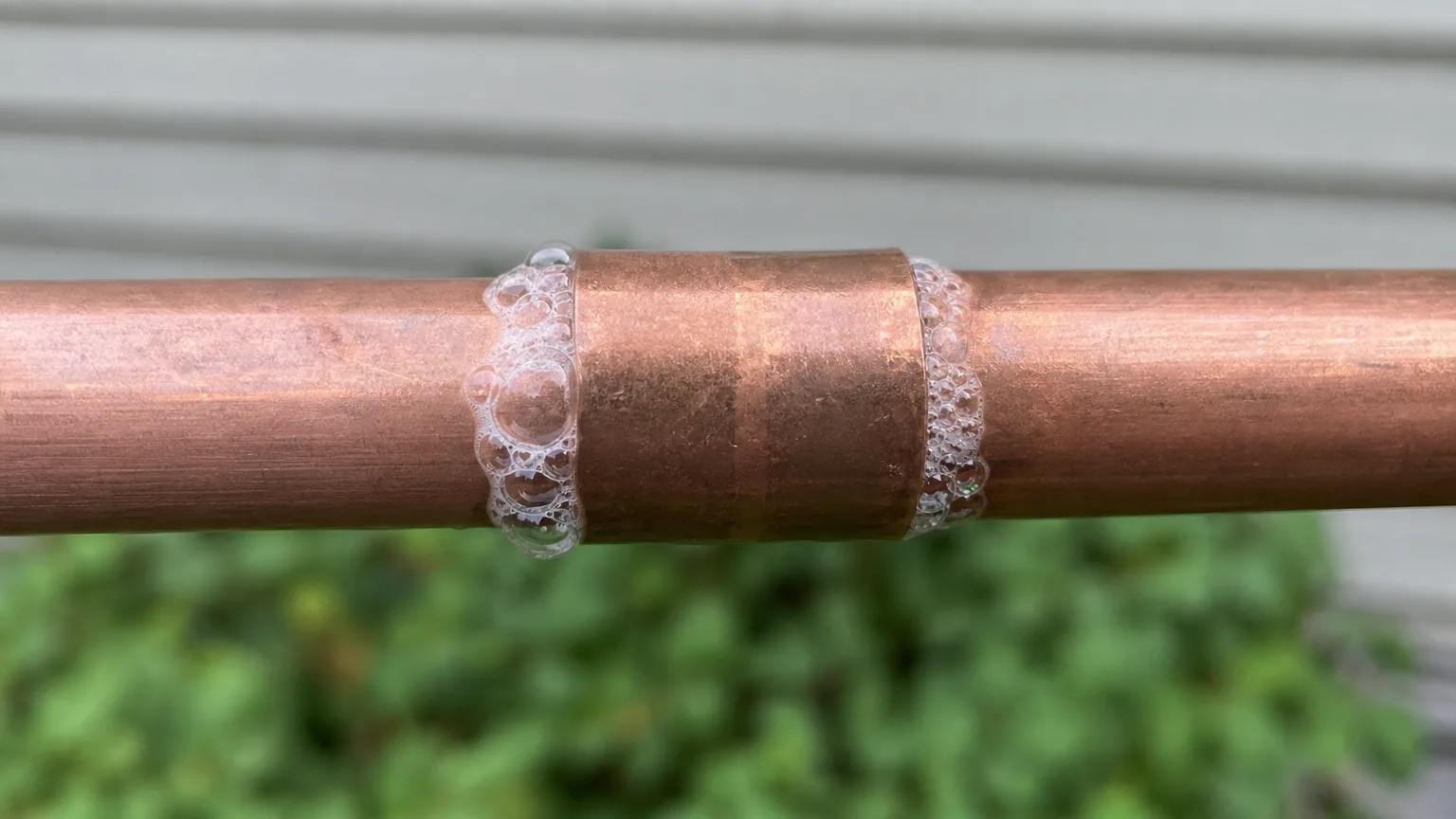
Visual and bubble check. Oil residue is the giveaway, because refrigerant leaving a joint carries compressor oil with it. Soap solution at accessible brazed joints, service valves, and Schrader cores catches the easy ones in minutes.
Electronic detector. A heated-diode or infrared sniffer traced slowly along the line set, coil hairpins, and return bends. Fast, but prone to false positives in a windy yard.
UV dye. Injected into the system, then found with a blacklight on a return visit days or weeks later. Useful for slow leaks that no sniffer will catch in one appointment.
Nitrogen standing pressure test. The strongest tool, because it isolates. The technician sections the system, pressurizes one section with dry nitrogen, and watches whether the gauge holds.
That last one is how the real ones get caught. A published walkthrough of a one year old heat pump that had lost its entire charge shows the method well: the visible outdoor joints soaped clean with no result, so the line set was separated in the attic and pressure-tested by itself. The pressure fell away quickly, which located the leak in the line set rather than in the equipment, and pointed at damage from work done on the house after installation. A top-off would have hidden that for a season and taught nobody anything.
What drives the bill is access and location, not the refrigerant. A leaking service valve in the open air is a short visit. An evaporator coil buried in an attic air handler is a labor day plus a part, and on an out of warranty system that number often lands close enough to a replacement to make the comparison worth running.
What the Gas Itself Costs
Installed pricing swings enormously by region and by who is holding the wrench, and industry estimates vary widely, so treat any single national number with suspicion. What you can anchor on is the wholesale side, which is public and which moved violently in 2025.
Trade press reporting put the spring 2025 wholesale price of a 20 pound cylinder of R-454B at roughly $650 to $700 in one major metro, against about $350 for R-32, with secondary market cylinders passing $1,000. The cause was not the chemical but the container: A2L-rated cylinders with pressure relief valves and left-hand threads were backordered, and one major producer added a surcharge of over 40 percent in early 2025 to cover imports. Supply has improved since, but that is the recent history sitting underneath 2026 quotes.
Work the arithmetic from there. If a system holds eight pounds and the wholesale gas alone is in the $30 to $35 per pound range, a full recharge carries a material cost before anyone has touched labor, recovery equipment, a vacuum pump, or the hour spent finding the leak. That is why a line item reading “refrigerant, 4 lbs” with no other detail deserves a question, and why the same line on an R-22 system deserves a harder one.
Ask for the invoice itemized: diagnostic fee, leak search, the repair itself, refrigerant by the pound at a stated rate, and evacuation. A company that will only give you one number has made the one number unarguable, which is the point.
What A2L Actually Changes
The A2L classification comes from ASHRAE Standard 34, which grades refrigerants on toxicity and flammability. The A means lower toxicity. The 2L means lower flammability with a slow burning velocity, under 10 centimeters per second, which is the slowest class of flammable refrigerant defined. These are difficult to ignite and difficult to keep burning. They are not propane.
What they do require is engineering, and that engineering is now in your house:
A leak sensor on the indoor unit. Under UL 60335-2-40, equipment using A2L refrigerant carries a refrigerant detection system that must respond when concentration reaches 25 percent of the lower flammability limit, within 60 seconds, across the sensor’s rated life. The mitigation response is unglamorous and effective: the indoor blower runs to dilute and disperse what leaked.
Charge limits tied to room size. Allowable charge is calculated against the smallest occupied volume the equipment may serve, with a safety factor of four built into the dilution math. This is why an A2L mini-split has a maximum room size for a given capacity.
Code and labeling changes. The 2024 International Mechanical Code was updated to align with the current ASHRAE 15 and 34 editions, naming the UL standards that A2L equipment must meet and adding detection, ventilation, and labeling provisions.
Different tools and different cylinders. A2L cylinders are gray with a red stripe, carry relief valves, and use left-hand threads so they cannot be cross-connected. Recovery machines, vacuum pumps, and detectors all need A2L ratings, and there are transport and storage rules for the van.
For you as an owner, the practical consequence is a new failure mode worth knowing about. A refrigerant detection system that trips, correctly or otherwise, will interrupt normal operation. If a new A2L system behaves strangely, ask whether the control board logged a sensor fault before anyone starts discussing the compressor.
At Replacement: Recovery and Reclaim Are Not Optional
When the old system finally comes out, the charge in it is regulated material. Intentionally releasing it is prohibited under Section 608, and refrigerant must be recovered before equipment is disposed of, scrapped, or rendered permanently inoperable. Used refrigerant cannot simply be resold either: to go back on the market it must be reclaimed to the purity specification in AHRI Standard 700, which the EPA has adopted into its own regulations.
That gives you a short list of things to watch on changeout day:
- A recovery machine and a recovery cylinder on site before the old unit is cut loose. If nothing is hooked to the system while it comes apart, the charge went into the air.
- The line set flushed or replaced when the refrigerant is changing, since mineral oil residue from an R-22 system will not play well with a polyolester charge.
- A nitrogen purge flowing through the copper while joints are brazed, which prevents the oxide scale that later clogs a metering device.
- Evacuation to a documented vacuum, and the final charge weighed in and written on the invoice rather than eyeballed.
Our walkthrough of what happens on HVAC installation day covers the rest of that punch list, including the commissioning numbers to collect before you release final payment. Refrigerant is the part of it nobody thinks to ask about, which is exactly why it is worth asking about.
Further reading (sources)
- U.S. Environmental Protection Agency on what the end of R-22 production means for a system you already own
- U.S. Environmental Protection Agency with the restriction on who may buy refrigerant at all
- National Association of Home Builders for the 2026 rule that let pre-2025 R-410A stock keep going in
- The ACHR News covering the GWP threshold behind the switch and the industry’s objection to the extension
- Air-Conditioning, Heating, and Refrigeration Institute telling owners to ask for leaks to be found rather than topped off, and where a recovered charge goes
- Contracting Business on what the A2L cylinder shortage did to refrigerant prices
- UL Solutions explaining what a refrigerant detection system has to do and how fast
- International Code Council with the A2L provisions added to the 2024 mechanical code
- The Cool Down for a leak traced to the line set rather than the equipment