Will Your Electrical Panel Handle a Heat Pump? Amps, Load Calcs, and Avoiding a Service Upgrade
Published on September 9, 2026
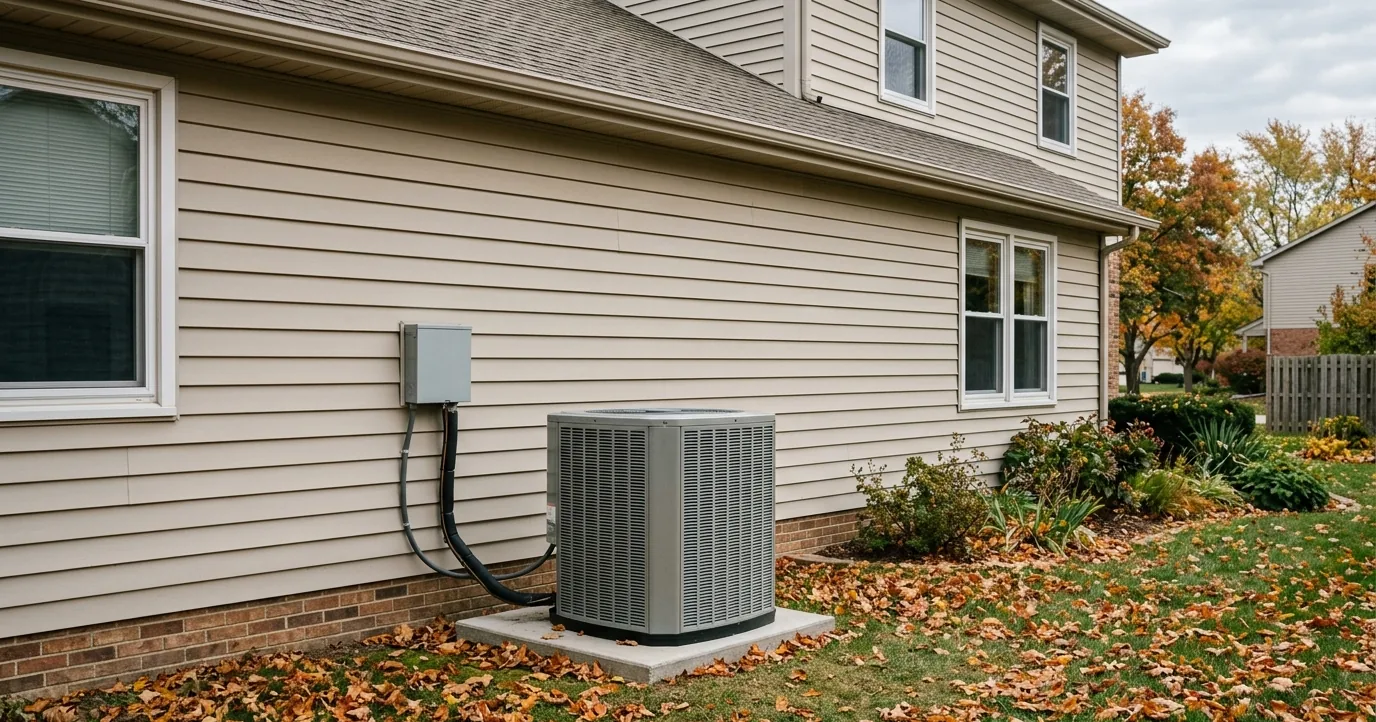
The quote comes back and there is a line on it nobody warned you about. Not the equipment, not the labor, not the permit. Somewhere near the bottom sits “electrical service upgrade” with a four-figure number next to it and no explanation attached. Ask what it is for and the answer is usually some version of “your panel won’t handle it.”
Sometimes that is true. Often it is a guess that nobody has actually checked, and it is the most consequential unexamined line item in home electrification. The good news is that the question has a real answer, arrived at by arithmetic a homeowner can follow. Before any of this applies to your house, get two facts in hand: the amperage stamped on your main breaker, and the age and type of the system you are replacing. Swapping a 20-year-old central air conditioner for a heat pump is a much smaller electrical event than converting a gas-heated house to all-electric, and the two get treated as the same problem far too often.
The Number on the Main Breaker Is Not the Whole Story
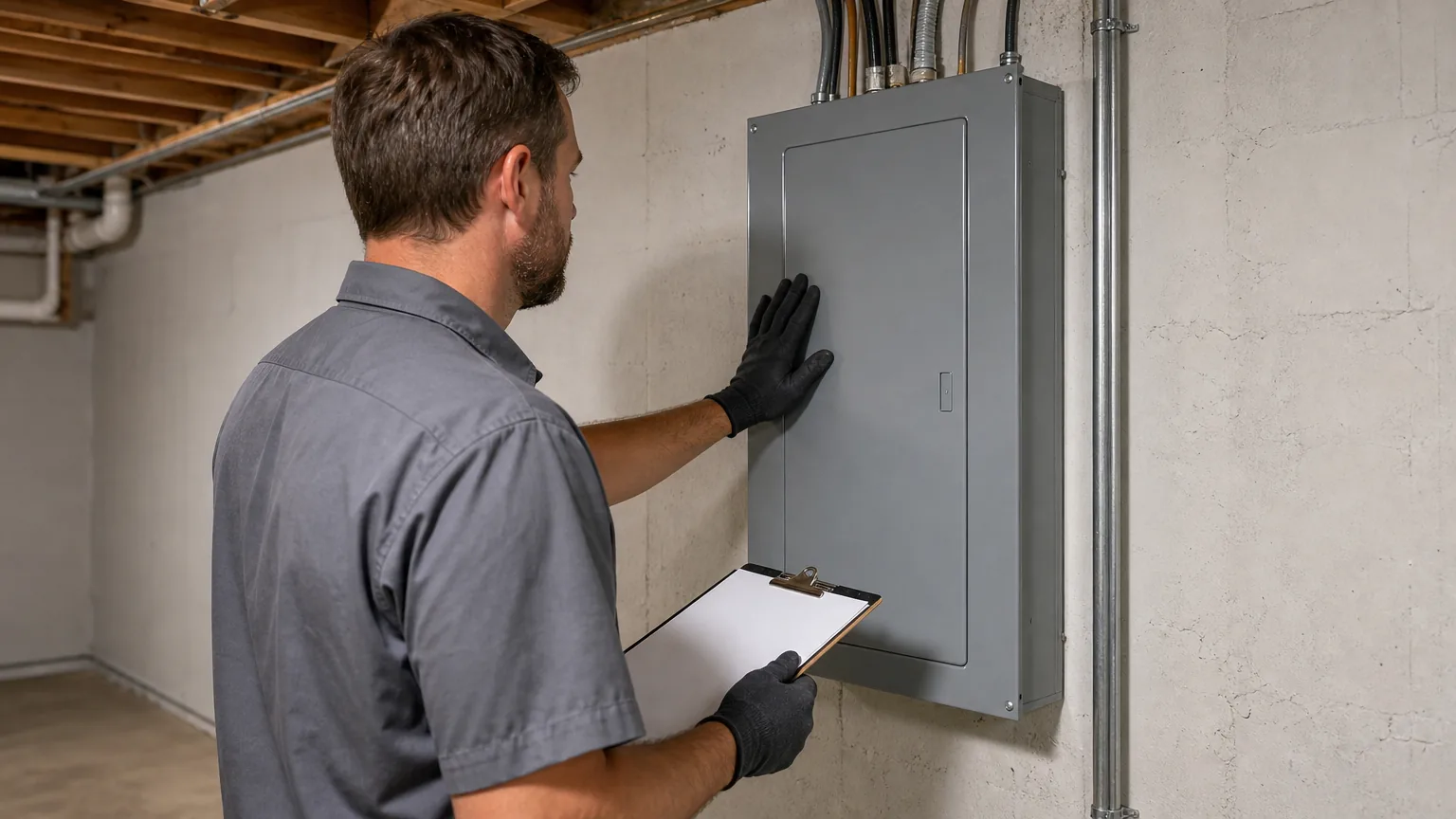
Open the panel door. The main breaker is the oversized double-wide switch, usually at the top, and it will be stamped with a number: 100, 125, 150, or 200. That number is your service size, and in most housing stock built before the 1990s it says 100.
Three different problems get reported to homeowners with the same sentence, “your panel is full,” and they cost wildly different amounts to solve.
You are out of amps. The house genuinely draws close to its service rating at peak, and adding load would push it over. This is the expensive one, and it is also the rarest of the three.
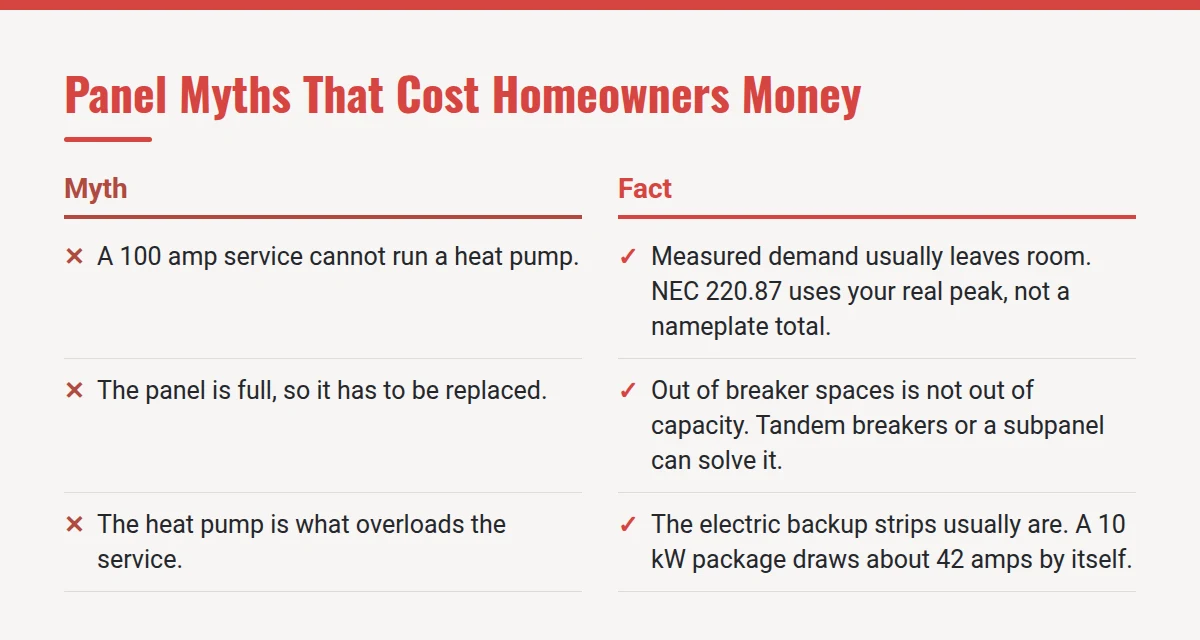
You are out of breaker spaces. Every slot is occupied, so there is physically nowhere to land a new two-pole breaker. This is a much cheaper problem. Many panels accept tandem breakers, two half-width breakers in one slot, in positions the manufacturer designates on the label inside the door. A subpanel fed from the existing service adds spaces without touching the meter, the mast, or the utility. Running out of spaces is not running out of capacity, and conflating the two is how a $600 job becomes a $4,000 one.
The panel itself is a liability. Some equipment gets replaced regardless of what the load math says. Federal Pacific Stab-Lok, Zinsco and Sylvania-Zinsco, Challenger, and split-bus panels with no single main disconnect all have well-documented failure modes, and many electricians will not add a circuit to them at any price. The same goes for a panel showing corrosion, heat discoloration, or double-tapped breakers. If that is your situation, the upgrade was owed already and the heat pump simply put a date on it.
Sort out which of the three you have before you argue about anything else, because only the first one is about capacity.
What a Heat Pump Actually Draws
Every piece of HVAC equipment carries a data plate listing minimum circuit ampacity (MCA) and maximum overcurrent protection (MOCP). MCA sizes the wire, MOCP caps the breaker, and together they are the only load numbers that belong in a calculation. Guessing from tonnage is how bad quotes get written.
For a typical 3-ton air-source heat pump, the outdoor unit lands on a 30 to 40 amp 240-volt circuit. That is the same circuit a 3-ton air conditioner uses, which is the single most useful fact in this whole article: if you already have central AC, that circuit exists, that load is already in your panel’s history, and swapping the outdoor unit for a heat pump adds running hours rather than a new service load.
The load that actually moves the needle is the supplemental electric heat inside the air handler. A 10 kW strip package at 240 volts draws roughly 42 amps and usually wants a dedicated 50 or 60 amp circuit of its own. That accessory can be electrically larger than the heat pump it is backing up, and it is routinely specified by habit at 10 or 15 kW because that is what the distributor stocks.
So two decisions drive the panel question more than the heat pump does. First, how many kW of strip heat you actually need, which depends on your design temperature and on how much capacity the equipment holds when it gets cold. Modern cold-climate units hold far more than older ones, and our guide to what actually works below freezing covers how to size backup heat to the real load instead of the default package. Second, whether you keep the existing furnace as a dual-fuel backup, which drops the electric backup requirement to zero. Either choice can turn a service upgrade into a non-issue, and neither one shows up on a quote unless somebody asks.
The Load Calculation That Usually Says Yes
There is more than one legal way to calculate whether a service can take a new load, and the method chosen decides the answer.
The familiar approach adds up nameplate ratings with standard demand factors applied. It is fast, it needs no data about your house, and it assumes a worst case that no real household ever produces. Plenty of 100 amp services fail on paper by that method while sitting at a third of their capacity in practice.
The alternative is NEC 220.87, “Determining Existing Loads,” and it is the provision worth knowing by name. Instead of summing nameplates, it uses your home’s measured maximum demand: the highest average kilowatt draw sustained over a 15-minute interval. If at least a year of that data exists, you take 125 percent of the peak, add the new load, and the total has to fit inside the service rating. If a year of data is not available, a 30-day recording works as long as it captures the peak heating or cooling season rather than a mild month.
This matters because real houses are nothing like their nameplate sum. A gas-heated home with an electric range, an electric dryer, and central air commonly peaks somewhere in the 20 to 40 amp range, because the oven, the dryer, and the compressor are almost never all at full tilt in the same quarter hour. Run 220.87 on a house like that and a heat pump fits inside 100 amps with room left over.
Getting the data is easier than it used to be. Many utilities publish interval usage through a Green Button download or a customer portal, and that file is exactly what the calculation wants. If yours only reports monthly kilowatt-hours, an electrician can install a recording meter or a whole-home energy monitor and log 30 days.
Two honest caveats. Your local authority having jurisdiction has the final word, code editions are adopted state by state rather than nationally, and some inspectors want the calculation stamped by an engineer. And the method assumes the record reflects normal operation, so a house that has been load-shaving or running solar behind the meter needs different treatment. Ask your electrician which edition your jurisdiction enforces before you count on any of it.
The 120-Volt Units That Skip the Question Entirely
A newer category sidesteps the panel argument completely by refusing to need a new circuit at all. Packaged window heat pumps from Gradient and Midea plug into an ordinary 120-volt outlet and mount in an existing window opening, with no wall cutting, no new ductwork, and no electrician. Midea’s unit is rated to deliver full heating output down to 5 degrees with no resistance backup strips, and Boston’s housing authority has been piloting the Gradient version in occupied public housing, which is exactly the setting where a service upgrade is impossible.
The limits are real and worth stating plainly. A 15 amp 120-volt circuit supports roughly 1,440 watts continuous, which conditions a room or a small open zone, not a house. Cost per BTU is higher than a conventional split system. Several rooms means several units, several outlets, and attention to which branch circuits those outlets share. And these are appliances that live in a window, with everything that implies for looks and for the view.
Where they win is apartments, condos, additions, historic buildings that cannot be altered, and the single stubbornly uncomfortable room. If that last one is your actual complaint, the panel may be a red herring entirely, and our zoning systems guide walks through the distribution fixes that address a hot or cold room without any new equipment load at all.
The same 120-volt logic has reached water heating. Rheem’s plug-in heat pump water heaters run on a standard outlet, including shared-circuit models sized for a 15 amp branch, which can save four figures on a gas-to-electric conversion that would otherwise need a new 240-volt run. They carry no resistance backup, so they suit spaces that stay above roughly 37 degrees, and the shared-circuit version is rated for households of about five people or fewer. Our heat pump water heater guide has the sizing detail.
Load Management: Making 100 Amps Behave Like More
If the calculation comes back genuinely tight, hardware can stretch what you have.
Circuit-sharing devices are the cheap end, roughly $400 to $700, from NeoCharge, SimpleSwitch, Splitvolt, and DryerBuddy. They interlock two 240-volt loads on one circuit so only one can draw at a time. One caution the marketing does not lead with: heating is not a deferrable load the way EV charging is, and you do not want your heat pump waiting its turn behind a clothes dryer at 6 a.m. in January. The smart play is the reverse. Put the EV charger and the dryer on the shared circuit, and spend the capacity you free up on the heat pump.
Smart panels and smart breakers are the expensive end. SPAN, Schneider Electric’s Square D line, Eaton’s smart breakers, and Koben’s Genius panel all actively manage what runs when, typically $3,000 to $5,000 plus installation. Lumin takes a cheaper subpanel-and-modules approach, targeting around $200 for the hub and $60 to $80 per controlled circuit, which avoids replacing the panel outright.
The code mechanism behind these is worth understanding, because it is what turns a gadget into a permit approval. The 2023 NEC expanded Article 750 for energy management systems, and where an EMS limits current to a service in the prescribed way, 220.70 permits the system’s maximum setpoint to be used as the load in the calculation instead of the connected equipment’s full rating. That is the legal basis for adding a heat pump to a service that could not otherwise accept it, and it depends entirely on your jurisdiction’s adopted edition and your inspector’s comfort with the approach.
One value judgment. If a smart panel costs about what a service upgrade costs, the service upgrade is the more durable purchase: copper does not need firmware updates, a cloud account, or a company that still exists in 2040. Buy a smart panel for what it does beyond the load calculation, such as circuit-level monitoring, battery and solar integration, or controlled backup during an outage. Buy it as cheaper wire and you may be disappointed twice.
What a Real Service Upgrade Costs
Two very different jobs get called a panel upgrade, and quotes rarely distinguish them.
A panel replacement swaps the enclosure, bus, and breakers while the existing service stays put. That is commonly $1,500 to $3,000, and some markets come in well under that.
A service upgrade replaces the service equipment itself: the meter base, the mast or weatherhead, the service-entrance conductors, and the grounding electrode system, with the utility disconnecting and reconnecting power around the work. Budget $3,000 to $6,000 through much of the country.
Then geography takes over. Midwest jobs cluster in that $3,000 to $6,000 band. Overhead upgrades in Northern California have been quoted at $5,000 to $10,000 with three to six months of utility scheduling attached, and replacing an underground service has run as high as $25,000 and roughly a year. That spread is not contractor greed; it is utility rules, trenching, and queue depth.
Make any quote itemize the rest of it. Permit and inspection typically run $100 to $500. Some utilities charge a coordination fee up to $500 and some charge nothing. In a number of jurisdictions the permit triggers a broader inspection of the existing wiring, and anything found out of compliance has to be corrected before sign-off, which has added $500 to $2,000 to plenty of projects. Drywall patching and paint are usually excluded.
The underrated cost is the calendar. If the utility queue in your area is three months deep, an October start does not produce heat in November. Schedule the electrical work ahead of the equipment, not alongside it. For how the electrical line item behaves next to everything else in a project, our full price breakdown by system type puts it in context, and the panel line has its own funding: HEEHRA rebates reach $4,000 for a panel and $2,500 for supporting wiring where a state program is running, plus the federal credit line for a panel tied to qualifying equipment. Our money guide covers what stacks with what.

Seven Questions for the Contractor Who Quoted You
- What is my calculated load in amps, and which method produced it? A contractor who cannot answer has not done a calculation.
- Did anyone pull twelve months of my actual demand data? If not, ask whether NEC 220.87 changes the answer.
- What is the MCA on the outdoor unit you are proposing? It is printed on the data plate. It is not a mystery.
- How many kW of supplemental heat is in that air handler, and why that much?
- What happens to the calculation at 5 kW of strips, or with the furnace kept as backup?
- Am I out of amps, out of breaker spaces, or looking at a panel nobody will work on? Three problems, three prices.
- Has the utility confirmed the drop and transformer can carry it, and what is the current queue?
If the answers are vague, that is information. The estimating rigor you see on the electrical side tends to predict the rigor everywhere else, and our guide to vetting an HVAC company covers the rest of the credentials worth checking before five figures change hands.
The Bottom Line
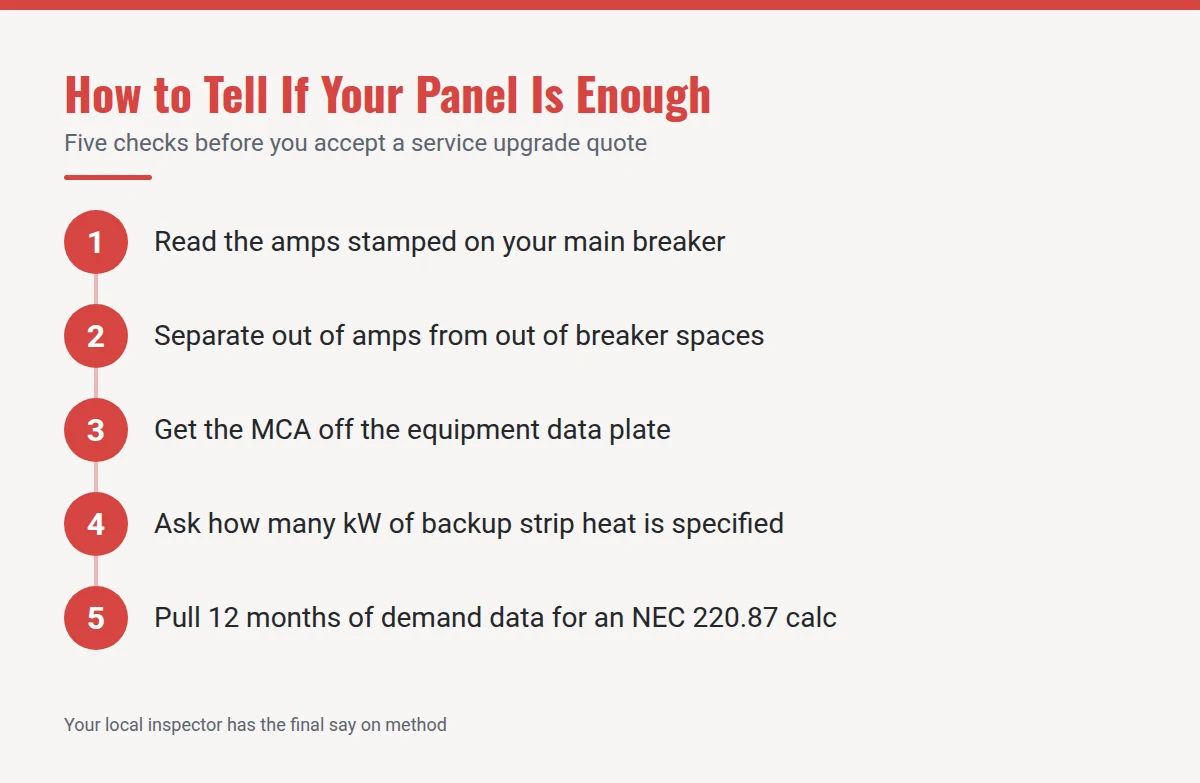
The panel is a genuine constraint on some houses and a phantom on many others, and the difference is knowable for the cost of an hour of somebody’s attention. Read your main breaker. Separate the amps problem from the breaker-space problem from the obsolete-equipment problem. Get the MCA off the data plate and ask hard questions about the strip heat, because that accessory, not the heat pump, is usually what pushes a service over.
Then insist on a load calculation that reflects how your house actually uses electricity rather than how it might behave on the worst day imaginable. When a service upgrade really is required, it is money well spent and it lasts fifty years. When it is not, it is several thousand dollars charged for an assumption, and the only thing standing between you and that charge is asking which one you are looking at.
Further reading (sources)
- The Cool Down on the overlooked piece slowing heat pump adoption
- Rewiring America for how to electrify a house on a 100 amp panel
- UpCodes with the code text on determining existing loads
- Canary Media covering the devices that stretch a panel instead of replacing it
- Mike Holt Enterprises explaining how an energy management setpoint enters the load calculation
- WBUR on a plug-in window heat pump pilot in Boston public housing
- Building Decarbonization Coalition for how the first 120 volt heat pump water heater came about