Replace Just the Broken Half? When to Keep a Working Furnace and When a Partial HVAC Replacement Backfires
Published on October 23, 2026

A homeowner in the Pacific Northwest laid out a problem this fall that HVAC contractors see constantly. The compressor in their two-ton heat pump had died after four and a half years, and they knew why. The previous owner’s installer, they wrote, “did a total hack job on the airflow (kinked return duct, no transition box).” The gas furnace inside, the other half of the same system, was 12 years old and still running. They had two quotes, and both fixed the ductwork. The one that also replaced the working furnace cost $5,500 more.
The replies split. Some said keep the furnace as backup heat, others said a Northwest house doesn’t need gas backup at all, and most agreed that how well a furnace has been looked after counts for more than the year it was built. That is a good instinct, but the price gap hides three questions that actually decide it: which parts genuinely have to match, what condition the surviving half is in, and what killed the half that died. Before you compare quotes, write down the age and type of both halves: the outdoor unit (air conditioner or heat pump, plus the refrigerant printed on its data plate) and the indoor unit (gas furnace or electric air handler). Everything below turns on those details.
The Coil Goes With the Outdoor Unit. The Furnace Doesn’t Have To.
A split system is two halves that share two different things. The outdoor unit and the indoor coil (the A-shaped evaporator that sits on top of the furnace or inside the air handler) share refrigerant, joined by copper tubing into one sealed loop. The furnace or air handler shares only air. Its blower pushes the house’s air across that coil, and its cabinet holds the coil up.
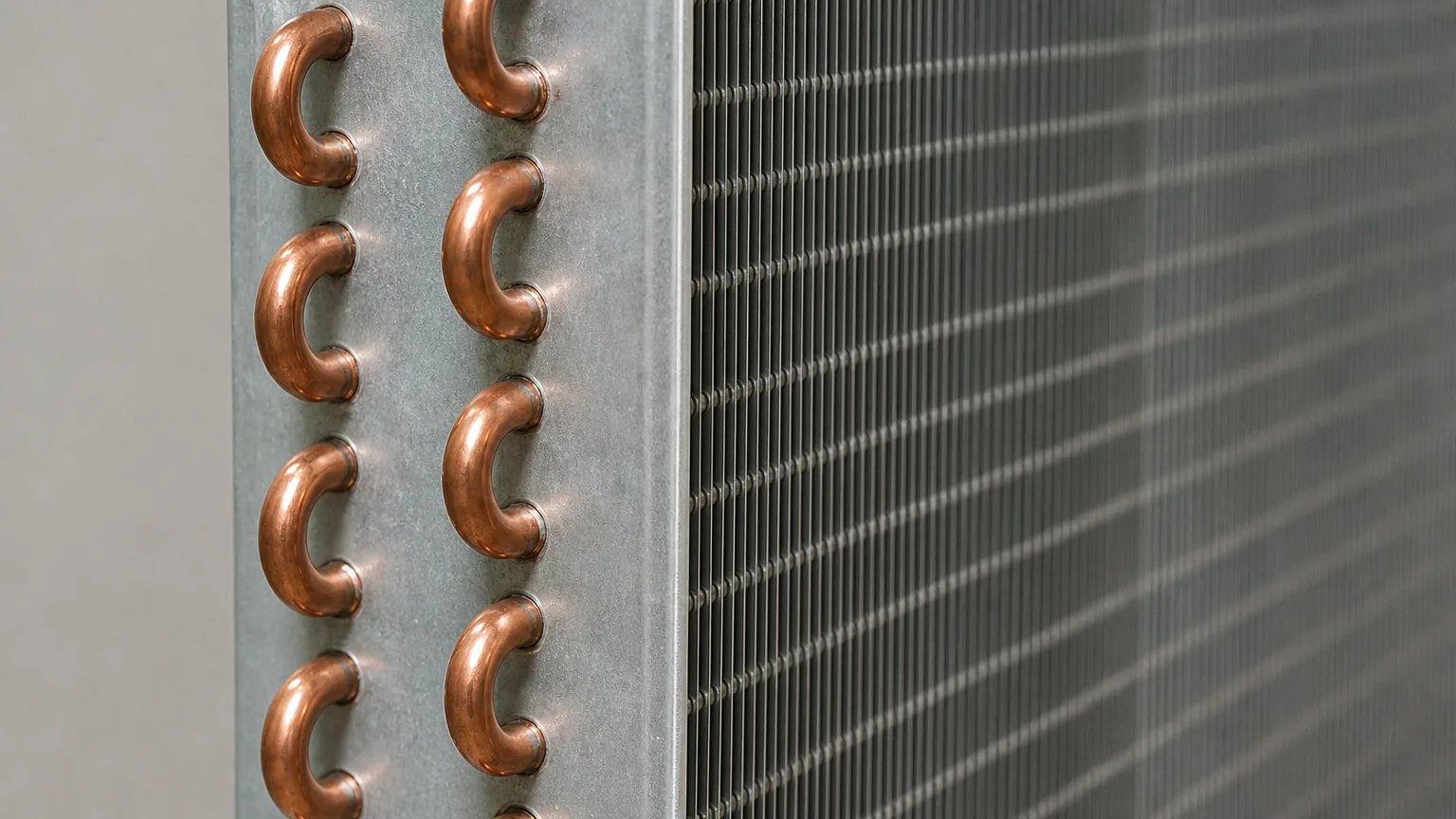
That split settles most of the matching question. The coil is part of the refrigerant circuit, so it nearly always leaves with the outdoor unit. A Department of Energy (DOE) Building America guide calls it “typical for the evaporator coil and expansion valve to be replaced at the same time that the condenser is replaced,” and the reasons are concrete:
- Refrigerant generation. New equipment now ships with the A2L refrigerants R-454B or R-32, and an R-410A system cannot be converted to them. “An existing A1 system cannot be retrofitted to use A2L refrigerants, and there are no drop-in options,” a refrigeration trainer told the trade paper ACHR News last year. One generation back, the DOE guide notes that most coils designed for R-22 are not rated for the higher pressures R-410A runs at.
- The metering device. The expansion valve or piston at the coil’s inlet has to suit the compressor feeding it. NIST’s laboratory study of heat pump installation faults treats a mismatched expansion valve as a fault in its own right: a valve that cannot open far enough to pass the refrigerant the compressor pumps.
- The rating. “For split systems, AHRI certifies the performance of the system and not the individual units,” in the words of the industry’s certification body. The efficiency number in the brochure belongs to one outdoor unit paired with one coil.
The furnace is different. Nothing inside it touches refrigerant, so keeping a good one is a legitimate choice, not a shortcut. That holds for the new refrigerants too. The same ACHR News piece calls it a misconception that an A2L outdoor unit and coil force a furnace replacement: “The existing furnace can remain, but a compatible OEM leak detection kit must be installed.” The sensor usually comes factory installed in the new coil and has to be wired so it can shut the furnace down if refrigerant leaks, so make sure the kit and that wiring appear on the quote.
There is also a narrower repair path if your system runs on R-410A and is young. Under the EPA’s refrigerant transition rule, the work that counts as installing a new system is assembling one for the first time or increasing an existing system’s cooling capacity, so a same-size R-410A outdoor unit on a coil it is certified with remains a repair. It also keeps you on a refrigerant whose service costs are heading up, as our guide to refrigerants in 2026 explains. On equipment this young, ask too whether the compressor alone can be replaced under the parts warranty. Contractors usually swap the whole outdoor unit when a compressor fails, but the DOE guide says they “should assess the practicality of replacing only the compressor.” Whichever path you take, the person who opens the refrigerant circuit must hold EPA Section 608 certification.
What a Mismatch Actually Costs
A mismatched system usually runs, which is exactly what makes it tempting. The costs land in three places.
The efficiency you think you bought. Federal certification rules require every single-stage or two-stage central air conditioner to carry at least one “coil-only” rating, and that rating must represent the least efficient combination sold with that outdoor unit. Manufacturers can certify other pairings too, including “blower-coil” systems in which the fan belongs to the rated package, either an air handler’s own blower or a designated furnace. In practice, a new outdoor unit and coil sitting on a furnace that was never part of a certified pairing are rated as a coil-only combination, and the “up to” number in the brochure may belong to a pairing you are not buying. AHRI’s own homeowner brochure is blunter about the worst case: “improperly matched indoor and outdoor units can create undue stress on your cooling system, resulting in an unnecessary, premature failure.”
The rebate. The same brochure notes that many utilities require the system’s AHRI reference number, the ID of one specific certified combination, before they will pay a rebate. “A mismatched system could disqualify the homeowner or the contractor from getting rebates,” the regulatory chief at one large equipment maker told ACHR News. Some programs also pay differently depending on what happens to the old heat. In 2026 the municipal light plant in Wellesley, Massachusetts, pays $8,500 for a whole-home heat pump when the existing heating system is removed or decommissioned, and $6,500 when it stays. Don’t count on a federal tax credit to close the gap: the IRS lists the energy efficient home improvement credit as covering improvements made through December 31, 2025.
The warranty. Read the new equipment’s warranty for conditions on what it is paired with, and have the contractor confirm in writing that the combination is one the manufacturer certifies. Then check the furnace’s own paperwork. A new outdoor unit does nothing for an old furnace’s coverage, so after a partial replacement you own two warranties that expire years apart.
Find Out What Killed the First One
This is the line item a price comparison hides, and in the Northwest case it matters more than the furnace does. A compressor killed by bad airflow will kill its replacement the same way, and a new furnace bolted onto the same kinked duct does not fix the duct.
Air conditioners are typically designed to move 350 to 400 cubic feet per minute (CFM) of air across the indoor coil for each ton of capacity, according to the DOE guide, and “very low airflow (below 200 cfm per ton) can lead to system failure due to icing of the indoor coil and can shorten equipment life.” A heat pump runs refrigerant through that same coil all winter as well, so an airflow defect works on it year round. A kinked return starves the blower of air. A missing transition, the sheet metal fitting that should join the duct smoothly to the equipment cabinet, forces air through an abrupt, turbulent connection. Both raise the static pressure the blower has to work against, and both cut airflow.
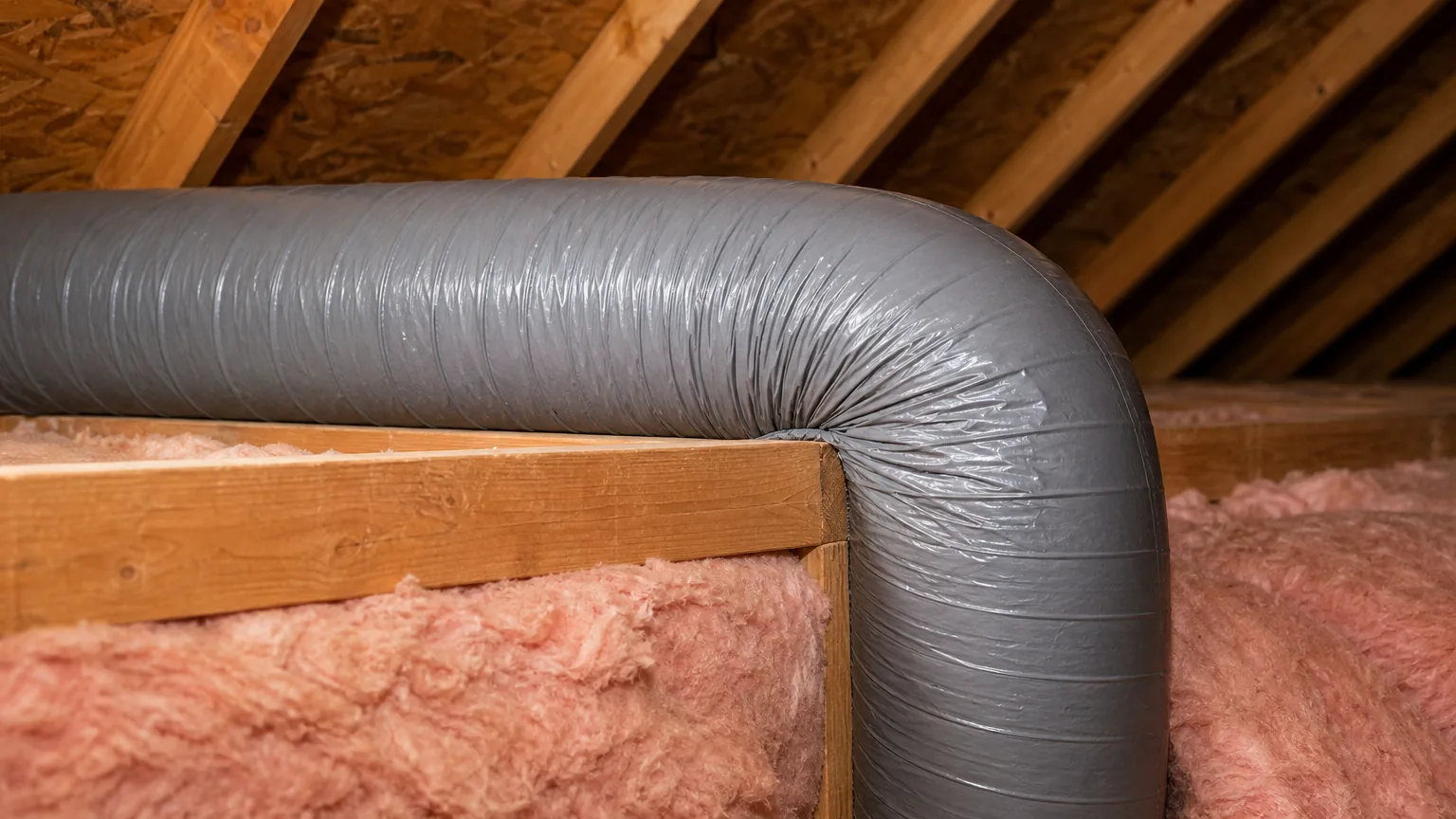
This is common, not exotic. When the Bonneville Power Administration sent researchers to 95 Northwest homes with heat pumps installed between 2015 and 2018, 30 percent had low airflow across the indoor coil, and the share of sites with low airflow or excessive static pressure had not budged since a similar study in 2005.
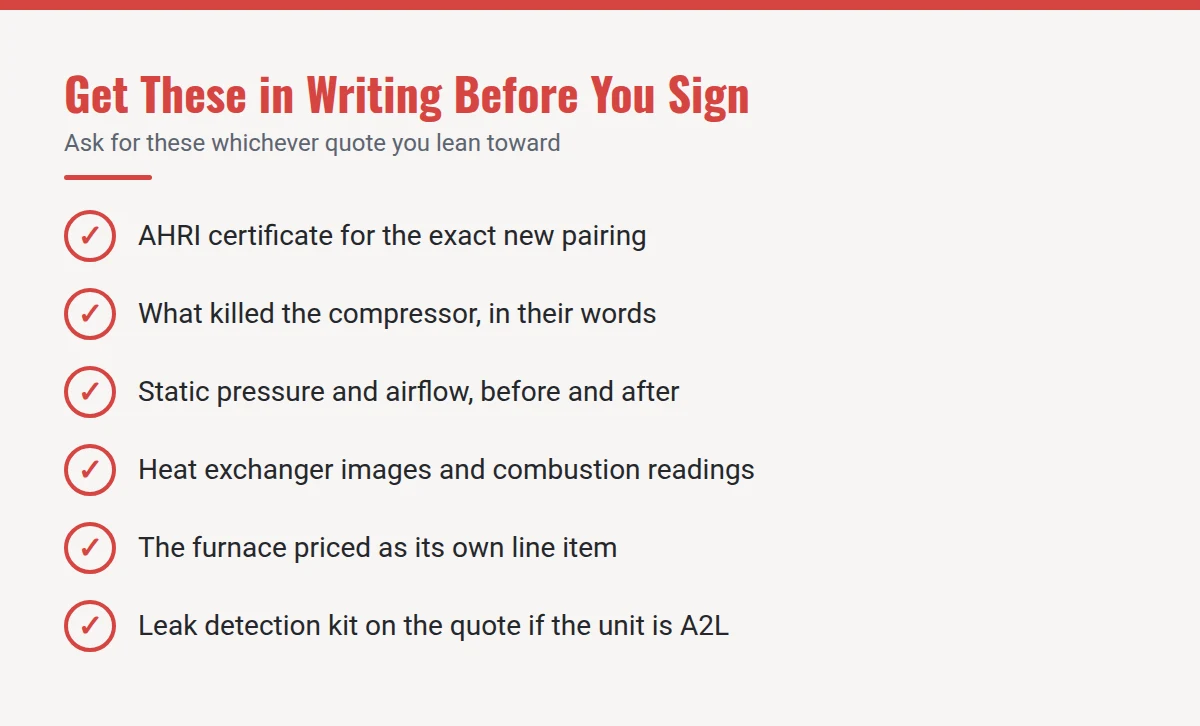
So before you compare prices, ask each contractor for three things in writing: what they believe killed the compressor, what the total external static pressure and airflow measure now, and what they will measure after the duct work. Static pressure is a quick reading taken with two probes. The Northwest heat pump program the BPA researchers measured against caps it at 0.8 inches of water column. A contractor who swaps the outdoor unit without measuring anything is betting your second compressor on the ducts that ate the first. Our guide to duct design, sealing and sizing covers what the fixes usually involve.
Is the Furnace Worth Keeping?
Age is the first filter, not the verdict. ENERGY STAR lists a furnace more than 15 years old, or a heat pump or air conditioner more than 10, among the signs it may be time to replace. Inside that window, condition and maintenance history matter more than the birth year. Three things decide condition.
The heat exchanger. This is the safety question, and the DOE guide puts it plainly: “the older the furnace, the greater the risk that cracks in the heat exchanger could introduce carbon monoxide into the house.” A real inspection produces evidence, such as camera images of the heat exchanger and combustion analyzer readings, so ask for both. A cracked heat exchanger is also the classic high-pressure upsell, so if one is called, get that evidence and a second opinion before you sign anything. Our guide to testing a repair diagnosis before you pay for it walks through how. If a carbon monoxide alarm sounds or you smell gas, skip all of this: get everyone outside and call 911 or your gas utility from there.
The blower. The furnace’s fan will push air across your new coil for as long as you keep it. Have the technician check the motor’s current draw against its nameplate, look at the blower wheel, and confirm the fan can deliver the airflow the new outdoor unit needs at your corrected static pressure. Note the motor type as well. Furnace fans manufactured since July 3, 2019 have had to meet a federal efficiency standard, and many older furnaces still run an older-style motor with a handful of fixed speeds. If you are buying a two-stage or variable-speed outdoor unit, ask whether its rated combination assumes a variable-speed blower your furnace does not have. Retrofitting a better motor into the old furnace is possible, but the DOE guide found the energy savings “will probably not offset the incremental cost” unless the old motor needs replacing anyway.
The job it will do next. If the new outdoor unit is a heat pump, the furnace becomes backup heat for the coldest stretch, an arrangement called dual fuel, and a furnace that runs a few weeks a year ages slowly. “If it’s maintained and used only as backup you might get another decade out of the thing,” one commenter told the Northwest homeowner. If you are still choosing between a heat pump and a cooling-only unit, our piece on why your next air conditioner should probably be a heat pump covers that decision.
Replace Both or Keep the Furnace? How It Usually Falls

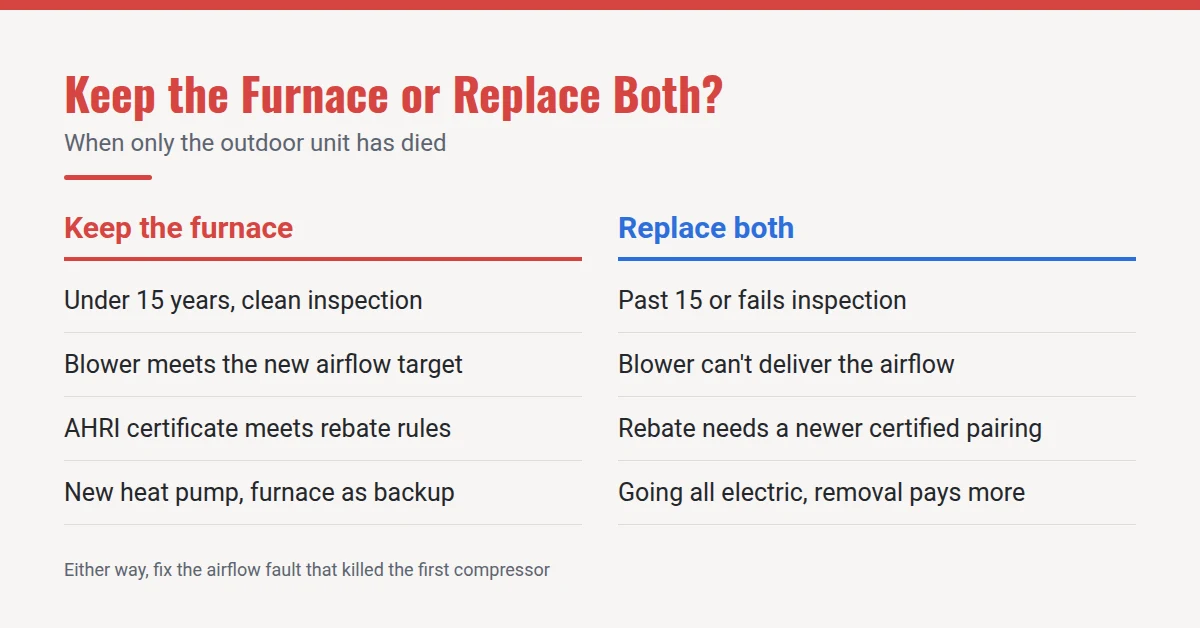
Replace both when:
- The furnace is past 15, fails a documented inspection, or has a history of repairs. Doing it later costs more, because the DOE guide notes that replacing the furnace along with the air conditioner is cheaper than doing it separately “because the cooling coil must typically be removed in both cases.”
- The blower cannot deliver the airflow the new system needs, even after the duct fix.
- The equipment you want, or the rebate tier you are chasing, is certified only with an indoor unit your old furnace cannot stand in for.
- You are going all electric, and a local program pays more when the old heating system comes out.
Keep the furnace when:
- It is well under 15, has a maintenance record, and passes an inspection that comes with readings and images rather than adjectives.
- The quote includes an AHRI certificate for the new outdoor unit and coil, and that rating meets your needs and any rebate’s requirements.
- The new outdoor unit is a heat pump and the furnace is moving to backup duty.
- The duct defect gets fixed either way, and the savings matter more to you now than one installation instead of two.
Whichever way you lean, ask both contractors to price the furnace as its own line item, so you can see exactly what the difference buys, and get at least one more quote, because installed prices vary widely by region. The Northwest homeowner got one more practical piece of advice from the thread: “Worth asking if they’d split the difference, worst they say is no.” When the work is done, file the AHRI certificate with the house papers. Our look at whether new HVAC adds resale value explains how that paperwork pays off when you sell.
The Bottom Line
The furnace sits outside the refrigerant circuit, so keeping a sound one is often the right call. The coil sits inside it, so it nearly always goes with the outdoor unit. The efficiency rating, the rebate, and part of the warranty belong to the combination, which is why the AHRI certificate for exactly what you are buying matters more than either price. And whichever quote you sign, the one item that cannot be optional is the fix for whatever killed the first compressor. A kinked return duct will ruin a new compressor whether it sits beside a new furnace or an old one.
Further reading (sources)
- The Cool Down on a Northwest homeowner weighing a $5,500 furnace swap after a heat pump compressor failed
- U.S. Department of Energy, Building America program with a measure guideline on air conditioner diagnostics, repair and replacement
- AHRI for its homeowner brochure on replacing indoor and outdoor units as a matched pair and what certification of a split system covers
- ACHR News on keeping an existing furnace with an A2L leak detection kit and how a mismatched system can cost a rebate
- 10 CFR 429.16, requiring a coil-only rating for every single-stage and two-stage outdoor air conditioner
- 10 CFR 430, appendix M1, defining coil-only and blower-coil indoor units
- 10 CFR 430.32(y), setting the efficiency standard for furnace fans made from July 3, 2019
- 40 CFR 84.54, defining when replacing parts counts as installing a new system
- NIST covering laboratory tests of heat pump installation faults, including a mismatched expansion valve
- Bonneville Power Administration for a 2019 field study of airflow and commissioning in Northwest heat pump installs
- ENERGY STAR with the signs it may be time to replace heating and cooling equipment
- Town of Wellesley on its light plant’s 2026 heat pump rebates and the bonus for removing the old system
- IRS for the end date of the energy efficient home improvement credit
- U.S. EPA on who needs Section 608 certification to work on refrigerant circuits