Boilers and Hydronic Heating: A Homeowner's Guide to Radiators, Radiant Floors, and Modern Condensing Boilers
Published on September 22, 2026
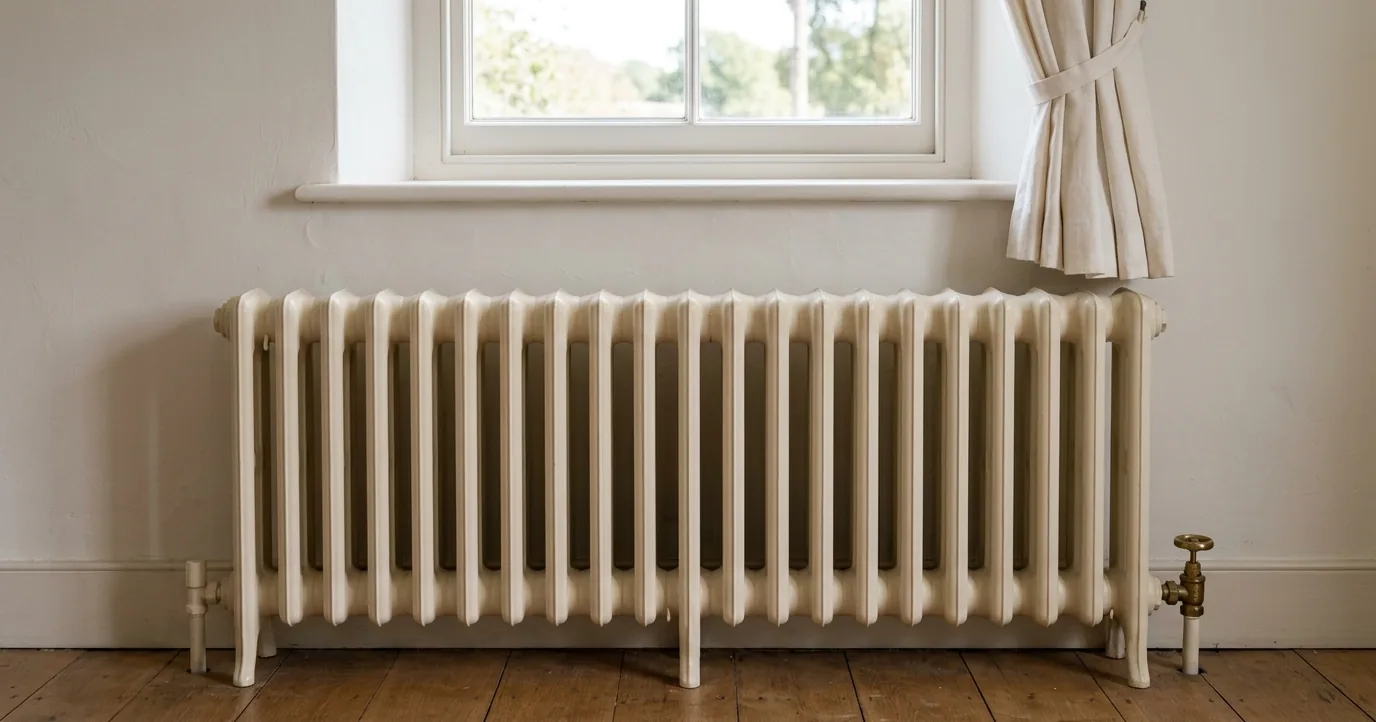
Almost everything written about home heating assumes there are ducts. Filters, registers, blower motors, static pressure, zoning dampers: the whole vocabulary belongs to forced air. Then a contractor walks into a 1928 house in Buffalo or Boston, looks at the cast iron radiators, and tells the owner the only path forward is to rip it all out.
That advice gets repeated every year, and it is usually wrong. The Energy Information Administration’s 2020 residential survey counted 9.29 million American homes whose main heating equipment is a steam or hot water system, out of about 123.5 million homes nationally. In the very cold and cold climate regions, where heating actually matters, it is 5.37 million homes out of 42.5 million, roughly one house in eight. Most of them are hot water rather than steam, and about 6.5 million run on natural gas with another 1.6 million on fuel oil.
A hydronic system is not a lesser version of a furnace. It is a different, older, and in several respects better way to move heat, and it has a genuine future. Here is how the whole thing works, what to check when a radiator goes cold, and what the two realistic paths to air conditioning and lower carbon actually look like.
What a Hydronic System Is, Piece by Piece
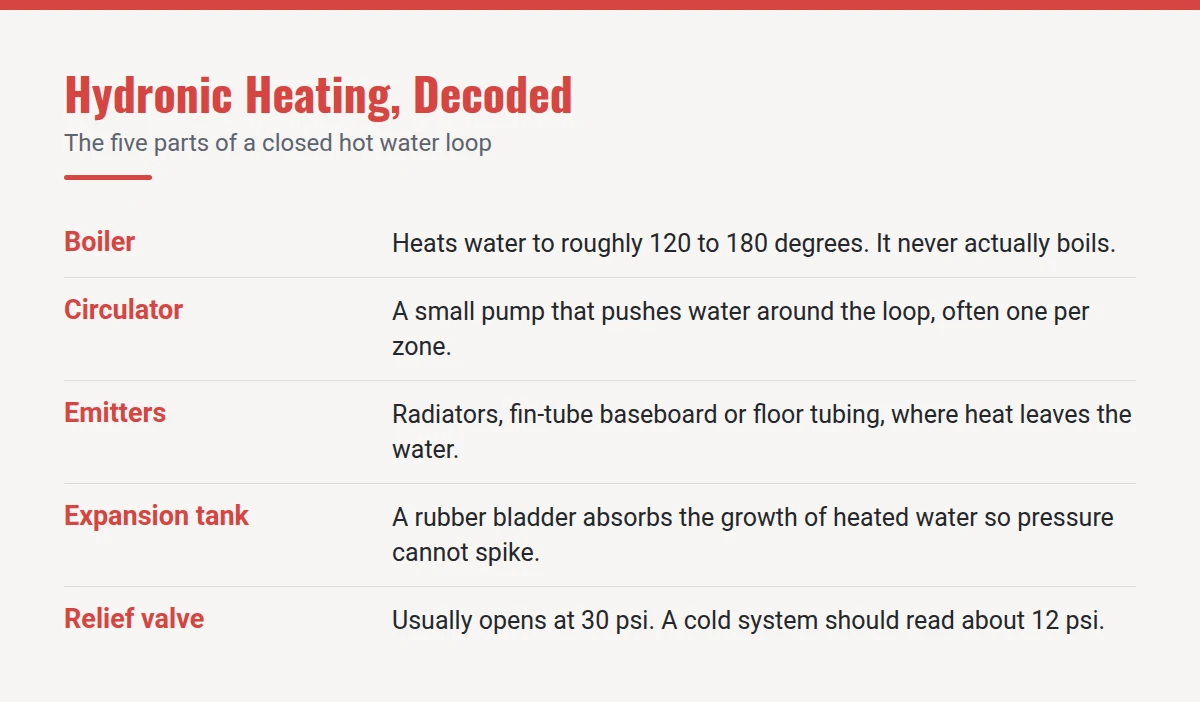
Strip away the branding and a hot water heating system is a closed loop with five jobs.
The boiler heats water, typically to somewhere between 120 and 180 degrees depending on the system and the weather. It never boils anything in a hot water system, despite the name. An aquastat or a modern control board decides when to fire and how hot to run.
A circulator pushes that water around the loop. It is a small pump, usually mounted near the boiler, and it draws surprisingly little power. Many houses have several, one per zone.
The emitters are where the heat leaves the water and enters the room: cast iron radiators, fin-tube baseboard, panel radiators, or tubing buried in a floor. Water returns to the boiler cooler than it left.
The expansion tank and air separator manage what water does when it is heated. Water expands, so a tank with a rubber bladder absorbs the growth instead of letting pressure spike. Air comes out of solution as the water warms, and a separator collects and vents it before it can collect in a radiator.
Safety and pressure controls finish the picture: a pressure relief valve, usually set to open at 30 psi, and a gauge that should read around 12 psi when the system is cold in a typical two-story house.
One distinction matters before anything else. If your radiators are fed by a single large pipe, the boiler has a sight glass with a water line in it, and you hear knocking or hissing when the heat comes on, you have a steam system, not hot water. Steam is a genuinely different animal with its own rules, its own vents, and its own failure modes. Most of what follows applies to hot water systems.
The Emitter Decides Everything
The single most useful idea in hydronics is that the emitter, not the boiler, determines what water temperature your house needs. And the water temperature determines which heat sources can ever serve it.
Cast iron radiators are the most forgiving thing in the building. All that ribbed surface area and all that mass means a radiator sized in 1928 for 180 degree water is usually still capable of heating the room at 140 degrees or lower, especially if anyone has added insulation or replaced windows since. They also coast: the iron stays warm long after the boiler stops, which smooths out temperature swings.
Fin-tube baseboard is the opposite. It is light, it responds quickly, and its output falls off steeply as the water cools, because thin aluminum fins have far less surface than a radiator. Writing in Plumbing & Mechanical, hydronics engineer John Siegenthaler puts a typical finned-tube element at about 425 Btu per hour per foot at 170 degree average water temperature, and urges designers to size baseboard around supply temperatures “perhaps even as low as 120 degrees F under design load,” because the baseboard will outlive its first heat source. Most baseboard in existing houses was not sized that way, which is the central problem in converting a baseboard house to anything low temperature.
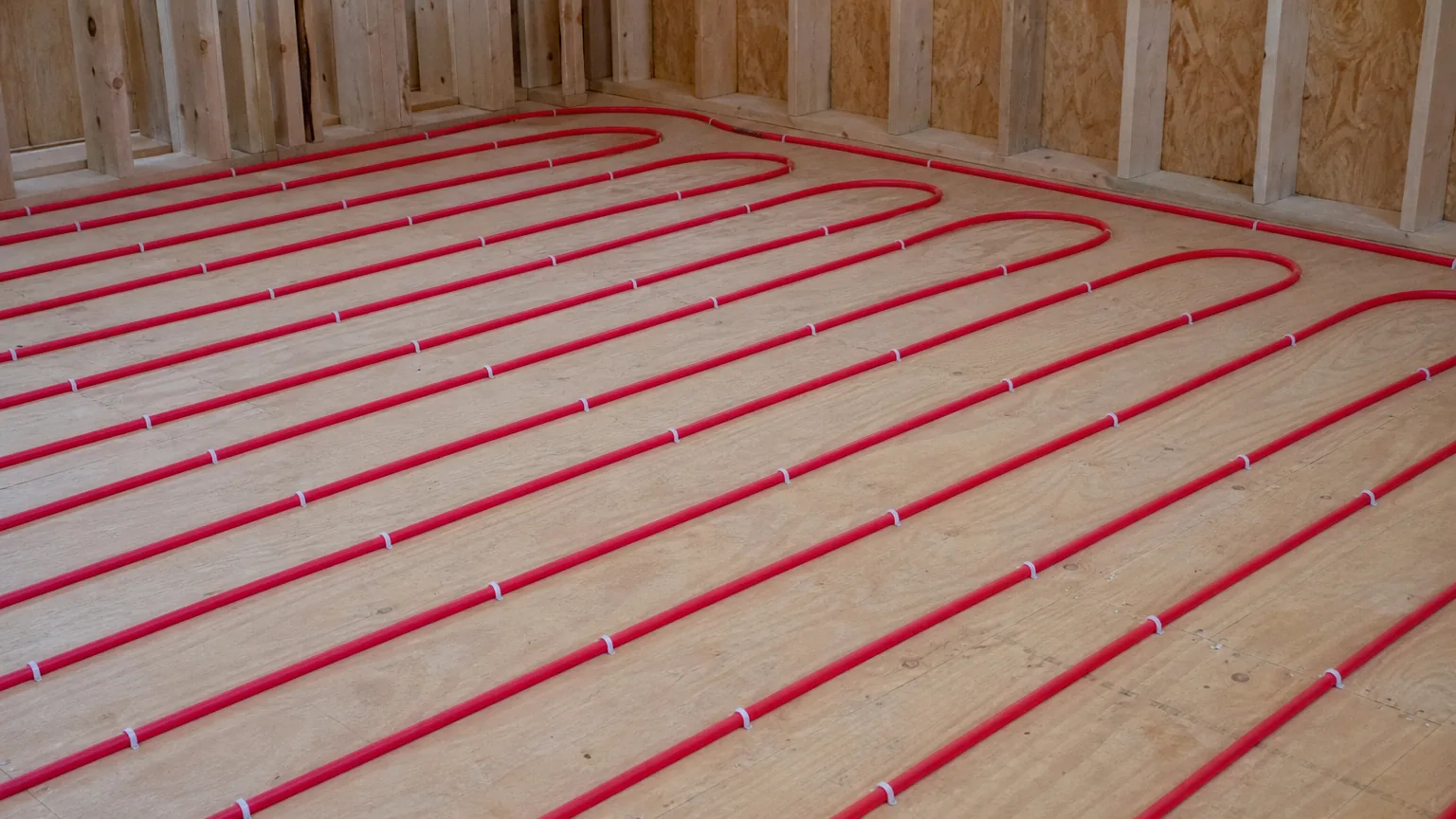
Radiant floors run coolest of all, commonly 90 to 120 degrees, because the emitter is the entire floor. They are the slowest to respond and the most even once they arrive, and they are the friendliest possible partner for a heat pump. They are also the hardest to retrofit into a finished house.
Panel radiators, the flat steel European style, sit in between and are the usual answer when a specific room needs more output at a lower temperature. Swapping one room’s baseboard for a panel radiator is a common and cheap move.
If you take nothing else away: more emitter surface means lower water temperature, and lower water temperature is worth money with every heat source that exists.
Why Hot Water Heat Feels Different at the Same Setting
People who move from a radiator house to a forced-air house almost always say the new place feels colder at the same thermostat number, and they are not imagining it.
Comfort does not track air temperature alone. It tracks a combination of air temperature and the temperature of the surfaces around you, which building scientists call mean radiant temperature. A room full of warm iron and warm floors raises that surface component, so the same 68 on the thermostat reads warmer to a body. There is no moving air stripping heat off your skin, either, which is why forced air at 70 can feel drafty while radiators at 68 do not.
The research is more measured than the marketing. A 2021 field evaluation in PLoS One by Dawe, Karmann, Schiavon and Bauman studied eight North American buildings with embedded radiant systems and drew on earlier work comparing 26 radiant buildings with 34 all-air buildings. Occupants of the radiant buildings reported slightly higher satisfaction with temperature, but the overall finding was that indoor environmental quality was broadly the same. Radiant heat is genuinely pleasant; it is not magic.
The honest tradeoffs run the other way too. A hydronic system moves no air, so it filters nothing, ventilates nothing, dehumidifies nothing, and cools nothing. Everything our whole-house guide to indoor air quality covers has to be solved separately in a boiler house, usually with standalone ventilation and portable or ducted filtration. Response is slow, so deep thermostat setbacks work poorly, particularly with radiant floors.
What a Modern Condensing Boiler Does That a 1970s One Cannot
Three things, and only one of them is about the burner.
It modulates. An older cast iron boiler has one fire: full. A modulating boiler throttles its burner down to match a mild day, which means longer, gentler cycles instead of short blasts. The Department of Energy’s Building America program credits modulating burners with improving average boiler efficiency by up to 8 percent compared with single-stage operation.
It runs outdoor reset. A sensor outside tells the control how cold it is, and the boiler lowers its water temperature accordingly: maybe 180 degrees at design conditions in January, maybe 120 on a 45 degree afternoon. This is not a luxury feature. DOE’s 2016 boiler standards rule made an “automatic means for adjusting water temperature” a design requirement for hot water boilers, alongside the AFUE minimums, for units built from January 15, 2021 onward. When Building America researchers retrofitted modern controls onto central boilers in three apartment buildings, utility bills fell an average of 19 percent.
It condenses, if you let it. A condensing boiler pulls so much heat out of the exhaust that water vapor condenses inside it, which is where 90-plus percent efficiency comes from. The catch is in the return water. Building America’s guidance is explicit: the water coming back to the boiler has to be below about 130 degrees for condensing to happen at all. Bolt a condensing boiler onto a baseboard system that runs 180 degrees all winter and it will spend the season behaving like an expensive 85 percent boiler.
That is why the emitter conversation comes first. The efficiency is bought by the distribution system and the control strategy, not by the label on the box.
For reference points when shopping: the federal minimum since January 2021 is 84 percent AFUE for a gas-fired hot water boiler, 82 for gas steam, 86 for oil-fired hot water and 85 for oil steam. ENERGY STAR, whose boiler specification was last revised effective January 2024, certifies gas boilers at 90 percent AFUE and oil boilers at 87.
Two more things worth knowing. DOE’s own analysis put the average life of a gas-fired hot water boiler at 26.6 years, far longer than a furnace, which is precisely why so many 1970s units are still running and why replacing one early rarely pays on fuel savings alone. And boilers are oversized even more routinely than furnaces, because the easiest thing a contractor can do is read the old nameplate and match it. Insist on a room-by-room heat loss calculation, the same Manual J discipline we push on every system, and expect the honest number to be smaller than what is down there now.
Zones, Circulators, and the Cold Radiator
Zoning a hydronic system is dramatically easier than zoning ductwork, which is one of its quiet advantages. Two approaches dominate. Zone valves put a small motorized valve on each branch, all fed by one circulator. Zone circulators give each branch its own pump. Valves are cheaper and simpler; circulators are more robust and easier to diagnose. Either way, adding a zone in a boiler house is a plumbing job, not a demolition job.
When one radiator or one run of baseboard goes cold while the rest of the house is fine, work through it in this order.
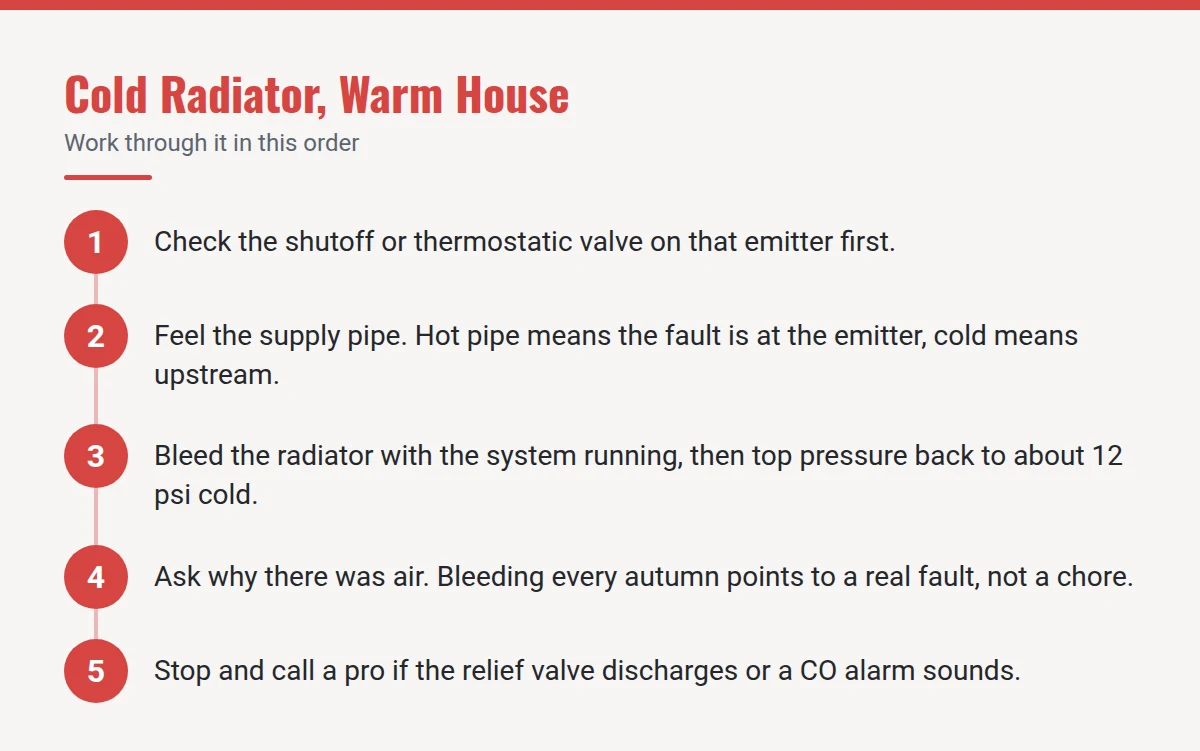
Check the obvious valve first. Each emitter usually has a shutoff or a thermostatic radiator valve. A TRV with its head stuck, or a valve someone closed years ago, accounts for a large share of cold radiator calls.
Feel the pipes. If the supply pipe into the emitter is hot and the emitter is not, the problem is at the emitter. If the supply pipe is cold too, the problem is upstream: the zone valve, the circulator, or the control calling for that zone.
Bleed it. Air collects at high points, and a radiator full of air cannot take water. With the system running, open the bleed valve at the top of the radiator with a bleed key or small screwdriver, hold a cup under it, let the hissing stop and a steady dribble of water start, then close it. Check the system pressure gauge afterward and top up to about 12 psi cold if it dropped.
Then ask why there was air. A system that needs bleeding once after a repair is normal. A system that needs bleeding every autumn is telling you something: a failing air separator, an expansion tank that has lost its charge, or a slow leak pulling in fresh water. Siegenthaler’s work on purging explains the mechanism, including why hot water sheds dissolved gas more readily than cold, which is why air removal works best with the system warm. Chasing the air every year without finding the source means you are also feeding the system fresh oxygenated water, which corrodes it from the inside.
Stop and call a professional if the relief valve is discharging, if the pressure gauge climbs well above 25 to 30 psi when the system is hot, if you smell gas, or if a carbon monoxide alarm sounds. Those are combustion and pressure problems, not bleeding problems. Boilers deserve the same annual attention we describe for furnace inspections, with combustion analysis and a relief valve check on the list.
Combi Boilers: One Box for Heat and Showers
A combination boiler heats the house and makes domestic hot water on demand from the same appliance, with no storage tank. The appeal is real: it reclaims the floor space a water heater occupied, it eliminates standby losses from a tank, and it is one piece of equipment to service.
The limits are equally real. Hot water output is capped by the burner, so a combi that satisfies one shower may struggle with two fixtures at once in a cold climate where incoming water is near freezing. Hard water scales the domestic heat exchanger, and a scaled combi loses flow before it loses heat. And a single failure takes out heating and hot water together, in February.
The alternative most hydronic pros reach for is a boiler paired with an indirect tank: a well-insulated storage tank heated by the boiler through a coil, treated as just another zone. Flow rate stops being burner-limited, and the tank buffers a small modulating boiler against short cycling. If hot water is the main driver rather than heating, compare both against a standalone heat pump water heater, which is often the cheapest hot water in the house to run.
Air Conditioning and Decarbonizing Without Ripping It Out
This is the question that sends radiator owners looking for advice, and there are two workable answers.
Path one: keep the boiler, add ductless heads for cooling. Mini-split heads mounted in the rooms that matter give you air conditioning without ducts and without touching the heating system. In the shoulder seasons they will also heat more cheaply than oil or propane, so the boiler sits idle from April into November. This is the lower-risk, lower-cost, widely available option, and it preserves the heating system that already works. Those heads carry refrigerant, so the A2L refrigerant transition is worth understanding before you buy.
Path two: an air-to-water heat pump feeding the existing loop. Instead of making hot water by burning fuel, a heat pump outside makes it by moving heat, and the same radiators and floors distribute it. Most of these units also run in reverse for chilled water, so fan coils can cool.
The obstacle is temperature, and government documents are unusually blunt about it. In the June 2023 discussion guide in which EPA and DOE proposed an ENERGY STAR specification for these products, DOE concluded that hydronic air-to-water and water-to-water heat pumps meet the definitional criteria of a consumer boiler. The same document notes that the 110 degree leaving water temperature used in testing “will not provide sufficient heat when used in legacy heat exchangers, typically designed for 160 to 180 degree F water.” The award criteria EPA cited required a heating COP of at least 1.7 at 5 degrees outdoor air with 110 degree water.
So the candidate list is specific rather than universal:
- Good candidates: houses with generous cast iron radiators or radiant floors, especially after insulation and air sealing work. Start with the envelope guide, because every improvement there lowers the water temperature the house needs.
- Harder candidates: houses on fin-tube baseboard sized for 180 degree water. Some rooms can be fixed by adding baseboard length or swapping in a panel radiator, and that emitter work is the real cost of the project.
- Hybrid is legitimate. Keeping the existing boiler as backup for the coldest stretch is a normal configuration, and the same cold-climate performance questions apply as with any heat pump.
Two practical cautions. The federal 25C credit that paid toward efficient heating equipment applies only to property placed in service through 2025, so no 2026 quote should net it out of the price; state and utility programs are where the money is now, and several Northeast states fund air-to-water equipment specifically. And this is specialist work. Hydronics is a distinct trade from sheet metal HVAC, so when you vet contractors, ask specifically how many air-to-water or low-temperature conversions they have commissioned, and ask to see a heat loss calculation with the design water temperature on it.
The Bottom Line
A hydronic house is not a problem to be solved. It is a distribution system with more thermal mass, better comfort at a given setpoint, and easier zoning than anything ducted, and it will outlive several heat sources. Learn which emitters you have and what water temperature they need, because that number governs every decision that follows. Buy a modulating condensing boiler only alongside outdoor reset and emitters that can run cool enough to let it condense. Bleed the cold radiator, then find out why there was air. And when cooling or electrification comes up, treat ductless heads and an air-to-water heat pump as two real options with different price tags, rather than accepting that the only answer is a dumpster in the driveway.
Further reading (sources)
- U.S. Energy Information Administration counts how many American homes heat with a steam or hot water system
- U.S. Energy Information Administration again for the same equipment broken out by climate region
- U.S. Department of Energy on the AFUE minimums, water temperature control requirement, and expected boiler lifetimes
- Building America Solution Center for why return water has to stay below 130 degrees to condense
- Building America Solution Center with measured savings from retrofitting modern boiler controls
- ENERGY STAR listing the certified AFUE levels for gas and oil boilers
- EPA and DOE in the discussion guide proposing an air-to-water heat pump specification
- Plumbing & Mechanical on sizing finned-tube baseboard for low supply water temperatures
- Plumbing & Mechanical for how air gets purged out of a hydronic loop and why heat helps
- Dawe and colleagues with a field study of comfort in eight buildings using radiant systems