What Your Home Energy Score Actually Means for Buying a Heat Pump or AC
Published on September 29, 2026
Buy a house in Portland, Oregon, and a number from 1 to 10 comes with the listing whether you asked for one or not. The city has required a Home Energy Score on homes advertised for sale since 2018, and by July 2026 it had recorded more than 50,000 of them. Buyers of new construction often meet a different number, the HERS Index, on the builder’s spec sheet. Homeowners who are not selling can order a score too, wherever a certified assessor works locally.
Most people read the score like a report card and move on. If you are about to buy a heat pump or an air conditioner, the grade is the least useful part. Behind it sits a record of the house itself (insulation, windows, air leakage, where the ducts run, how old the equipment is) and a list of upgrades that would improve it. Those are the inputs a contractor needs to size new equipment, and they are exactly what a quick quote tends to skip.
Two Scores, Two Scales
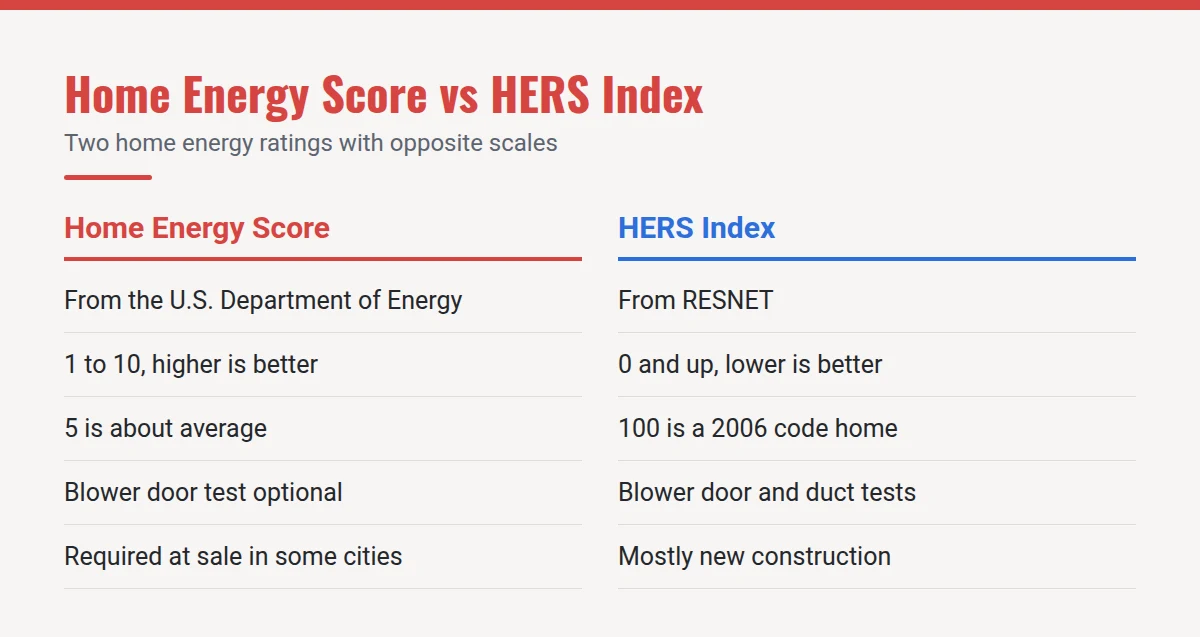
The Home Energy Score is the U.S. Department of Energy’s rating, and higher is better. A 10 puts a house among the 10 percent of homes expected to use the least energy, a 1 means it is expected to use more energy each year than 85 percent of homes, and a 5 is about average. An assessor walks the house and records how it is built and equipped, and DOE’s scoring tool models the energy use from those inputs. The report comes with options to cut energy use and costs.
The HERS Index comes from RESNET, the nonprofit that certifies home energy raters, and it runs the other way: lower is better. A home built to the 2006 International Energy Conservation Code scores 100, a net zero energy home scores 0, and each point is 1 percent of energy use against that 2006 reference home, so older, leakier houses land well above 100. Most HERS ratings are done on new homes. A third of all new single-family homes built in the U.S. in 2025 were rated, and the more than 420,000 homes rated that year averaged 53.
So what is a good score? On the Home Energy Score, anything above 5 beats the average home. On the HERS Index, anything under 100 beats a house built to the 2006 energy code, and a new home in the 50s is ordinary today. For an equipment purchase, though, “good” is the wrong question. A 3 and a 9 are both useful to a contractor, because both prove the house is not the average house that sizing shortcuts assume.
What the Score Models, and What a Rating Measures
Both numbers are asset ratings: they rate the house, not the household. Pacific Northwest National Laboratory (PNNL), which runs DOE’s scoring tool, describes an asset rating as comparing homes on their fixed characteristics “while holding occupant-determined factors and behaviors constant.” A furnace’s efficiency counts; the thermostat that runs it does not. That is what makes two houses comparable, and it has three consequences for an equipment decision.
It is not a bill forecast. Two households in identical houses get the same score, whatever their bills say. How you run the system matters a great deal, particularly with a heat pump, as our guide to heat pump setbacks explains.
It is not an inspection. Nothing in the assessment tests whether the air conditioner cools, the heat exchanger is sound, or the refrigerant charge is right.
It does not know how big your equipment is. The scoring tool records the type, efficiency, and installation year of the heating and cooling systems, but it has no input for their capacity. A score alone cannot tell you whether your current system is the right size. What it can tell you is what the house is made of.
The bigger difference between the two ratings is what gets measured. The Home Energy Score is mostly observed. PNNL calls it an “entry-level” assessment that an experienced assessor finishes in under an hour, and the blower door test is optional: if none was run, the tool asks only whether the house has been professionally air sealed. A HERS rating measures. The rater typically runs a blower door test on the house and a leakage test on the ducts, so the report carries real numbers for the two inputs a load calculation most often has to guess.
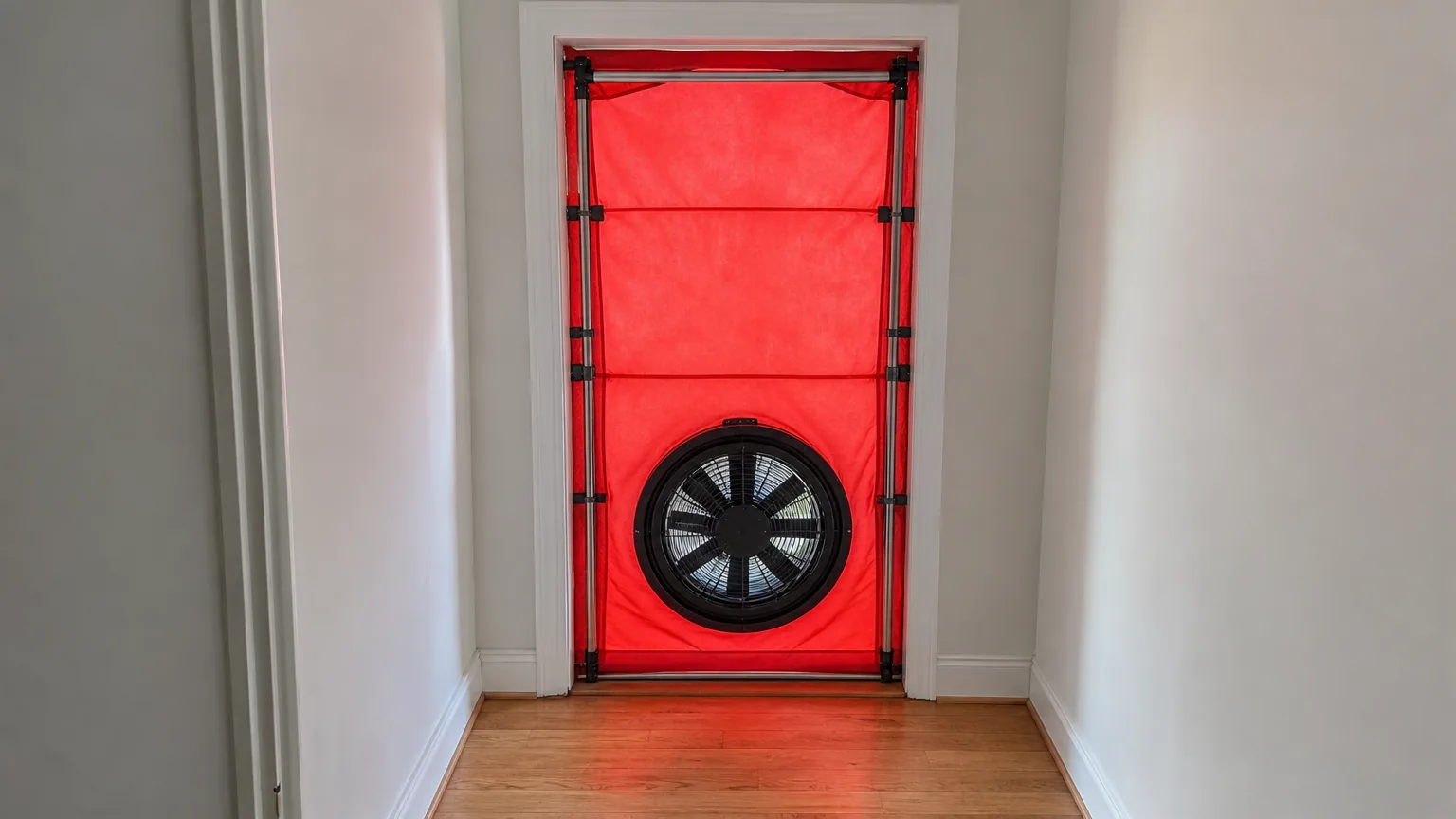
Those two numbers carry a lot of weight. In the New York case study described below, air leakage was the largest single line in the heating load, about 20,400 of 67,000 Btu per hour, and it went into the calculation as a Manual J category (“semi-loose”) rather than a measured rate. The unsealed, uninsulated ducts in the crawlspace added another 15,500. Together they made up more than half the load. If your report carries a measured leakage number, it is one of the most valuable figures on the page.
Why a Low Score Should Make You Doubt the Tonnage Quote
Most replacement quotes are sized one of two ways: square footage divided by a rule of thumb (500 square feet per ton is the classic), or the size of the unit being hauled away. A 2018 Department of Energy review of field research found that most systems, especially emergency replacements, go in without a detailed load calculation. Rules like that describe an average house. A score near either end of the scale is written proof that yours is not one.
A low score cuts two ways. Today, a leaky, thinly insulated house really does need more capacity per square foot than average, so a floor-area guess can land close, or even short. But the report also lists the upgrades that would raise the score, and every one of them shrinks the load. Size the equipment to the house as it stands, do the attic and duct work two years later, and you own an oversized system for the next fifteen.
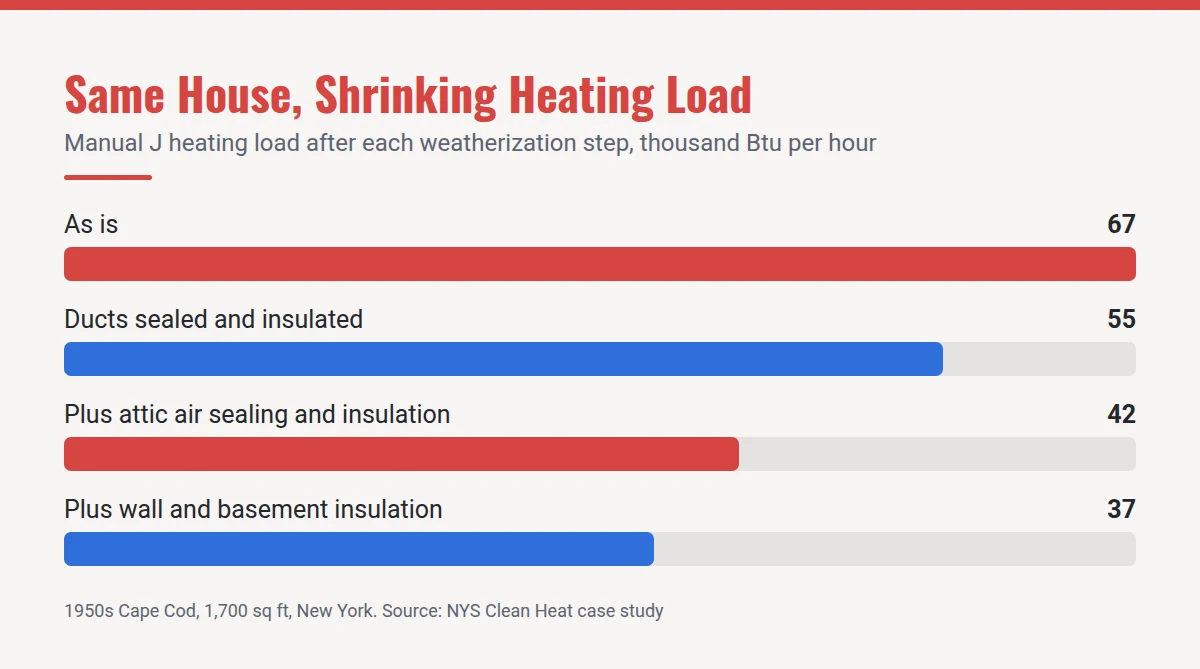
The swing is bigger than most people expect. New York’s Clean Heat program ran Manual J on a 1,700 square foot, 1950s Cape Cod in Saratoga County, before and after weatherization. Sealing and insulating the ducts alone cut the heating load from 67,000 to 55,000 Btu per hour. Air sealing and insulating the attic spaces took it to 42,000, and wall and basement insulation to 37,000. The cooling load fell from 25,000 to about 15,000, roughly the difference between a two-ton air conditioner and one of about a ton and a quarter, in the same floor plan. The contractor’s first bid was four multi-zone ductless systems. In the program’s estimate, the second weatherization package plus a single 42,000 Btu heat pump cost less than that bid, insulation included.
That is why the Northeast Energy Efficiency Partnerships (NEEP) heat pump sizing guide says planned weatherization work “should be done first if possible, to reduce HVAC size and cost,” and why Natural Resources Canada treats the old equipment’s size as a last resort, usable only when the house has had no comfort problems, nothing significant has been upgraded since that equipment went in, and there is evidence it was sized sensibly in the first place. Our envelope guide covers the fixes themselves and their payback order. The point here is sequence: decide which items on the report you will actually do before anyone sizes equipment.
A high score cuts the other way. A tight, well-insulated house scoring 8 or 9, or a new home rated in the HERS 40s or 50s, can need far less capacity than its square footage suggests, and that is where rule-of-thumb sizing does the most damage. DOE’s review is candid that the energy penalty of oversizing may be smaller than the industry long assumed. What remains is a bigger purchase price and short cycling, which costs comfort, dehumidifies poorly in summer, and wears equipment out sooner. Heat pumps raise the stakes in cold climates, where the heating load usually sets the size; our cold-climate heat pump guide covers sizing to your design temperature and where backup heat takes over.
How the Report Feeds a Manual J
ACCA’s Manual J is the industry standard for calculating a home’s heating and cooling loads, and its inputs overlap heavily with a score report: insulation, window area and which way the windows face, infiltration, and where the ducts run and how much they leak. Canada goes a step further. Newer EnerGuide home evaluation reports there may list the design loads outright, and Natural Resources Canada’s sizing guide says design load values “can be taken directly from the audit report” once the recommended retrofits are done. Our central air conditioner buying guide explains Manual J and the Manual S equipment selection that follows it. Here is how to put your report to work.
- Check the date and what has changed since. Berkeley treats a report as valid for five years. New windows, an insulation job, an addition, or a finished basement since the assessment all change the load.
- Give every bidder the whole report, not just the number. The recorded details are a head start on the inputs, and they show you whether a contractor’s assumptions match what the assessor actually found.
- Get measured leakage numbers. NEEP warns that infiltration estimates are “often overstated” and recommends blower door testing. If your report used an estimate, a test before sizing is cheap insurance.
- Settle the upgrades first. Ask for the load calculated for the house after the improvements you have committed to, not the house as it stands.
- Compare the loads, not just the tonnage. Ask each bidder for the Manual J summary. A quote whose equipment runs well past its own calculated load needs an explanation.
New construction already works this way. ENERGY STAR’s HVAC design rules for certified new homes tell the designer to use the infiltration rate from the home’s energy rating (or standard Manual J default categories). They recommend a single-speed air conditioner between 90 and 115 percent of the calculated cooling load and allow no more than 130, while variable-speed equipment, which can throttle down, is allowed up to 160. If you are still choosing who to hire, our guide to vetting an HVAC contractor has the rest of the questions.
If You Were Handed a Score at a Sale
A growing list of cities puts an energy rating in front of buyers at the time of sale, whether or not anyone asked for one.
| Where | What the seller must do |
|---|---|
| Portland, Oregon (since 2018) | Get a Home Energy Score and show it in every listing, ad, and showing |
| Milwaukie, Hillsboro, and Bend, Oregon | Get and disclose a Home Energy Score before listing |
| Berkeley, California (current rules since 2026) | Get a Home Energy Score, post it in the listing, and complete upgrades before the sale or defer them to the buyer |
| Minneapolis (since 2020) | Include an energy section, scored 0 to 100, in the city’s Truth in Sale of Housing evaluation |
| Austin, Texas | Give buyers an energy audit covering HVAC efficiency, age, and condition on homes 10 or more years old |
Portland’s scores now cover more than 30 percent of the city’s housing stock, and they can be searched online, so a buyer can look up a house before booking a showing. Oregon’s real estate regulator notes that no city requires a minimum score to sell. Berkeley’s rules are the ones with teeth for HVAC: sellers either complete upgrades worth six credits before the sale or split a $5,000 deposit with the buyer, who then has two years to finish them, and a heat pump heating and cooling system earns all six credits on its own.

Whatever the city, read the sheet the same way. Check its date against what the listing says has been updated. Compare the equipment it lists, and its age, with what is actually in the basement and the side yard. Then keep the upgrade list for your first-year plan, because it is the start of the sizing conversation you will eventually have. Just do not treat it as a verdict on the HVAC. Minneapolis states plainly that its energy report does not require repairs, so have the system checked on its own before you close, and remember that any work on the refrigerant side legally requires an EPA 608 certified technician.
Is It Worth Getting a Score Before You Replace?
If your system still runs and you have a season to plan, yes. An assessment that includes a blower door test gives a contractor a measured leakage number instead of a guess, and gives you a ranked list of upgrades to settle before anyone quotes a size. For an existing home, the practical route is a Home Energy Score or a fuller energy audit, since most HERS ratings are for new construction. Many utilities subsidize assessments, so check yours before paying full price, and get more than one quote on the equipment afterward, because pricing varies widely by region.

If the system has already failed, you will not wait weeks for an assessment, and emergency replacements are exactly where DOE’s review found load calculations get skipped. Hand the contractor whatever report you have and insist on a Manual J anyway. If the report lists upgrades you intend to make soon, ask for equipment sized to the house after them, and lean toward variable-speed equipment, which has the most headroom if the load shrinks later.
The Bottom Line
A home energy score describes the house, not the equipment in it, and that is exactly why it helps when you shop for a heat pump or air conditioner. Read past the number to the facts and the upgrade list, because those are Manual J inputs. A low score means the load is about to change if you act on the report, so settle the upgrades before anyone sizes a system. A high score means a rule of thumb will oversize you. And if a seller handed you the score, treat it as the first page of your plan rather than the last word on the house.
Further reading (sources)
- City of Portland on what a 1, a 5 and a 10 mean on the Home Energy Score
- Pacific Northwest National Laboratory explaining how the Home Energy Scoring Tool works as an asset rating
- PNNL’s scoring tool documentation, listing every input an assessor records
- RESNET for how the HERS Index is defined and what a rating involves
- RESNET’s 2026 trends report with the average HERS Index of homes rated in 2025
- U.S. Department of Energy reviewing field studies of residential HVAC installation and sizing
- NYS Clean Heat on weatherizing a 1950s Cape Cod before a heat pump install
- NEEP with its guide to sizing and selecting heat pumps in cold climates
- Natural Resources Canada on estimating design loads from audit reports and existing equipment
- ENERGY STAR for the HVAC design rules behind certified new homes
- City of Portland announcing its 50,000th recorded Home Energy Score
- Oregon Real Estate Agency on which Oregon cities require a score before listing
- City of Berkeley with its time-of-sale Home Energy Score and upgrade rules
- City of Minneapolis answering questions about the Truth in Sale of Housing energy disclosure
- Austin Energy on the ECAD energy audit that home sellers must provide